
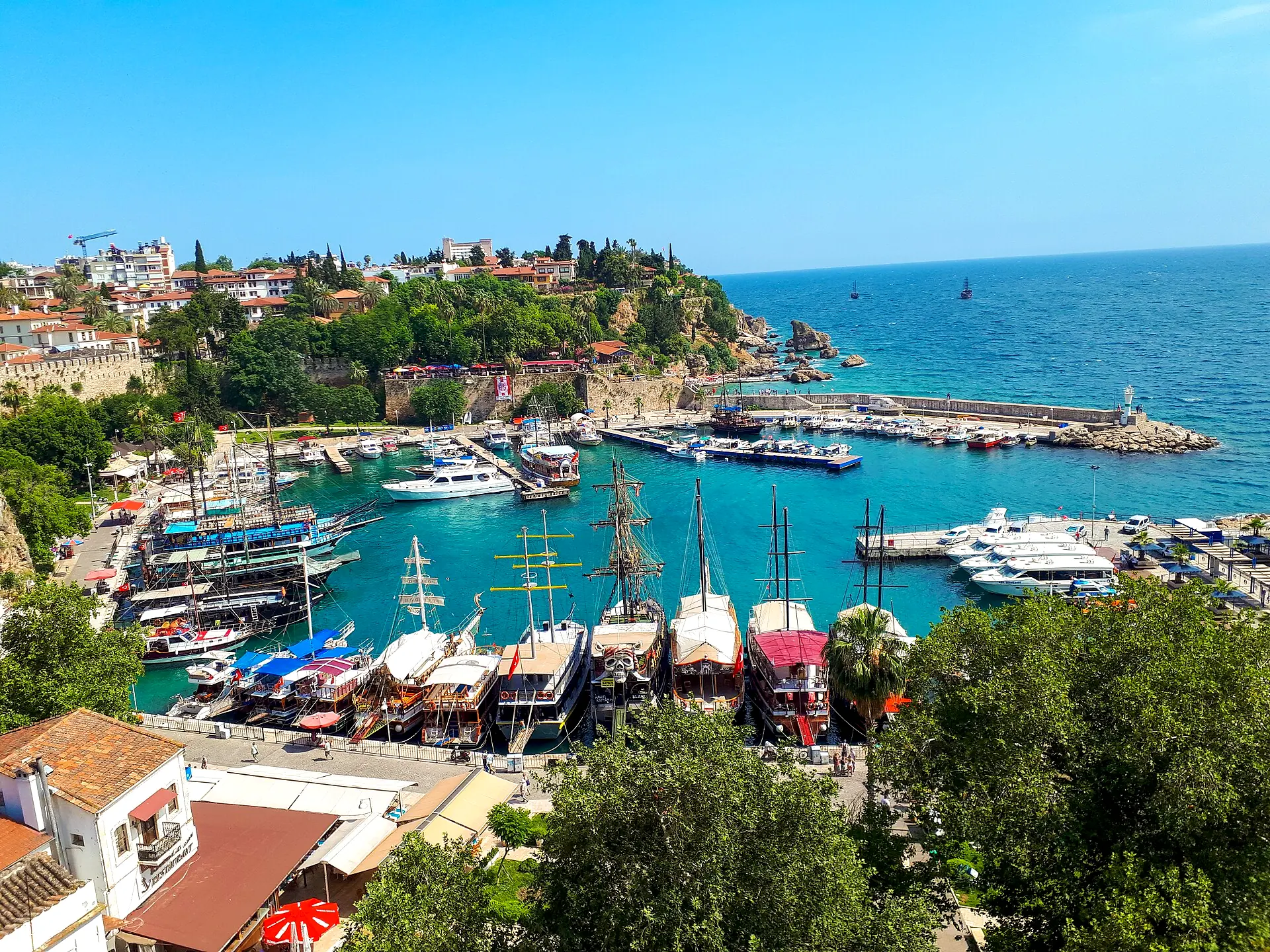
Antalya is a province on Türkiye’s Mediterranean coast, between the Taurus Mountains and the sea. Its capital, also called Antalya, is named after Attalos II of Pergamon. The province covers ancient Lycia, Pamphylia and part of Pisidia, and combines beaches, Roman ruins and mountain scenery.
Faits essentiels
- Location: Mediterranean coast of south-west Türkiye, between the Taurus Mountains and the sea
- Airport: Antalya Airport (AYT); domestic flights from Istanbul IST and SAW. Check current timetables
- Distance by road: Buses from Istanbul take about 12 hours; from İzmir about 6 hours; from Ankara about 9 hours
- Best season: April-May and October-November for sightseeing; summer is hot and humid
- Typical visit time: 3 to 4 days for the city, Perge and Aspendos; a week with the coast
- UNESCO status: The World Heritage Site of Xanthos lies on the coast of the province; see our Xanthos-Letoon page
- Area and population: 20,177 km²; 2,688,004 inhabitants (2022)
- Shoreline: 657 km with beaches, ports and ancient cities
- Old town: Kaleiçi, with Hadrian’s Gate (built 130 AD)
- Entrance: See official page of each site and museum
What is Antalya and why visit?
Antalya Province lies on the Mediterranean coast of south-west Türkiye. Its capital, the city of Antalya, has a historic old town, a harbour, beaches and easy access to Roman cities. Visitors come for sea and sun, but also for Perge, Aspendos, Termessos and the Lycian coast.
Wikipedia calls the province the centre of Turkey’s tourism industry. Moreover, GoTürkiye presents Antalya as a place where the sea, sun, history and nature meet.
The province includes more than the city. Alanya, Side, Kemer, Kaş, Kalkan and Belek each have a different character, so choose a base that fits your plans.
What is the history of Antalya?
Antalya has been settled since prehistoric times. The Karain cave north of the city holds evidence of early Paleolithic habitation. The city was founded in the 2nd century BC by Attalos II of Pergamon. Later it passed to the Romans, Byzantines, Seljuks and Ottomans.
The Hittites called the people of the area Lukka, which is thought to relate to Lycia. In the Hellenistic period the west was Lycia, the east Pamphylia and the north Pisidia. In addition, Wikivoyage notes that Antalya passed to the Seljuks in 1207 and the Ottomans in 1391.
After World War I, the Treaty of Sèvres assigned Antalya to Italy. The 1923 Treaty of Lausanne reversed this and set Türkiye’s present borders. Consequently, the province rejoined the Republic.
The table gives the main periods.
| Period | Event | Visible today |
|---|---|---|
| Paleolithic | Early habitation at Karain cave | Cave and Antalya Museum finds |
| 2nd century BC | Attalos II founds Attaleia | Roman harbour area |
| 130 AD | Hadrian’s Gate built for the emperor’s visit | Üçkapılar in Kaleiçi |
| 1207 and 1391 | Seljuk then Ottoman control | Fluted Minaret Mosque (1230 origin) |
| 1923 | Lausanne confirms the borders | Modern city |
What should you see in Antalya?
Start in Kaleiçi, the old quarter around Hadrian’s Gate, then visit Perge and Aspendos on separate half days. Add the Düden waterfalls and a beach afternoon. Wikivoyage describes Aspendos as a Graeco-Roman city with a well-preserved amphitheatre seating 7,000. Use the list and table below to choose between the main sights.
Perge, the capital of Pamphylia, is described as the second best preserved ancient city of Türkiye after Ephesus. Therefore, it suits visitors with an interest in Roman ruins.
The list below gives the main sights.
- Kaleiçi old town and Hadrian’s Gate.
- Fluted Minaret Mosque, a Seljuk building of 1230 rebuilt in 1373.
- Hıdırlık Tower, a Roman bastion built in the 2nd century AD.
- Perge Ancient City, with a colonnaded agora, theatre and stadium.
- Aspendos Theatre, near Serik, about 40 km east.
- Düden waterfalls, with the lower falls dropping into the sea.
- Konyaaltı and Lara beaches.
- Alanya Castle, Patara Beach and Köprülü Canyon within the province.
This at-a-glance table sorts the main sights by distance.
| Sight | Location | Typical time |
|---|---|---|
| Kaleiçi and harbour | City centre | 2 to 3 hours |
| Antalya Museum | Konyaaltı Cd, tram to Müze | 1 to 2 hours |
| Düden Waterfalls | Lara Cd and inland | 1 hour |
| Perge | Aksu, northeast | Half day |
| Aspendos | Near Serik, about 40 km east | Half day |
| Alanya Castle | East coast | Day trip |
| Patara and Xanthos-Letoon | West coast | Full day trip |
How do you get to Antalya and get around?
Antalya Airport (AYT) receives flights from Europe and daily domestic flights from Istanbul (IST and SAW), Ankara and İzmir. The AntRay tram line 1A runs from the airport to downtown. Check current timetables, because tram and bus times change. The intercity bus station is about 6 km northwest of the centre.
Inside the city, trams and buses accept contactless cards or the Antalyakart. The centre is walkable, and Wikivoyage advises against using a car or bicycle in the old town. A taxi is a practical choice for the Lara resort strip near the airport. Furthermore, taxi drivers can quote a trip to Perge, while Aspendos is farther.
The table lists typical routes and durations.
| Route | Typical duration | Notes |
|---|---|---|
| Airport to old town by tram 1A | About 50 minutes to İsmetpaşa | Every 15 minutes; check current timetable |
| Airport to bus station by route 600 | About 1 hour | Check current timetable |
| Istanbul to Antalya by bus | About 12 hours | Hourly departures |
| İzmir to Antalya by bus | About 6 hours | Check current timetable |
| Ankara to Antalya by bus | About 9 hours | Check current timetable |
| Istanbul to Antalya by car | About 8.5 hours | Toll roads via Bursa |
When is the best time to visit Antalya?
April to May and October to November suit sightseeing. Summers are hot, sunny and humid, with days averaging 30 to 35°C and sometimes above 40°C. Winters are mild but bring storms and heavy rain. The sea stays warm late into autumn.
As a result, plan ruins visits for morning hours in summer. Wikivoyage also notes that European school holidays crowd the resorts.
The table compares the seasons.
| Season | Weather | Crowds and notes |
|---|---|---|
| Spring (Apr-May) | Warm, pleasant | Good for ruins and walks |
| Summer (Jun-Sep) | Hot, humid, 30-35°C by day | Peak resort season; start early |
| Autumn (Oct-Nov) | Warm sea, comfortable days | Good for sightseeing and swimming |
| Winter (Dec-Mar) | Mild with storms and downpours | Quiet; some businesses close |
How long should you stay in Antalya?
Three to four days cover the old town, Perge, Aspendos and a beach day. A week lets you add the Lycian coast. These are planning guides only. Use the table below to match a plan to your time. Keep one flexible block for rest, weather and queues.
In addition, the long resort strip means hotel choice affects daily travel time.
This table suggests plans for different lengths of stay.
| Time | Suggested plan | Pace |
|---|---|---|
| Half day | Kaleiçi, harbour, Hadrian’s Gate | Easy |
| 1 day | Kaleiçi plus the museum and Düden Falls | Full |
| 2 to 3 days | Add Perge and Aspendos | Comfortable |
| 5 to 7 days | Add Alanya, Side, Kaş or Patara | Relaxed |
What practical tips help in Antalya?
Carry water, use sun protection, and check each site’s official page for fees and hours. Ruins have uneven stone and little shade. Dress modestly in mosques. These points are general advice. Confirm details with the venue or the official page before you go.
Wikivoyage also warns that taxi touts at the airport may steer arrivals away from the bus. Therefore, confirm your transfer in advance.
The following tips cover access, safety and etiquette.
- Tickets: see the official page of each site and museum.
- Dress: hats and light clothing for ruins; covered shoulders and knees in mosques.
- Accessibility: Kaleiçi streets are stone-paved and uneven; ask hotels about step-free access.
- Safety: swim at supervised beaches and respect warning flags.
- Photography: follow site signs; drones may need permits.
- Etiquette: remove shoes in mosques and keep voices low.
Where should you stay and eat in Antalya?
Kaleiçi suits visitors who want old-town atmosphere, Konyaaltı offers a long beach west of the centre, and Lara is a resort strip near the airport. Wikivoyage describes inexpensive pansiyons in Kaleiçi. Belek, Side, Kemer and Alanya serve those who prefer resort stays.
Try Mediterranean fish, mezes, and local pide in the city. Also look for fresh orange and pomegranate juice stalls in season.
The table compares areas for a stay.
| Area | Suits | Trade-off |
|---|---|---|
| Kaleiçi | Walkers, history, evenings | Steep stone streets |
| Konyaaltı | Beach and museum access | Further from the old town |
| Lara | Resort stays near the airport | Fewer historic sights |
| Side and Belek | Beach resorts and golf | Day trips need transport |
What are the nearby places and day trips from Antalya?
Day trips cover Termessos, Perge, Aspendos, Side, Alanya, Kemer and the Lycian coast. Pick one direction per day, and check the schedule for buses or a private transfer. Related pages describe the main sights. Pick one direction per day. Keep the return transport in mind before you commit to a longer trip.
Holy tourism is organised around Myra and Patara, linked to St Nicholas. In contrast, Saklıkent offers skiing in winter.
These places connect easily with Antalya.
- Termessos, a ruined ancient city above the Taurus forests.
- Side and Manavgat for Roman ruins and waterfalls.
- Alanya, with an ancient citadel on a crag.
- Kemer and Olympos for diving and beaches.
- Patara and Myra for Lycian and St Nicholas heritage.
Plan this with TurkGT
TurkGT is an Istanbul-based travel company. We arrange guided tours, private transfers, licensed guides and interpreters, and can connect an Istanbul stay with onward travel. Share your dates by WhatsApp, and we confirm the plan there. Our team can also help with hotel timing, airport pickups and local advice.
Questions fréquentes
Where is Antalya Province?
It is on the Mediterranean coast of south-west Türkiye, between the Taurus Mountains and the sea.
What is Antalya named after?
It is named after Attalos II, king of Pergamon, who founded the city in the 2nd century BC.
Which ancient regions did Antalya cover?
Lycia in the west, Pamphylia in the east and part of Pisidia in the north.
How do I get from the airport to the old town?
AntRay tram 1A runs from the airport to İsmetpaşa near Kaleiçi. Taxis also serve the route. Check current timetables.
When should I visit?
April to May and October to November suit sightseeing. Summer is hot and humid.
How many days do I need?
Three to four days cover the city, Perge and Aspendos. A week adds the coast.
Is Perge worth a half day?
Wikipedia describes it as the second best preserved ancient city of Türkiye after Ephesus, with an agora, theatre and stadium.
How long is the coastline?
Wikipedia gives the shoreline as 657 km.
À lire aussi sur TurkGT
- Lieux et guides à Antalya
- Kaleiçi
- Alanya
- Sidé
- Kemer
- Kaş
- Kalkan
- Belek
- Xanthos-Letoon
- Cascades de Düden
- Plage de Konyaaltı
- Plage de Lara
- Théâtre d’Aspendos
- Cité antique de Perge
- Canyon de Köprülü
Sources
- Antalya Province (Wikipedia)
- Antalya (Wikivoyage)
- Mediterranean Turkey (Wikivoyage)
- GoTürkiye: Antalya
- Türkiye Kültür Portalı: Antalya – Genel Bilgiler
Dernière vérification: 2026-11-17.