
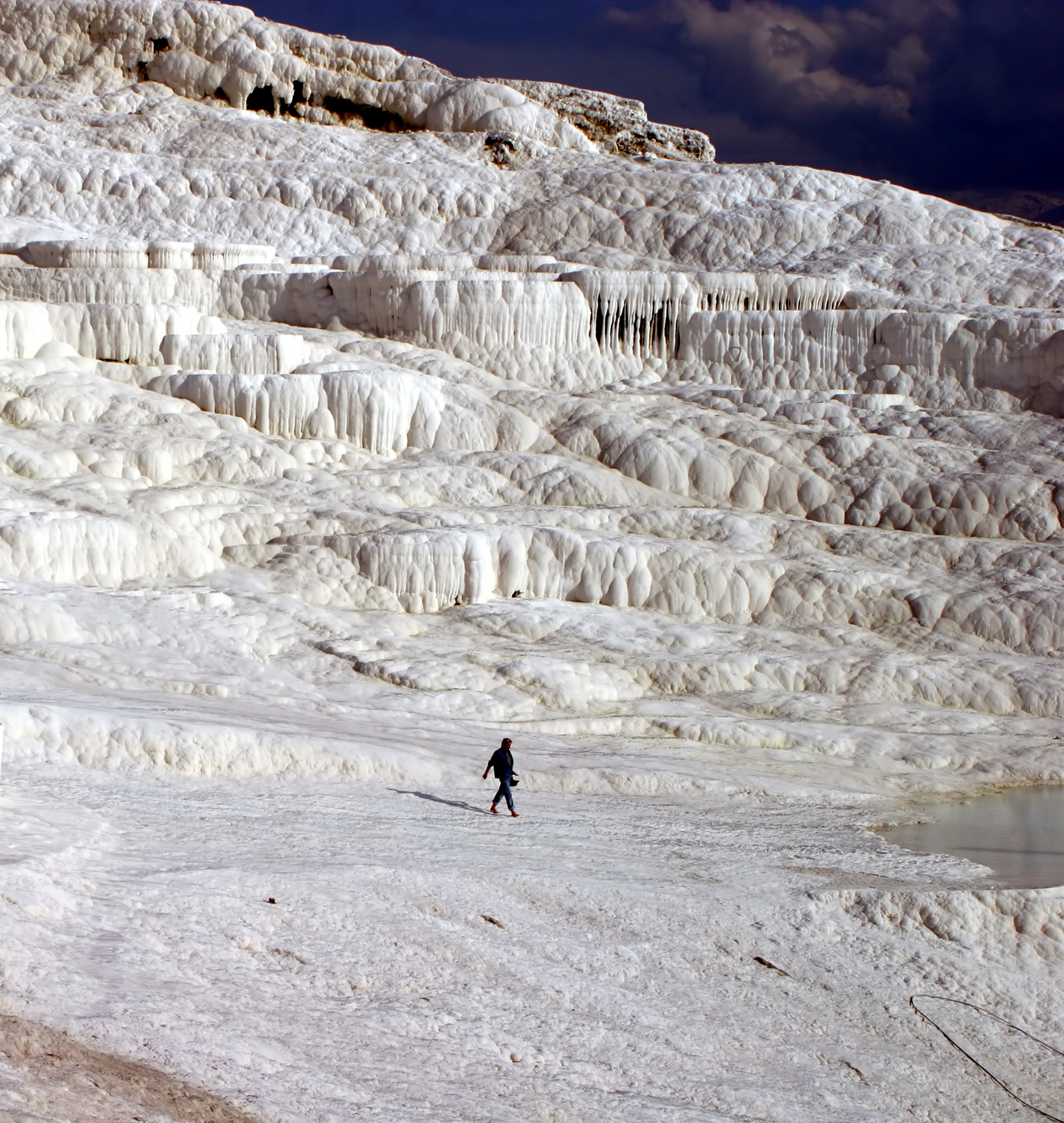
Denizli is a province in western Türkiye above the Aegean coast, best known for Pamukkale, Hierapolis and Laodicea. UNESCO places Pamukkale in the province. Visit for white travertine terraces, thermal pools and Roman-era ruins, 20 km north of the city of Denizli.
Önemli bilgiler
- Location: Western Anatolia, high ground above the Aegean coast
- Pamukkale from Denizli: 20 km north (Wikivoyage)
- Airport: Çardak; daily flights from IST and SAW (Wikivoyage); check current schedule
- Best season: Spring and autumn; summers average highs of 35 °C
- Typical visit time: 1 day for Pamukkale and Hierapolis; 2-3 days with Laodicea
- Highest point: Mount Honaz, 2,571 m
- Population: 1,056,332 (2022)
- UNESCO: Hierapolis-Pamukkale World Heritage property
- Entrance: See official page
What is Denizli and why visit it?
Denizli is a province in western Türkiye, on high ground above the Aegean coast. It is best known for Pamukkale and the ancient cities of Hierapolis and Laodicea. UNESCO places Pamukkale in the province of Denizli. Visit for white travertine terraces, thermal pools and Roman-era ruins.
Most visitors treat the city of Denizli as a transit point. Wikivoyage says most visitors simply transit to reach Pamukkale, 20 km north. However, the province holds more than one famous site, so a longer stay rewards you.
Therefore Denizli suits history, nature and wellness travellers. It also links easily with Ephesus, Aphrodisias and the Aegean coast in a wider route.
The main reasons to visit are these.
- Pamukkale travertines: calcified terraces and pools, below the ruins of Hierapolis.
- Hierapolis: an ancient city established around 190 BC by the Pergamene Kingdom.
- Laodicea on the Lycus: an ancient city 6 km north of Denizli.
- Biblical heritage: Laodicea is one of the seven churches named in Revelation.
- Thermal springs: Karahayıt and Pamukkale are on the international tourist circuit, per Wikivoyage.
What is the history of Denizli?
Traces of prehistoric cultures run across the province. The Hittites were followed by Phrygians, Lydians and Persians, and then by cities founded by the ancient Greeks and Alexander the Great. Hierapolis was established around 190 BC by the Pergamene Kingdom, and Laodicea by King Antiochus II for his wife Laodice.
Both cities later came under Roman rule. As a result, the ruins show Roman-era streets, baths and theatres layered over Hellenistic foundations. Moreover, the biblical link adds a second pilgrimage story: the Church of Laodicea was a sacred place even in pre-Christian times.
The modern name has a link to the past. According to Wikipedia, the name Laodicea slowly changed into Ladik and then through several forms to Denizli.
The table shows the main historical steps.
| Period | Event | Where to see traces |
|---|---|---|
| Prehistory | Traces of prehistoric cultures | Across the province |
| Early peoples | Hittites, Phrygians, Lydians, Persians | Regional sites and museums |
| About 190 BC | Hierapolis established by the Pergamene Kingdom | Hierapolis, above the terraces |
| Hellenistic | Laodicea founded by Antiochus II for Laodice | Laodicea, 6 km north of Denizli |
| Roman era | Both cities under Roman rule | Hierapolis and Laodicea ruins |
What should you see in Denizli? (highlights at a glance)
Start with Pamukkale and Hierapolis, then add Laodicea. The calcified terraces and pools now stand below the ruins of Hierapolis, according to Wikipedia. For a full picture, add a thermal pool visit and, if time allows, Mount Honaz or Acıgöl.
Use this list as your core plan.
- Pamukkale travertines: white terraces and pools.
- Hierapolis: ruins above the terraces.
- Laodicea on the Lycus: ruins and the Church of Laodicea.
- Mount Honaz: 2,571 m, the highest peak in the province.
- Acıgöl: the biggest lake, whose name means bitter lake.
- Kızıldere: a 200 °C hot spring with a geothermal power plant.
The table compares the main stops.
| Stop | Type | Typical time | Best for |
|---|---|---|---|
| Pamukkale travertines | Natural formation | 1-2 hours | Photos and pools |
| Hierapolis | Ancient city | 2-3 hours | Roman-era ruins |
| Laodicea | Ancient city | 1-2 hours | Quieter ruins |
| Karahayıt | Thermal village | 1-2 hours | Spa visits |
| Mount Honaz / Acıgöl | Nature | Half day | Landscape |
How do you get to Denizli and Pamukkale?
Most visitors fly into Çardak Airport or take a bus. Wikivoyage says Çardak has daily flights from Istanbul (both IST and SAW) with Turkish Airlines and Pegasus. The local bus to Pamukkale runs from Platform 76 every 20 min, according to Wikivoyage. Check current timetables and fares.
The train is slower. Wikivoyage says the Pamukkale Ekspresi runs once a day from Eskişehir, taking 8 hours 20 min. Therefore most travellers choose a plane or coach.
The table lists typical routes with Wikivoyage figures.
| Route | Mode | Typical duration | Note |
|---|---|---|---|
| Istanbul to Çardak Airport | Flight | Check current schedule | Daily flights from IST and SAW (Wikivoyage) |
| Denizli bus station to Pamukkale | Local bus | About 20 km (Wikivoyage) | Every 20 min from Platform 76 |
| Eskişehir to Denizli | Train | 8 h 20 min (Wikivoyage) | Once a day |
| Denizli to Laodicea | Bus or dolmuş | Short ride, then 1.5 km walk | Wikivoyage describes the approach road |
| Around Pamukkale | Walk, minibus | Short distances | Check current options |
When is the best time to visit Denizli?
Spring and autumn are comfortable for walking on the terraces and ruins. Wikivoyage reports average summer highs of 35 °C and winter days around 5-10 °C. Therefore avoid midday heat in summer, and bring warm layers in winter.
The table gives a seasonal overview.
| Season | Weather (general) | Crowds | Notes |
|---|---|---|---|
| Spring | Mild | Moderate to busy | Good for ruins |
| Summer | Average highs 35 °C (Wikivoyage) | Busy | Go early or late in the day |
| Autumn | Cooler | Moderate | Comfortable walking |
| Winter | Days around 5-10 °C (Wikivoyage) | Light | Thermal pools feel warmer in cold weather |
How long should you stay in Denizli?
A day covers Pamukkale and Hierapolis. One night allows a sunset visit and a thermal bath. Two nights add Laodicea and the surrounding region.
These plans show typical choices.
| Time | Suggested plan | Who it suits |
|---|---|---|
| Half day | Pamukkale and Hierapolis highlights | Day-trippers |
| 1 day | Terraces, Hierapolis, thermal pool | First-time visitors |
| 2-3 days | Add Laodicea, Karahayıt, Honaz | History and wellness travellers |
What practical tips help in Denizli?
The travertines are protected, so follow signs and rules. For tickets and fees, see the official page, because the site is a UNESCO property with its own ticketing and museum-pass rules. Bring sun protection and sturdy shoes.
These tips cover most visits.
- Tickets: see official page (muze.gov.tr) for fees and MuseumPass options.
- Terraces: walk only where allowed; surfaces can be slippery.
- Accessibility: ruins have uneven ground; ask about easier routes.
- Photography: sunrise and sunset light is softer; drones may be restricted.
- Safety: drink water in summer heat and wear a hat.
- Etiquette: respect the protected site and do not take stones.
Where should you stay and eat in Denizli?
Stay in Pamukkale village for easy access to the terraces, or in Karahayıt for thermal hotels. The city of Denizli suits transit stays; Wikivoyage notes the bus station is surrounded by budget hotels. Eat at local restaurants and try regional dishes.
Neighbourhood-level notes:
- Pamukkale village: walkable to the site.
- Karahayıt: thermal-hotel area.
- Denizli city centre: practical for buses and connections.
What are the nearby places and day trips from Denizli?
Nearby places include Laodicea, Karahayıt and Hierapolis. Wider day trips can reach other Aegean sites. Link Pamukkale with the Aegean coast in a longer route.
Related pages:
- Pamukkale Travertines
- Hierapolis-Pamukkale
- Laodicea on the Lycus
- Pamukkale village
Plan this with TurkGT
TurkGT is an Istanbul-based travel company that offers guided trips, private transfers, and guide or interpreter services. Send us your dates, and we will confirm options by WhatsApp. Prices follow only after we confirm availability.
Sık sorulan sorular
Where is Pamukkale?
Pamukkale is in Denizli province in western Türkiye. UNESCO says it lies in the province of Denizli.
How far is Pamukkale from Denizli?
Wikivoyage says Pamukkale is 20 km north of Denizli.
What is Hierapolis?
Hierapolis was established around 190 BC by the Pergamene Kingdom, per Wikipedia. Its ruins stand above the Pamukkale terraces.
Where is Laodicea?
Laodicea is 6 km north of the city of Denizli, according to Wikipedia.
Can I fly to Denizli from Istanbul?
Wikivoyage says Çardak Airport has daily flights from IST and SAW. Check current schedules.
What is the highest mountain in Denizli?
Mount Honaz, at 2,571 m, according to Wikipedia.
How hot is Denizli in summer?
Wikivoyage gives average summer highs of 35 °C.
How much does entry cost?
See the official page for current fees. We do not list prices.
TurkGT’de ilgili sayfalar
- Şu yerler ve rehberler: Denizli
- Pamukkale
- Hierapolis-Pamukkale
- Pamukkale Travertenleri
- Lykos Kıyısındaki Laodikeia
Kaynaklar
- Denizli Province (Wikipedia)
- Denizli (GoTürkiye)
- Hierapolis-Pamukkale (UNESCO World Heritage Centre)
- Denizli – Wikivoyage
Son inceleme: 2026-11-17.