
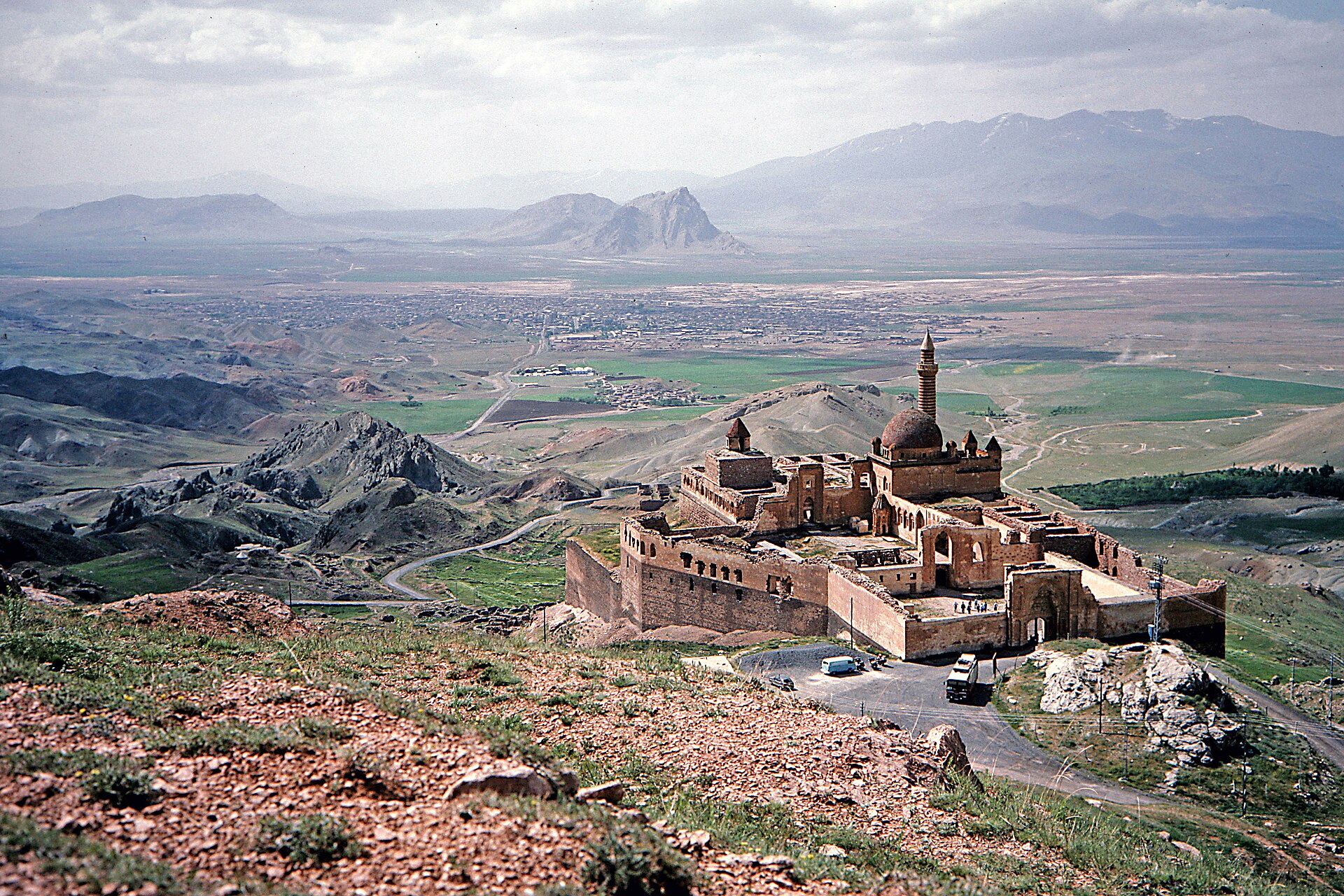
İshak Pasha Palace is a semi-ruined Ottoman-period palace and administrative complex in Doğubayazıt, Ağrı Province, eastern Türkiye. Construction began in 1685 and the Culture Portal dates completion to 1784. It stands on a high hill above the old town, a short drive from Mount Ararat and the Iranian border.
Key facts
- Location: Doğubayazıt district, Ağrı Province, eastern Türkiye
- Distance from the town: About 3 km east of Doğubayazıt town centre (Wikivoyage)
- Nearest airports: Iğdır (about 70 km) and Ağrı (about 100 km), per Wikivoyage
- Built: Begun 1685; completed 1784 (Culture Portal); Wikipedia says 1784 or 1785
- Style: Mixture of Anatolian, Iranian and North Mesopotamian traditions (UNESCO Tentative List text)
- Best season: Late spring to early autumn; winters are cold and roads can be hard
- Typical visit time: 1.5 to 2 hours at the palace; half a day with the nearby sights
- UNESCO status: On the Tentative List since 25 February 2000; not inscribed
- Nearby landmark: Mount Ararat, about 25 km north-east of the town (Wikivoyage)
- Entrance: See official page (Ministry of Culture and Tourism) for fees and hours
What is İshak Pasha Palace and why visit?
İshak Pasha Palace is a fortified Ottoman-era palace on a hill overlooking Doğubayazıt. It combines Anatolian, Iranian and Armenian-influenced building traditions. Visitors come for the carved stonework, the domes and courtyards, and the view across the plain towards Mount Ararat.
The palace is partly ruined, which makes the layout easy to read. Moreover, its position on the old Silk Road route near the Iranian frontier explains why a local ruling family built it here. As a result, the visit teaches history and geography at the same time.
These are the main reasons to visit:
- A rare surviving example of an Ottoman provincial palace, according to Wikipedia.
- A mix of building traditions that differs from palaces in Istanbul, Bursa and Edirne.
- A mosque with a minaret built in two colours of stone.
- Views of the plain and the Ararat massif from the hilltop.
What is the history of İshak Pasha Palace?
Çolak Abdi Paşa began the palace in 1685, and Küçük İshak Paşa finished it in 1784, according to the Culture Portal. İshak Paşa gave the palace its name. The family governed the Bayezid district, and the Culture Portal says the district was ruled from the palace until the First World War.
Wikipedia adds that an earthquake damaged the palace in 1840 and that it was partly restored over the following twenty years. In contrast, the Russo-Turkish War of 1877-1878 caused new damage. Later the building served as an administrative centre and then as a military fort until 1937, and stone was taken from it for houses.
Restoration work has continued in recent decades, including a roof and a wood-and-glass shelter over parts of the palace. Therefore the present building mixes original fabric and modern protection.
The table below sets out the main dates.
| Date | Event |
|---|---|
| 1685 | Construction begins under Çolak Abdi Paşa |
| 1784 (or 1785) | Work finished under İshak Paşa |
| 1840 | Earthquake damages the palace |
| 1877-1878 | Russo-Turkish War causes further damage |
| Until 1937 | Used as an administrative centre and military fort |
| 2000 | Added to the UNESCO Tentative List |
What is there to see at İshak Pasha Palace?
The palace has a terrace, two courtyards and building groups around them, according to the Culture Portal. Wikipedia lists the selamlık (men’s quarter), the mosque, the harem, a bath, a soup kitchen, a mausoleum and a central heating system among the sections.
The entrance is on the east facade, which is the side hardest to defend. Consequently, the entrance itself is a feature worth studying before you go inside.
Look for these parts of the complex:
- The east-facing entrance gate and its carved decoration.
- The first and second courtyards.
- The single-domed mosque and its two-colour minaret.
- The harem section, which an inscription dates to 1784 (Wikipedia).
- The mausoleum on the second courtyard.
- The dome interiors, which resemble Armenian churches according to the UNESCO summary quoted by Wikipedia.
This at-a-glance table summarises the main parts of the palace.
| Part | What to notice | Suggested time |
|---|---|---|
| Entrance and first court | Gate, carved stone | 15 minutes |
| Mosque and mausoleum | Minaret, domes | 20 minutes |
| Selamlık and harem | Rooms, halls, layout | 30 minutes |
| Terrace and view | Plain and Ararat massif | 15 minutes |
How do you get to İshak Pasha Palace?
Fly to Iğdır or Ağrı, then continue by road to Doğubayazıt. Wikivoyage lists Iğdır about 70 km north and Ağrı about 100 km west, with daily flights from Istanbul taking about 2 hours 10 minutes. From the town, a dolmuş or taxi covers the 3 km to the palace.
Wikivoyage says a dolmuş runs every 30 minutes from the foot of İshak Paşa Sokak. Always check the current timetable. From Van, dolmuşes take about 4 hours over a distance of 185 km.
The table below compares the main ways to reach the palace.
| Option | How it works | Typical time |
|---|---|---|
| Flight to Iğdır or Ağrı, then road | Airport, then bus or car to Doğubayazıt | Istanbul flight about 2 h 10 min; check road transfer time |
| Bus or dolmuş from Van | Via the D975 road over the Tendürek Pass | About 4 hours (185 km) |
| Town to palace | Dolmuş every 30 minutes or taxi | About 3 km |
| Private transfer or tour | Driver and guide handle the route | Arranged in advance |
When is the best time to visit?
Late spring to early autumn is the most comfortable period. Eastern Anatolia has cold winters, and Wikivoyage warns of rough driving on the Tendürek Pass road in winter. Snow and wind can affect access, so check conditions first.
However, the clear air of autumn often gives the best views of Mount Ararat. In summer the days are long, but midday sun is strong on the exposed hilltop.
The table shows what to expect by season.
| Season | Weather | Crowds | Notes |
|---|---|---|---|
| Spring | Cool, changeable | Low to moderate | Green plain; some snow on Ararat |
| Summer | Warm to hot days | Highest | Take sun protection and water |
| Autumn | Mild, clear | Moderate | Good visibility for views |
| Winter | Cold, snow likely | Low | Roads over passes can be hard (Wikivoyage); confirm access |
How long should you stay?
Plan 1.5 to 2 hours at the palace itself, or half a day if you add Eski Bayezıt and the tomb of Ehmedê Xanî. Wikivoyage places the Eski Beyazıt Mosque 200 m east of the palace and the tomb 200 m further east.
Therefore a full day in Doğubayazıt can include the palace, the old settlement and a view of Mount Ararat.
These sample plans show how to use your time.
| Plan | What you do | Best for |
|---|---|---|
| Half day | Palace, Eski Bayezıt mosque, tomb of Ehmedê Xanî | Short stop |
| 1 day | Add the Durupınar site and a drive towards Ararat | Most visitors |
| 2-3 days | Add Ağrı Dağı region, the Ice Cave hike and Van | Mountain and history combined |
What are the practical tips for visiting?
Check the official page for tickets, fees and hours, wear sturdy shoes, and carry water and sun protection. The palace has steps, uneven stone floors and exposed areas, so it is not fully step-free.
The region lies near the Iranian border, so carry your passport and follow local guidance at checkpoints. Moreover, ask before photographing people, and keep to marked paths in ruined areas.
These tips apply to most visits:
- Check the official page for current fees, hours and any closed sections.
- Wear sturdy, flat shoes for stone floors and steps.
- Bring a hat, sunscreen and a windproof layer.
- Carry ID; expect checkpoints in the border region.
- Dress modestly when entering the mosque area.
- Do not climb on fragile walls or restricted areas.
Where should you stay and eat?
Doğubayazıt town is the practical base, and Wikivoyage describes a pedestrianised main street, İnegöl Caddesi. Choose a central hotel for easy dolmuş connections or a quieter option near the road to the palace.
For food, look for local kebab and breakfast places in the town centre. Therefore plan meals in town before or after the palace visit, since facilities near the hilltop are limited. Check current options locally.
Neighbourhood-level options:
- Doğubayazıt centre around İnegöl Caddesi for hotels and restaurants.
- The road to İshak Paşa Sokak for convenient access to the palace.
- Iğdır or Ağrı for an overnight stop near the airports.
What else is near İshak Pasha Palace?
Mount Ararat rises 25 km north-east of Doğubayazıt and is Türkiye’s highest peak at 5,137 m, according to Wikivoyage. Eski Beyazıt Mosque, the tomb of Ehmedê Xanî and the Durupınar site are closer. Van and Akdamar lie to the south.
Kars and Ani are reachable via Iğdır and are a natural continuation of an eastern Türkiye route.
Good additions to your route:
- Eski Beyazıt Mosque, built in the 16th century (Wikivoyage).
- Tomb of Ehmedê Xanî, a multi-domed structure east of the mosque.
- Durupınar site, a rock formation with a visitor centre.
- Ice Cave on the flanks of Little Ararat, reached by a short hike.
- Lake Van and Akdamar Church to the south.
- Kars Castle and Ani to the north-east.
The table lists related places and directions.
| Place | Direction | Note |
|---|---|---|
| Mount Ararat | About 25 km north-east | Highest peak in Türkiye |
| Van | About 185 km south-west (Wikivoyage) | Akdamar Church, Van Castle |
| Kars | Via Iğdır | Kars Castle, Ani |
| Iranian border | About 35 km east (Wikivoyage) | Documents needed in advance |
Plan this with TurkGT
TurkGT is an Istanbul-based travel company. We offer guided tours, private transfers, licensed guide and interpreter services, and multi-day trips that can include İshak Pasha Palace and Mount Ararat. We can combine the palace with Ararat viewpoints, Van and Kars in one eastern Anatolia itinerary, with airport transfers arranged.
Tell us your dates, group size and interests on WhatsApp. We confirm the route, timing and what is included in writing before you book, and we do not quote prices on this page.
Frequently asked questions
When was İshak Pasha Palace built?
Construction began in 1685 and the Culture Portal dates completion to 1784. Wikipedia says 1784 or 1785.
Where is İshak Pasha Palace?
In Doğubayazıt district, Ağrı Province, about 3 km east of the town centre.
Is İshak Pasha Palace a UNESCO World Heritage Site?
Not yet. It has been on UNESCO’s Tentative List since 25 February 2000.
How do I get to the palace from Doğubayazıt?
By dolmuş or taxi over about 3 km. Wikivoyage mentions a dolmuş every 30 minutes; check the current timetable.
Which airport is closest?
Wikivoyage lists Iğdır about 70 km and Ağrı about 100 km from Doğubayazıt.
How long should I allow?
About 1.5 to 2 hours at the palace, or half a day with nearby sights.
Can I see Mount Ararat from the palace?
The palace overlooks the plain, and Mount Ararat lies about 25 km north-east. Visibility depends on weather.
How much is the ticket?
Please check the official Ministry of Culture and Tourism page for current fees and opening hours.
Related on TurkGT
- Part of Ağrı
Sources
- İshak Paşa Sarayı – Türkiye Kültür Portalı
- Ishak Pasha Palace – UNESCO World Heritage Centre Tentative List
- Ishak Pasha Palace – Wikipedia
- Doğubayazıt – Wikivoyage
Last reviewed: 2026-11-18. Opening hours, ticket prices and other changeable details are not listed because they change; check the official source before you travel.