
Istanbul is Türkiye’s largest city and one of the few in the world that spans two continents. It lies on the Bosphorus, between the Sea of Marmara and the Black Sea, and served as capital of the Roman, Byzantine and Ottoman empires. Visitors come for its historic peninsula, its waterways and its food, and the old centre holds a UNESCO listing.
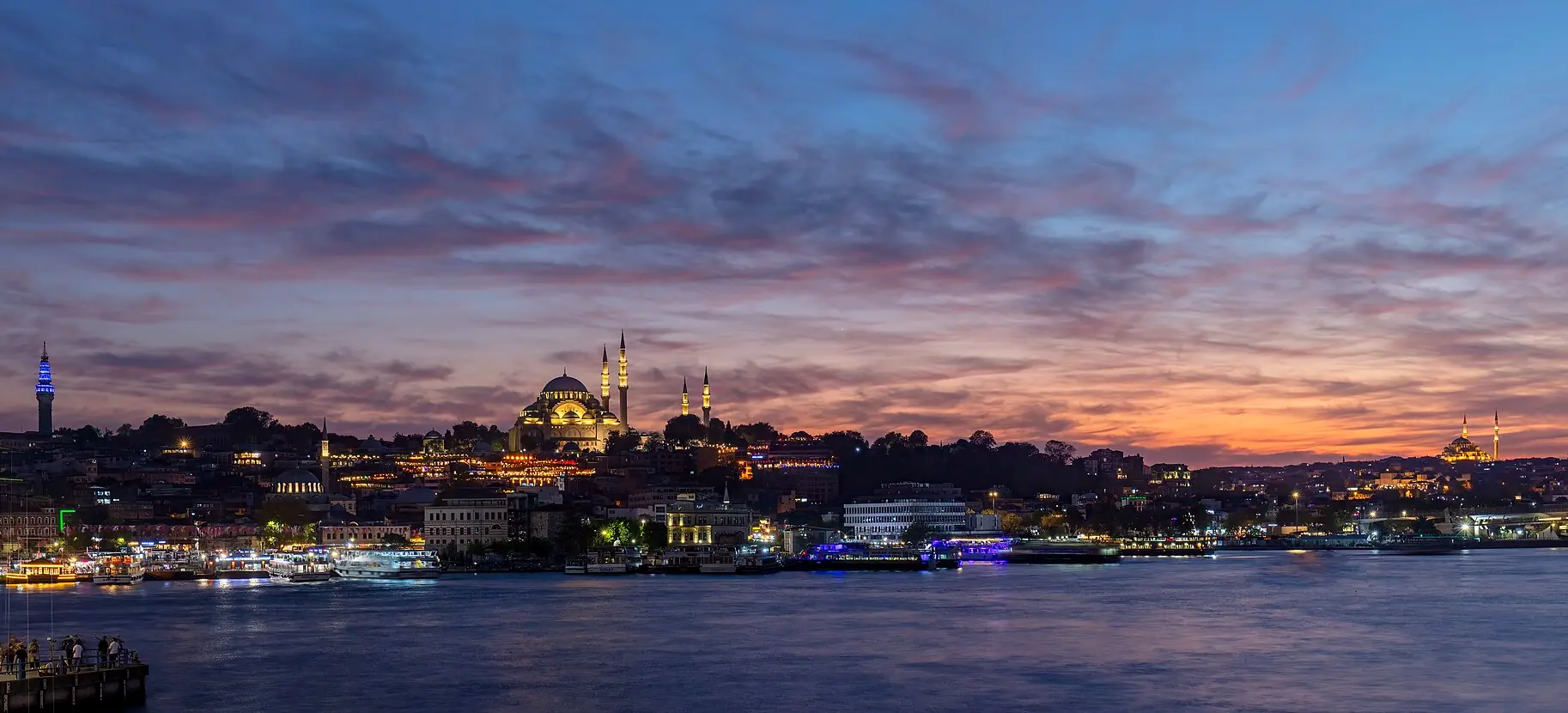
Key facts
- Location: Northwest Türkiye, on the Bosphorus between the Sea of Marmara and the Black Sea
- Airports: Istanbul Airport (IST) about 30 km northwest of the centre; Sabiha Gökçen (SAW) about 30 km east, on the Asian side
- Other cities: Ankara is the capital; Istanbul is the largest city. Check current bus, rail and flight timetables for onward travel
- Best season: Late spring (late May to early June) and early autumn (late September to early October); tulips bloom from late March to early May
- Typical visit time: Two to three days for the old city and the Bosphorus; four or five days adds the Asian side and day trips
- UNESCO status: Historic Areas of Istanbul, inscribed in 1985, covering four zones
- Earlier names: Byzantium, then Constantinople
- Public transport: İstanbulkart smart card for metro, tram, bus, Marmaray and ferries
- Entrance fees: See the official page of each museum or monument; the Museum Pass Istanbul exists as an official product
What is Istanbul and why visit?
Istanbul is a megacity of more than 15 million people on the Bosphorus strait in northwestern Türkiye. It belongs to Europe and Asia at once. Visitors choose it for Byzantine and Ottoman monuments, ferry rides between two continents, bazaars, and a food scene that ranges from street snacks to long meals.
Moreover, the city is easy to understand once you see its three parts. The Bosphorus divides Europe from Asia. The Golden Horn, an estuary, splits the European side in two. Most monuments cluster in the old city on the Sultanahmet peninsula, while Galata, Beyoğlu and Taksim form the modern heart across the water. Kadıköy and Üsküdar anchor the Asian side.
Therefore, a first visit works best when you group sights by district. This page explains the history, the highlights, the transport links and the seasons, so you can decide how many days to give the city.
What is the history of Istanbul?
Istanbul was founded as Byzantium by Greek colonists in the seventh century BC. Emperor Constantine re-established it as Constantinople in AD 330. For almost 16 centuries it served as capital of four empires. The Ottomans took it in 1453, and the Republic later moved the capital to Ankara.
Earlier traces exist. Neolithic artifacts found in the early 21st century show that the historic peninsula was settled as far back as the 6th millennium BC. The first known name, Byzantium, was given by Megarian colonists around 657 BC, and the Latin name Constantinopolis honours Constantine the Great.
In contrast to its imperial past, the modern name is quite young as an official label. Constantinople stayed the most common name in the West until the 1930s, when Turkish authorities began to press for the use of Istanbul in foreign languages. Today the palaces and imperial mosques that line the hills remain visible reminders of the city’s central role.
The table below summarises the main political phases of the city.
| Period | Name and status | What it means for a visitor |
|---|---|---|
| 7th century BC | Byzantium, Greek colony on the Sarayburnu promontory | Archaeological layers under the old city |
| AD 330-1204, 1261-1453 | Constantinople, Roman and Byzantine capital | Hagia Sophia, the city walls, cisterns |
| 1204-1261 | Constantinople under the Latin Empire | A short interlude between Byzantine periods |
| 1453-1922 | Ottoman capital | Topkapı Palace, imperial mosques, bazaars |
| 1923 onward | Largest city of the Republic; Ankara is the capital | Modern districts, ferries, metro and Marmaray |
Is Istanbul a UNESCO World Heritage Site?
Part of it is. UNESCO inscribed the Historic Areas of Istanbul in 1985. The listing covers four zones, not the whole metropolis. These are the Archaeological Park, the Süleymaniye quarter, the Zeyrek quarter and the zone of the city walls.
The property includes Sarayburnu, Topkapı Palace, Hagia Sophia, the Sultan Ahmed Mosque, Hagia Irene, the Zeyrek Mosque, the Süleymaniye Mosque, Little Hagia Sophia and the walls of Constantinople. Consequently, a walk through Sultanahmet alone touches several protected monuments. For an overview of the listing, read our page on the Historic Areas of Istanbul.
What should you see in Istanbul?
The core sights sit within walking distance of Sultanahmet Square, with the Bosphorus and the Galata district as the next circle. Plan one monument cluster per half day, and leave time for a ferry ride. Each linked page gives details for that landmark.
Wikivoyage notes that most sights are concentrated in the old city on the peninsula of Sultanahmet, to the west of the Bosphorus between the Horn and the Sea. As a result, visitors on a short stay can see many monuments without crossing the water.
The following highlights cover the main historic areas and the waterfront.
- Hagia Sophia, the Byzantine landmark in the Archaeological Park zone, next to the Blue Mosque.
- The Blue Mosque (Sultan Ahmed Mosque) with its six minarets and the Hippodrome square outside.
- Topkapı Palace, the Ottoman court complex on Sarayburnu, with its harem and treasury.
- The Basilica Cistern, a Byzantine underground water reservoir near Hagia Sophia.
- Grand Bazaar and Spice Bazaar for shopping, tea and spices.
- Galata Tower and the Galata, Karaköy and Beyoğlu streets above the Golden Horn.
- Dolmabahçe Palace and Ortaköy Mosque on the European shore of the Bosphorus.
- The Süleymaniye Mosque, designed by Sinan, with a view over the Golden Horn.
This at-a-glance table groups the highlights by district.
| District | Main highlights | Typical visit time |
|---|---|---|
| Sultanahmet | Hagia Sophia, Blue Mosque, Topkapı Palace, Basilica Cistern, Hippodrome | 1 to 2 days |
| Eminönü and Fatih | Spice Bazaar, Grand Bazaar, Süleymaniye Mosque, Zeyrek | Half day to 1 day |
| Galata and Beyoğlu | Galata Tower, İstiklal Avenue, Karaköy | Half day |
| Beşiktaş and Bosphorus shore | Dolmabahçe Palace, Ortaköy Mosque, Bosphorus cruise | Half day |
| Asian side | Kadıköy market, Üsküdar, Maiden’s Tower, Çamlıca | Half day to 1 day |
How do you get to Istanbul and get around?
Most international visitors arrive at Istanbul Airport (IST), about 30 km northwest of the centre, or at Sabiha Gökçen (SAW) on the Asian side. From IST, the M11 metro, Havaist buses and taxis run to the city. Check current timetables before you travel, as lines and schedules change.
Inside the city, the İstanbulkart works on buses, trams, suburban trains, the metro and local ferries. You touch the card to a reader on boarding, and one card can serve several passengers. The T1 tram is the most useful line for the old city, with interchanges at Kabataş, Karaköy and Eminönü. Furthermore, the Marmaray cross-town train links Halkalı, Sirkeci and Üsküdar under the Bosphorus.
However, rush hours slow the trams. Wikivoyage advises skipping the T1 tram in the busiest hours and walking instead, because it is quicker than waiting for a crowded car.
The table lists the main airport and city transport options with typical durations.
| Route or mode | Typical duration | Notes |
|---|---|---|
| IST airport to Sultanahmet by taxi | About 50 minutes for roughly 50 km | Traffic changes the time; use official taxi stands |
| IST airport by M11 metro | Varies by transfer | Metro operates about 06:15 to 00:15; check the current timetable |
| IST airport by Havaist bus to Aksaray | About 90 minutes | Departs every 25 to 30 minutes; check the current timetable |
| SAW airport by M4 metro to Kadıköy | About 1 hour | Continue by ferry or Marmaray |
| Marmaray, Halkalı to Gebze corridor | About 1 hour end to end | Runs about every 15 minutes in daytime; check the current timetable |
| Ferries across the Bosphorus | Short crossings | Eminönü, Karaköy and Kadıköy piers; use İstanbulkart |
When is the best time to visit Istanbul?
Late spring and early autumn suit most visitors. Wikivoyage names late May to early June and late September to early October as the pleasant periods, with warm days and less rain than winter. Summer is warm, and winter is cool, damp and sometimes snowy.
Istanbul has an oceanic climate with Mediterranean influences. Therefore, pack layers in every season. In April, tulips bloom across the parks, which adds colour to the old city.
The table compares the seasons by weather and crowds.
| Season | Weather | Crowds and notes |
|---|---|---|
| Spring (Apr-Jun) | Mild, mix of rain and sun; tulips from late March to early May | Popular for sightseeing; late May is pleasant |
| Summer (Jul-Aug) | About 26°C by day, humid, northeasterly Poyraz wind | Peak visitor season; carry water and use shade |
| Autumn (Sep-Nov) | Mild, less rain than winter | Early autumn is pleasant; sea is still warm |
| Winter (Dec-Mar) | About 8°C by day, damp, some snow | Fewer visitors; rain gear needed; some ferry trips may change |
How long should you stay in Istanbul?
Two full days cover the old city highlights, and three days allow a Bosphorus cruise and the Galata area. Five days add the Asian side and a day trip. These are planning guides, not rules, because queues and weather change the pace.
In addition, many visitors combine the city with a flight to Cappadocia. Our Cappadocia short trip from Istanbul by flight shows how that works.
This table suggests plans for different lengths of stay.
| Time | Suggested plan | Pace |
|---|---|---|
| Half day | Sultanahmet Square, Hagia Sophia and Blue Mosque exteriors, Hippodrome walk | Fast; layover friendly |
| 1 day | Sultanahmet monuments plus Grand Bazaar or Spice Bazaar | Full day on foot |
| 2 to 3 days | Add Topkapı Palace, Basilica Cistern, a Bosphorus cruise and Galata | Comfortable |
| 4 to 5 days | Add Dolmabahçe, the Asian side, Fener and Balat, and a day trip | Relaxed |
What practical tips help in Istanbul?
Dress modestly for mosques, buy tickets only from official sources, and ask prices before ordering where menus are not displayed. Wikivoyage warns that tourists are constantly overcharged where prices are missing. Check each museum’s official page for fees and opening hours.
The city also sits close to the North Anatolian Fault, so read local earthquake guidance and ask your hotel about safety routines.
These points cover dress, tickets, accessibility, safety and etiquette.
- Dress code: cover shoulders and knees in mosques, and carry a scarf; women cover their hair inside active mosques.
- Shoes come off at mosque entrances, so wear socks you are happy to show.
- Tickets and fees: see the official page of each museum or palace; the Museum Pass Istanbul is an official product.
- Accessibility: old-city streets are steep and cobbled, and some historic sites have stairs; ask the venue about step-free routes.
- Safety: watch traffic when crossing, keep valuables close in crowds, and use official taxi stands.
- Photography: tripods and drones may be restricted at monuments, so follow signs and staff instructions.
- Etiquette: greet shopkeepers politely and agree prices before buying; stop photography during prayer times.
Where should you stay and eat in Istanbul?
Choose Sultanahmet for the old city, Taksim or Harbiye for the modern centre, and the Bosphorus shore for quieter stays. Sultanahmet has many reasonably priced hotels with terrace views of the Marmara Sea and the Blue Mosque, according to Wikivoyage. Kadıköy suits visitors who like markets and cafés.
For food, try balık-ekmek (grilled fish in bread) by the waterfront, döner and dürüm wraps, simit, corn on the cob from carts, and fresh juices. In addition, Turkish tea and coffee accompany most meals, and baklava shops cluster near Karaköy.
The table compares areas for a stay.
| Area | Suits | Trade-off |
|---|---|---|
| Sultanahmet | First visit, walking to major monuments | Quiet at night; tourist-focused |
| Taksim and Harbiye | Shopping, nightlife, metro links | Busy and noisy |
| Karaköy and Galata | Cafés, galleries, ferries | Hills and stairs |
| Kadıköy (Asian side) | Markets, local food, ferry rides | Longer trip to Sultanahmet |
| Bosphorus shore | Views and calm evenings | Farther from the old city |
What are the nearby places and day trips from Istanbul?
Day trips from Istanbul include the Princes’ Islands by ferry, Şile on the Black Sea coast, and Bursa and Edirne for Ottoman heritage. Choose one trip per day, and check ferry and bus timetables for the season. Related pages on TurkGT cover the main neighbourhoods and landmarks.
Moreover, those who want to continue within Türkiye can fly to Cappadocia or move on to İzmir, Antalya or the Muğla coast. Our guide pages for these provinces explain the routes.
The following nearby places connect easily with the city.
- Princes’ Islands (Büyükada and Heybeliada) by ferry from the Marmara shore.
- Şile for the Black Sea coast and its lighthouse.
- Beylerbeyi Palace and the Asian Bosphorus villages.
- Bursa for early Ottoman capital history.
- Edirne for the Selimiye Mosque.
Plan this with TurkGT
TurkGT is an Istanbul-based travel company. We offer guided tours with licensed guides, private transfers, and interpreter support. For example, see our Sultanahmet Walking Tour (Hippodrome, Hagia Sophia, Blue Mosque), our Two Continents Tour with a Bosphorus cruise, and the 3-Day Istanbul Historical and Cultural Tour with Guide.
Tell us your dates and interests by WhatsApp, and we confirm the plan with you there.
Frequently asked questions
Is Istanbul the capital of Türkiye?
No. Ankara is the capital. Istanbul is the largest city and was the capital of the Roman, Byzantine and Ottoman empires.
Is Istanbul in Europe or Asia?
Both. The Bosphorus divides the city, and about two-thirds of residents live on the European side.
How many days do you need in Istanbul?
Two to three days cover the old city and a Bosphorus cruise. Four to five days add the Asian side and a day trip.
Which airport should I choose, IST or SAW?
Istanbul Airport (IST) is the main international gateway on the European side. Sabiha Gökçen (SAW) is on the Asian side and has the M4 metro to Kadıköy. Pick by your flight and hotel area.
What is the İstanbulkart?
It is a public transport smart card for buses, trams, metro, suburban trains and local ferries. One card can be used for several passengers on most lines.
When do the tulips bloom in Istanbul?
Wikivoyage says tulips bloom from late March to early May, depending on the cultivar, with April the usual peak.
Is the whole city a UNESCO site?
No. The 1985 listing covers four zones of the historic centre: the Archaeological Park, the Süleymaniye quarter, the Zeyrek quarter and the city walls.
How much do tickets cost?
Fees change, so see the official page of each museum. The Museum Pass Istanbul is an official product listed on the Ministry of Culture and Tourism site.
Related on TurkGT
- Places and guides in İstanbul:
- Sultanahmet
- Beyoğlu
- Galata
- Beşiktaş
- Kadıköy
- Üsküdar
- Princes’ Islands
- Şile
- Historic Areas of Istanbul
- Hagia Sophia
- Blue Mosque (Sultan Ahmed Mosque)
- Topkapı Palace
- Galata Tower
- Basilica Cistern
Sources
- Istanbul (Wikipedia)
- Istanbul (Wikivoyage)
- Historic Areas of Istanbul (Wikipedia)
- Historic Areas of Istanbul – UNESCO World Heritage Centre
- İstanbul Genel Bilgiler – Kültür Portalı
Last reviewed: 2026-11-17.