
İzmir is a province and metropolitan municipality on Türkiye’s Aegean coast, wrapped around the Gulf of İzmir. Its capital, the city of İzmir, was known in antiquity as Smyrna and is the third most populous city in Türkiye. Visitors use it as a base for Ephesus, Pergamon, Çeşme and Alaçatı.
Key facts
- Location: Central Aegean coast of western Anatolia, on the Gulf of İzmir
- Airport: İzmir Adnan Menderes (ADB), 16 km south of the centre; flights from Istanbul IST and SAW. Check current timetables
- Distances: Çeşme about half an hour by road; Selçuk (for Ephesus) a few hours by public transport; Istanbul by air or long bus ride
- Best season: Spring and autumn; beach swimming is good in September and October
- Typical visit time: 2 to 3 days for the city; 4 to 6 days with Ephesus, Pergamon and Çeşme
- UNESCO status: No UNESCO site in the city centre; Ephesus and Pergamon are in the province (see our WHS pages)
- Area and population: 11,891 km²; 4,462,056 inhabitants in 2022 (province)
- Districts: 30 in total; the central 11 form the city
- Old names: Smyrna
- Entrance: See official page of each site and museum
What is İzmir and why visit?
İzmir is the third most populous city in Türkiye and the largest metropolitan area on the Aegean Sea. It sits at the head of a gulf, with a seafront promenade, a Roman agora, an Ottoman bazaar and a lively café culture. Travellers use it as a hub for Ephesus, Pergamon, Çeşme and Alaçatı.
Moreover, the city offers a different pace from Istanbul. The climate is Mediterranean, the ferries cross the gulf, and food centres on seafood, herbs and local pastries. As a result, it suits slower itineraries that combine culture and coast.
In this page, İzmir refers to both the city and the province. The province covers 11,891 km² and includes the Urla-Çeşme peninsula and many historic towns.
What is the history of İzmir?
İzmir has more than 3,000 years of recorded urban history. Ancient Smyrna stood at the head of a broad sheltered inlet. It was settled by Aeolians and Ionians, destroyed by the Lydians around 600 BC, rebuilt under Alexander’s successors and thrived under the Romans. The Ottomans took it in 1415.
Wikipedia notes that the name Smyrna stayed in use in English until around 1930. Consequently, older travel books and maps use Smyrna. In the Ottoman period the city became a thriving trading centre with Greek, Jewish, Armenian, Muslim, Italian and French communities.
The modern city dates from the War of Turkish Independence. Turkish forces took İzmir on 9 September 1922, which the city celebrates as the date of its independence. In addition, the Treaty of Lausanne in 1923 confirmed Türkiye’s borders.
The table sets out the main phases.
| Period | Event | What remains |
|---|---|---|
| About 3000 BC | Early settlement at Bayraklı | Archaeological site and finds |
| Hellenistic and Roman | Smyrna rebuilt on Mount Pagos, today Kadifekale | Agora of Smyrna, Kadifekale |
| 1415 | Ottoman rule under Mehmet I | Kemeraltı bazaar zone |
| 1901 | Clock Tower built in Konak Square | City landmark |
| 9 September 1922 | Turkish forces take İzmir | Independence day in the city |
| 1923 | Treaty of Lausanne | Modern province |
What should you see in İzmir?
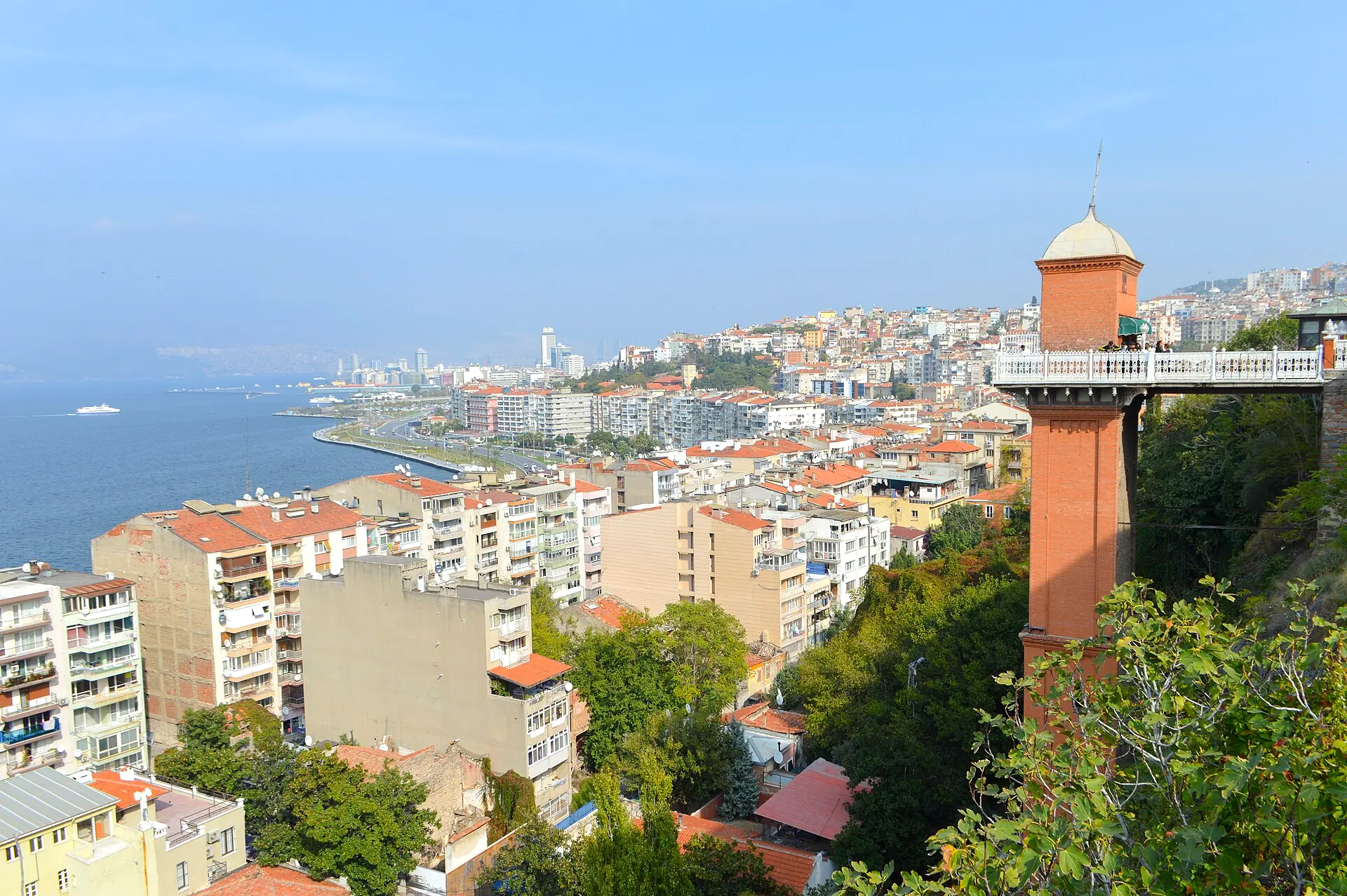
Begin at Konak Square with the Clock Tower, then walk into Kemeraltı bazaar and the Agora of Smyrna. Take the Historical Elevator for a view over the gulf, and finish with a ferry ride. Wikipedia states the Clock Tower is 25 m tall and was designed by Raymond Charles Père in 1901.
The Historical Elevator, built in 1907, carries people between the Karataş waterfront and the hill. Therefore, it works as both a sight and a shortcut.
The following sights form a walkable first day.
- Konak Square and the Clock Tower (1901).
- Kemeraltı bazaar, the Ottoman market zone near the Agora.
- The Agora Open Air Museum, the preserved Agora of Smyrna.
- Kadifekale, the hilltop castle above the city.
- Historical Elevator (Asansör), built in 1907.
- İzmir Archaeological Museum, with finds from Smyrna and other Ionian cities.
- Konak Pier and the seafront promenade at sunset.
This at-a-glance table groups sights by area.
| Area | Main sights | Typical visit time |
|---|---|---|
| Konak | Clock Tower, Konak Mosque, pier | 1 to 2 hours |
| Kemeraltı | Bazaar, Agora, synagogues on Havra Street | Half day |
| Karataş | Historical Elevator and waterfront | 1 hour |
| Kadifekale | Hilltop castle, views | 1 to 2 hours |
| Alsancak | Cafés, ferry terminal, promenade | Evening |
How do you get to İzmir and get around?
İzmir Adnan Menderes Airport (ADB) is 16 km south of the centre and has frequent flights from Istanbul. İzban suburban trains run to Alsancak, and ESHOT bus 202 runs to Republic Square. Check current timetables, since frequencies change. You need an İzmirimkart for the train and subway.
The city is not yet on the high-speed network, so Wikivoyage says trains are slow overnight services while daytime buses cover the distance in half the time. Inside the city, the metro runs east-west, trams loop the centre and north shore, and ferries cross the gulf. Furthermore, bank cards work on trams and metro, according to Wikivoyage.
The table lists the main transport options.
| Route or mode | Typical duration | Notes |
|---|---|---|
| Airport to Alsancak by İzban | Frequent; about every 10 minutes | Change at Hilal for the metro; check current timetable |
| Airport by bus 202 to Republic Square | Most of an hour | Hourly; İzmirimkart needed |
| Metro Bornova to Fahrettin Altay | East-west line | Connects Basmane, Konak, Halkapınar |
| İzdeniz ferries | Short crossings | Cheap and scenic |
| Çeşme by road | About half an hour by car | Check current timetable for buses |
| Istanbul to İzmir | Flight or long bus ride | Check current timetable |
When is the best time to visit İzmir?
Spring and autumn suit most visitors. Wikivoyage says these seasons are warm and pleasant, and that sea temperature lags behind land, reaching about 20°C in September and October. Summer is hot, rainless and humid, with highs of 30 to 35°C that feel like 40°C.
Winters are mild to cool, around 12 to 16°C, with occasional downpours. The Etesian wind, called meltem, blows regularly across the gulf. Consequently, summer evenings on the waterfront feel pleasant.
The table compares the seasons.
| Season | Weather | Crowds and notes |
|---|---|---|
| Spring | Warm, pleasant | Good for Ephesus and Pergamon |
| Summer | Hot and humid, 30-35°C | Beach season; avoid midday sightseeing |
| Autumn | Warm; sea about 20°C in Sep-Oct | Good for beaches and culture |
| Winter | Mild to cool, some rain | Quiet; some beach services closed |
How long should you stay in İzmir?
Two days cover the city centre and Kemeraltı. Add one day each for Ephesus and Pergamon, and one more for Çeşme and Alaçatı. These are planning guides, not rules. Use the table below to match a plan to your time.
Moreover, nights in İzmir work well as a base because ferries, trains and buses fan out from the centre.
This table suggests plans for different lengths of stay.
| Time | Suggested plan | Pace |
|---|---|---|
| Half day | Konak, Clock Tower and Kemeraltı | Easy |
| 1 day | Add Agora, Elevator and Alsancak evening | Full |
| 2 to 3 days | Add Ephesus or Pergamon | Comfortable |
| 4 to 6 days | Add Çeşme, Alaçatı, Şirince and Selçuk | Relaxed |
What practical tips help in İzmir?
Use the İzmirimkart or a bank card for public transport, carry water in summer, and check each site’s official page for fees and hours. Wikivoyage advises the usual care of valuables and caution with traffic. These points are general advice.
Mosques require modest clothing. Therefore, carry a light scarf and wear shoes that are easy to remove.
The following points cover tickets, access and etiquette.
- Tickets: see the official page of each museum and archaeological site.
- Dress: modest clothing for mosques and synagogues; sun hat in summer.
- Accessibility: Kemeraltı is a maze of narrow lanes; the waterfront is flat and easier.
- Safety: look after valuables in busy markets and watch for traffic.
- Photography: follow signs in museums and places of worship.
- Taxis: İzmir-registered taxis cannot go beyond the provincial boundary, so arrange longer trips in advance.
Where should you stay and eat in İzmir?
Alsancak suits visitors who want cafés and the waterfront. Konak and Basmane are close to the bazaar and train links. Karşıyaka and Çeşme offer a quieter seaside stay. Choose by what you plan to do. The table below compares the main areas.
Local specialties include grilled sea bass, kumru (a warm sesame-bread sandwich), boyoz (a pastry for breakfast) and tulum cheese. Wikivoyage lists these as local foods.
The table compares areas for a stay.
| Area | Suits | Trade-off |
|---|---|---|
| Alsancak | Cafés, seafront, nightlife | Busier at night |
| Konak and Kemeraltı | Sights and bazaar | Crowded in the day |
| Basmane | Train and bus links | Simple surroundings |
| Karşıyaka | Local feel, ferry ride | Away from sights |
| Çeşme and Alaçatı | Beach holidays | Distance from the city |
What are the nearby places and day trips from İzmir?
Day trips include Ephesus and Selçuk, Pergamon at Bergama, Şirince, Çeşme, Alaçatı and Manisa. Choose one direction per day, and check train and bus schedules. Related pages cover the main places. Pick one direction per day. Keep the return transport in mind before you commit to a longer trip.
Çeşme is half an hour’s drive west of İzmir. Selçuk is a few hours south and is the hub for Ephesus. Bergama to the north has the ruins of Pergamon.
These places connect with İzmir.
- Ephesus and Selçuk, including the Library of Celsus.
- Pergamon and Bergama, in the north of the province.
- Şirince, a hill village known for wines.
- Çeşme and Alaçatı on the western peninsula.
- Manisa and Sardes, the capital of ancient Lydia.
- Tire and Birgi, traditional Aegean towns.
Plan this with TurkGT
TurkGT is an Istanbul-based travel company. We arrange guided tours, private transfers, licensed guides and interpreters, and can combine an Istanbul stay with the Aegean. Message us on WhatsApp with your dates, and we confirm the plan there. Our team can also help with hotel timing, airport pickups and local advice.
Frequently asked questions
Where is İzmir Province?
It lies on the Aegean coast of western Anatolia and encloses the Gulf of İzmir.
How many districts are there?
There are 30 districts, and the central 11 form the city of İzmir.
How old is İzmir?
Wikipedia cites more than 3,000 years of recorded urban history, and Wikivoyage places early settlement around 3000 BC.
What is the Historical Elevator?
It is a landmark that has connected two levels of the city since 1907.
How do I reach Ephesus?
Go through Selçuk, the hub for Ephesus. The IZBAN line extends to Selçuk. Check current timetables.
When is the best season?
Spring and autumn are warm and pleasant. Summer is hot and humid.
How many days do I need?
Two days for the city; add days for Ephesus, Pergamon and Çeşme.
What food is local?
Grilled sea bass, kumru, boyoz and tulum cheese.
Related on TurkGT
- Places and guides in İzmir:
- Çeşme
- Alaçatı
- Bergama
- Selçuk
- Pergamon and its Multi-Layered Cultural Landscape
- Ephesus
- Library of Celsus
- Şirince Village
- İzmir Clock Tower
- Kemeraltı Bazaar
Sources
- Izmir (Wikivoyage)
- İzmir (Wikipedia)
- İzmir Province (Wikipedia)
- İzmir (GoTürkiye)
- İzmir Genel Bilgiler – Kültür Portalı
Last reviewed: 2026-11-17.