
Perge is an ancient city in the Aksu district of Antalya, about 15 kilometres east of the city centre. It began as the Hittite-era settlement Parha and grew into the capital of the Roman province of Pamphylia Secunda. Visitors come for its theatre, stadium, baths and colonnaded main street.
Key facts
- Location: Aksu district, Antalya Province, on the Mediterranean coast
- Distance from Antalya: About 15 km east of the city centre (Wikipedia)
- Nearest airport: Antalya Airport (AYT); confirm the transfer time with your driver
- Earlier name: Parha in Hittite sources
- Main periods: Bronze Age, Hellenistic, Roman, early Christian
- Excavations: Started in 1946
- UNESCO status: On the Tentative List since 2009 (Culture Portal)
- Best season: Spring and autumn (April-May, October-November)
- Typical visit time: 2 to 3 hours on site
- Entrance: See the official Ministry of Culture and Tourism page
What is Perge and why visit?
Perge is a ruined Greek and Roman city in Aksu, east of Antalya. It matters because it shows a complete Roman town plan: two main streets, a theatre, a stadium, baths and a central water channel. Moreover, it sits close to the city, so it fits easily into a half day.
The site belonged to the Pamphylia region, a low coastal plain between the Taurus Mountains and the sea. As a result, Perge was a rich trading and religious centre. Today it gives visitors a clear picture of daily life in a provincial Roman capital, without the crowds of the coast.
Visitors usually choose Perge for these reasons:
- It is one of the best-planned Roman cities in Anatolia, according to the Culture Portal.
- The stadium and theatre are among the better preserved in the country.
- Many finds from the city are displayed in the Antalya Museum.
- The site links easily with Aspendos, Side and the old town of Kaleiçi.
What is the history of Perge?
Perge was inhabited from the Bronze Age until about 1100 AD. It passed from Hittite and Greek hands to Persian, Hellenistic and Roman rule. Its peak came in the 2nd and 3rd centuries AD, when wealthy citizens paid for monumental buildings. Later it became a Christian bishopric.
Excavations on the acropolis date the first settlement to the early Bronze Age, 4000-3000 BC. A Hittite treaty names a border city called Parha, which scholars link with Perge. The settlement probably became a Greek colony of Rhodes in the 7th century BC.
Alexander the Great was welcomed here in 334 BC. After that, the Seleucids ruled, and the lower-city walls date from 223 BC. In 133 BC the last Attalid king left his kingdom to Rome. Later, the Romans built the Via Sebaste to connect Perge with Pisidian Antioch.
The 2nd century AD brought a construction boom. Plancia Magna, a local noblewoman and priestess of Artemis, paid for the monumental gate complex. In contrast, the river Cestrus silted up in late Roman times, and the city declined as a secular centre. It then became an important Christian centre under Constantine.
The table below summarises the main periods of Perge.
| Period | Date | What happened |
|---|---|---|
| Early Bronze Age | 4000-3000 BC | First settlement on the acropolis |
| Late Bronze Age | Hittite era | Border city named Parha in a Hittite treaty |
| Hellenistic | 334 BC onwards | Alexander is welcomed; walls built from 223 BC |
| Roman | 1st-3rd century AD | Monumental city; Plancia Magna funds the gates |
| Early Christian | 4th-6th century | Important Christian centre; bishops attend councils |
| End of occupation | About 1100 | Perge inhabited until the Seljuk period |
What are the highlights of Perge?
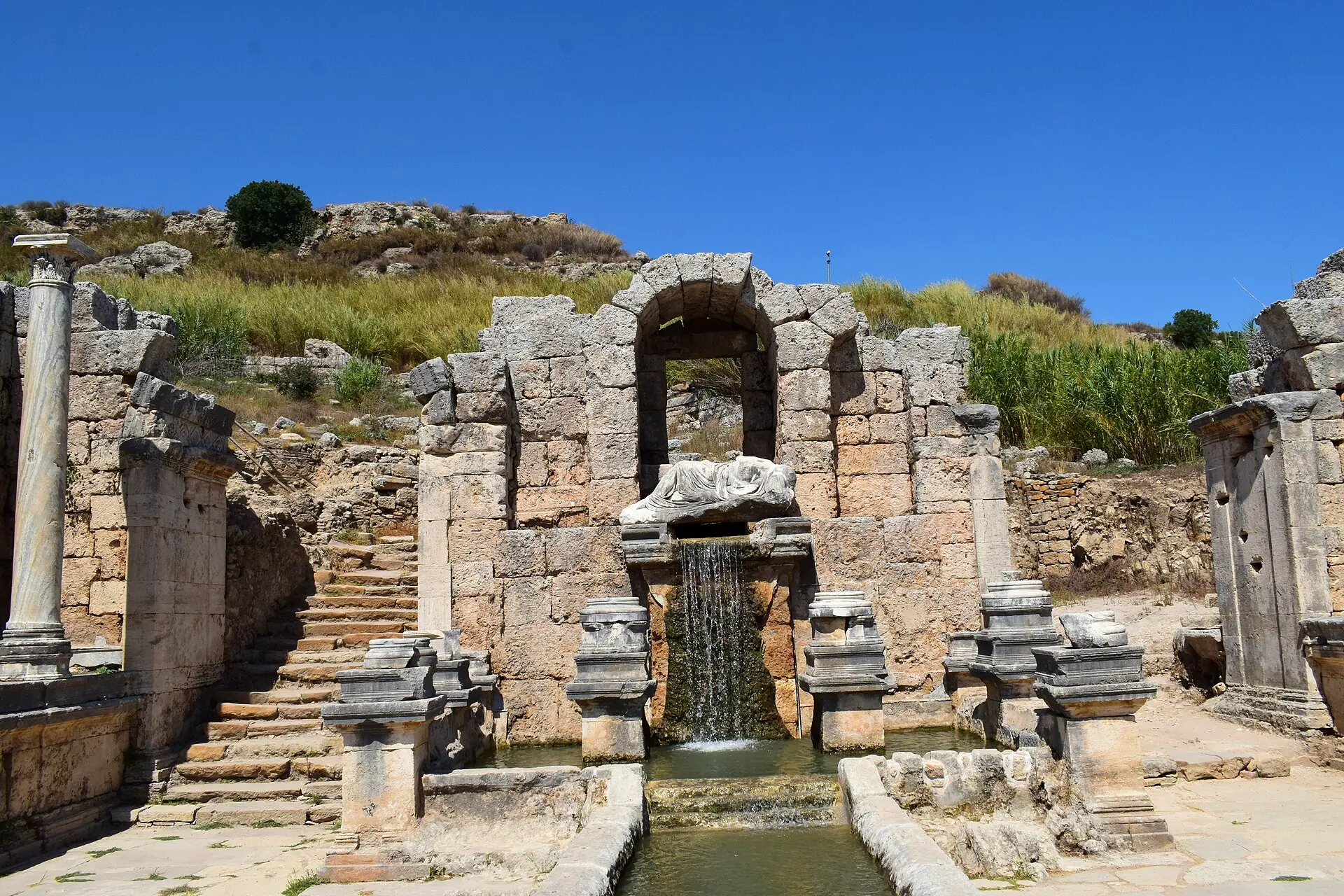
The main sights are the theatre, the stadium, the colonnaded main street with its central water channel, the Hellenistic gate, the south baths and the nymphaea. Together they show how a Roman city looked and worked. Walk the main street first, then see the large buildings.
The Culture Portal says the city plan rests on two main streets, one east-west and one north-south. A long channel with cascading pools ran down the centre of the main street. Wikipedia calls this a unique feature for a Roman city.
The theatre lies outside the walls near the stadium. It is larger than those of Myra and Patara, according to Wikipedia. The Culture Portal gives the theatre a capacity of 15,000 and calls the stadium one of the best-preserved in Türkiye.
These are the sights to look for on a walk through the site:
- The Hellenistic city gate and the later monumental gate complex.
- The colonnaded street with the central water channel.
- The theatre and the stadium outside the walls.
- The south baths, noted for their size and sculpture finds.
- Hadrian’s nymphaeum and the southern nymphaeum.
- The mosaics found since 2003, including Oceanus and Medusa.
The following table gives the highlights at a glance.
| Sight | What it is | Why it matters |
|---|---|---|
| Theatre | Roman theatre outside the walls | Large and well preserved; capacity of 15,000 (Culture Portal) |
| Stadium | Roman running track | One of the best-preserved in Türkiye (Culture Portal) |
| Colonnaded street | Main street with water channel | Unusual cascading pools in the centre |
| South baths | 1st century AD bath complex | Big, monumental, many sculptures found |
| Nymphaea | Monumental fountains | Hadrian’s nymphaeum, about 122 AD |
| Mosaics | Greek mosaics | Oceanus and Medusa found in 2003 |
How do you get to Perge and get around?
Perge is about 15 kilometres east of Antalya, so you can reach it by taxi, private transfer, organised tour or public transport with a connection. A private car is the simplest choice. Check the current bus and dolmuş timetables before you travel.
Wikivoyage notes that a taxi driver can act as a private guide, and that this suits Perge well. Antalya Airport (AYT) is the usual arrival point, and the AntRay tram serves the city. Furthermore, the site is only a short drive from the Aksu area.
Inside the site, you walk. Paths are long and open, and the ground is uneven. Therefore, wear sturdy shoes and plan for shade breaks.
This table compares the common ways to reach the ruins.
| Option | Typical duration | Notes |
|---|---|---|
| Private transfer or taxi from Antalya | Short drive; confirm with the driver | Most flexible; can wait for you |
| Organised tour | Half day | Often combined with Aspendos or Side |
| Public bus or dolmuş with a connection | Varies | Check the current timetable |
| Rental car | Short drive | Parking at the site; follow signs to Aksu |
When is the best time to visit Perge?
Spring and autumn are the most comfortable seasons for Perge. Wikivoyage describes April-May and October-November as optimum for sightseeing on the Antalya coast. Summers are hot and rainless, so visit early or late in the day. Winters are mild but can be stormy.
Wikivoyage says summer days in Antalya average 30-35 degrees and may pass 40. The site has little shade, as a result. In winter, rain can make the stone slippery.
The table below shows what to expect in each season.
| Season | Weather | Crowds | Notes |
|---|---|---|---|
| Spring (Apr-May) | Warm, pleasant | Moderate | Good light; flowers on the plain |
| Summer (Jun-Aug) | Hot, dry, humid | High on the coast | Go early; bring water and a hat |
| Autumn (Oct-Nov) | Warm to mild | Moderate to low | Comfortable walking |
| Winter (Dec-Mar) | Mild, stormy spells | Low | Check weather; wet stone is slippery |
How long should you stay at Perge?
Most visitors need two to three hours at Perge. A short visit covers the theatre, stadium and main street. A fuller day adds the Antalya Museum, where many statues from the city are shown. The plans below suit different budgets of time.
Keep in mind that the ruins are spread out. Moreover, shade is limited. Plan the walk in two parts, with a rest in between.
Here are three sample plans.
| Plan | Time | What to do |
|---|---|---|
| Half day | 3 to 4 hours | Perge site, then lunch in Aksu or Antalya |
| One day | Full day | Perge in the morning, Antalya Museum and Kaleiçi after lunch |
| Two to three days | 2-3 days | Add Aspendos, Side, Düden Waterfalls and a beach day |
What practical tips help at Perge?
Wear comfortable shoes, bring water and use sun protection. Ticket prices and opening hours change, so check the official Ministry of Culture and Tourism page. Photography is generally allowed outdoors, but follow signs and staff instructions near restoration areas. Allow extra time for the walk.
The ground is uneven, with stone paving and steps. Therefore, access is limited for wheelchair users and for people with reduced mobility. Ask before you go if you need specific help.
These tips make the visit easier:
- Check the official page for tickets, museum-card rules and opening hours.
- Start early in summer to avoid the midday heat.
- Use a guide to read the ruins; signs give only short information.
- Do not climb on fragile walls or take stones.
- Keep children close near open drops and uneven steps.
- Dress for sun and walking rather than for a formal visit.
Where can you stay and eat near Perge?
Most visitors stay in Antalya and visit Perge as a short trip. Kaleiçi suits travellers who want an old-town setting. The Lara and Konyaaltı areas suit beach stays. For food, try the cafes of Aksu, or return to Antalya for dinner.
Wikivoyage describes the Lara strip as the main package-holiday area to the east of the city, with long sandy beaches. In contrast, Konyaaltı has a long pebble beach and lower prices, according to Wikivoyage.
Choose your base by travel style:
- Kaleiçi: historic atmosphere and walking distance to the harbour.
- Lara: resort hotels and sandy beach, closer to Aksu.
- Konyaaltı: pebble beach and the Antalya Museum nearby.
What can you visit near Perge?
Perge links well with Aspendos, Düden Waterfalls, Kaleiçi and the beaches of Antalya. Aspendos is the next ancient city on the coast. Wikivoyage places it 40 kilometres east, near Serik. Köprülü Canyon is a longer day trip. Both stops fit into one day with a driver. Check distances before you plan.
As a result, many visitors plan a Roman Pamphylia day: Perge in the morning and Aspendos in the afternoon.
Related places to consider:
- Aspendos Theatre, a well-preserved Roman theatre.
- Düden Waterfalls, a green stop in Antalya.
- Kaleiçi, the old town with its harbour.
- Köprülü Canyon, for nature and rafting.
- Konyaaltı Beach and Lara Beach for a swim.
Plan this with TurkGT
TurkGT is an Istanbul-based travel company. We can arrange guided trips, private transfers, licensed guides and interpreter support for ancient-city visits like Perge. Tell us your dates and group size on WhatsApp, and we will confirm the details with you.
Frequently asked questions
Where is Perge?
Perge is in the Aksu district of Antalya Province, about 15 kilometres east of Antalya city centre.
What was Perge famous for?
It was the capital of the Roman province of Pamphylia Secunda and the birthplace of the mathematician Apollonius of Perga. It is known for its theatre, stadium and colonnaded street.
Is Perge a UNESCO World Heritage Site?
No. It has been on the UNESCO Tentative List since 2009, according to the Culture Portal.
How long does a visit to Perge take?
Plan two to three hours for the main sights. Add time if you also visit the Antalya Museum.
What is the best time of year to visit?
Spring and autumn are most comfortable. Summer is hot, so visit early in the day.
How do I get to Perge from Antalya?
By private transfer, taxi, tour or a public service with a connection. Check the current timetable.
Did Saint Paul visit Perge?
Yes. Wikipedia cites the Acts of the Apostles for a journey by Paul to Perga in 46 AD.
How much is the ticket?
Check the official Ministry of Culture and Tourism page for current fees and museum-card rules.
Related on TurkGT
Sources
Last reviewed: 2026-11-18. Opening hours, ticket prices and other changeable details are not listed because they change; check the official source before you travel.