
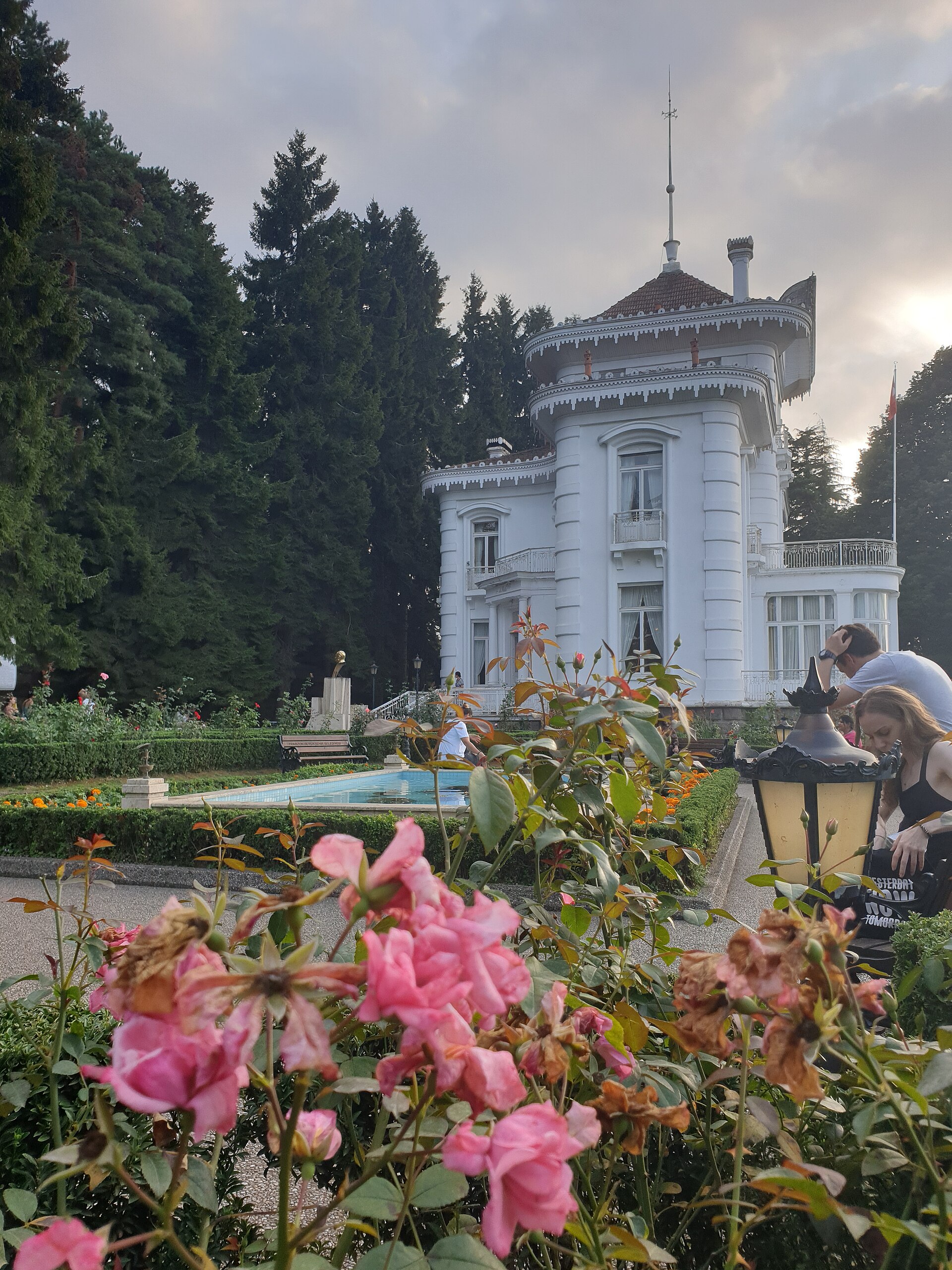
Atatürk Köşkü (Atatürk Pavilion) is a historic villa on the Soğuksu ridge above Trabzon, on Türkiye’s Black Sea coast. Built as a summer house, it hosted Mustafa Kemal Atatürk on visits in 1924, 1930 and 1937 and became a museum in 1943. Visit it for the architecture, the garden setting and the city views.
Key facts
- Location: Soğuksu, Ata Cad., 61040 Merkez/Trabzon
- Type: Historic villa and museum (former summer house)
- Builder: Konstantin Kabayanidis (per Culture Portal)
- Museum since: 1943
- From Trabzon Airport: Taxi or transfer into the city, then uphill to Soğuksu; check current road times
- From city centre: Short taxi or dolmuş ride uphill; check local routes
- Best season: May to September for dry spells and garden views
- Typical visit time: 1 to 1.5 hours
- UNESCO status: Not a UNESCO site
- Entrance: See official page (opening status after the 2023 reopening: check)
What is Atatürk Köşkü and why visit?
Atatürk Köşkü is a villa on the Soğuksu hillside above Trabzon that became a museum in 1943. It is worth visiting for three reasons: its European-style architecture, its link to Atatürk’s stays in the city, and the elevated setting above the Black Sea port.
The Ministry’s Culture Portal says the building was erected as a summer house by Konstantin Kabayanidis on the Soğuksu ridges that dominate Trabzon. Moreover, it records Atatürk’s stays in the house. As a result, the villa works both as an architecture stop and as a short history lesson.
In contrast to the monasteries and plateaus around Trabzon, this is a compact city sight. Therefore it fits easily into a half-day that also includes Boztepe and the old quarters.
Visitors usually come for these reasons:
- Early 20th-century villa architecture with European motifs
- Rooms linked to Atatürk’s visits to Trabzon
- A garden setting on a ridge above the city
- An easy city stop between Sümela or Uzungöl excursions
What is the history of the pavilion?
The pavilion dates from the era when wealthy Trabzon families built summer villas on the hills. The Culture Portal names Konstantin Kabayanidis as the builder, and Wikivoyage calls him a banker and dates the house to the late 19th century. However, the official sources give different construction dates, so check the museum labels on site.
Atatürk was hosted here in 1924 but did not stay. He visited again in November 1930. In June 1937 he stayed two nights, and on the night of 11 June he decided to give his property to the Turkish nation. The building was converted into a museum in 1943.
In 2023 Trabzon Metropolitan Municipality announced a reopening for 29 October 2023, the centenary of the Republic, after a year-long restoration.
The timeline below summarises the dated events from official sources.
| Year | Event |
|---|---|
| Late 19th century | Villa built for Konstantin Kabayanidis (Wikivoyage; official sources differ) |
| 1924 | Atatürk hosted at the pavilion, did not stay |
| November 1930 | Second visit, hosted at the pavilion |
| June 1937 | Two-night stay; 11 June decision to donate his property to the nation |
| 1943 | Converted into a museum |
| 29 October 2023 | Reopening announced after restoration |
What can you see at the pavilion?
The pavilion is a house museum, so you see rooms, furniture and personal memorabilia rather than a large gallery. The Culture Portal says the ground floor has a sitting room, a rest room, a dining room and a guest room. Wikivoyage adds that the house is furnished to period with his memorabilia.
The architecture shows European and Western Renaissance influences, with showy European motifs, according to the Culture Portal. Therefore the facade and the interior details deserve as much attention as the displays.
Plan to look at these features:
- The exterior facade and decorative motifs
- The ground-floor sitting, dining and guest rooms
- Period furniture and memorabilia on display
- The garden and the views toward Trabzon and the sea
The table lists the main highlights at a glance.
| Highlight | What to look for | Time needed |
|---|---|---|
| Facade | European and Renaissance-style motifs | 10 minutes |
| Ground floor rooms | Sitting, rest, dining and guest rooms | 25-30 minutes |
| Memorabilia | Period furnishings and personal items | 15-20 minutes |
| Garden and view | Ridge setting above the city | 15 minutes |
How do you get to Atatürk Köşkü?
The pavilion is in the Soğuksu district, uphill from the centre of Trabzon. A taxi is the simplest way, and city minibuses (dolmuş) serve many hill neighbourhoods. Ask your hotel for the current route. Allow extra time on busy summer days.
Trabzon Airport has frequent domestic flights, and Wikivoyage lists hourly connections from Istanbul (IST and SAW). Buses from Istanbul take about 18 hours, and the Otogar is 3 km east of the centre. Moreover, our airport guide covers transfer options.
Typical ways to reach the pavilion are shown below; always check current timetables.
| From | Option | Notes |
|---|---|---|
| Trabzon Airport | Taxi or private transfer to Soğuksu | Check current road conditions and fares |
| Istanbul | Flight to Trabzon, hourly per Wikivoyage | Check current timetable |
| Istanbul | Intercity bus, about 18 hours (Wikivoyage) | Otogar is 3 km east of centre |
| City centre | Taxi or dolmuş uphill | Ask the driver for Atatürk Köşkü |
When is the best time to visit?
The best time is late spring to early autumn, when the garden is open to walking and rain is less likely to spoil the views. Wikivoyage describes summer as warm and humid with frequent light showers, and spring as dry and mild.
However, Trabzon is a wet city, so bring a light rain layer in any season. Winter visits are possible, but the garden views are less pleasant.
The table gives a season-by-season guide.
| Season | Weather | Crowds | Notes |
|---|---|---|---|
| Spring | Dry and mild (Wikivoyage) | Moderate | Good for gardens and city walks |
| Summer | Warm, humid, light showers | Higher | Busiest season |
| Autumn | Cooler, variable | Lower | Pleasant for city sights |
| Winter | Cold and damp | Low | Check opening status before you go |
How long should you stay?
Plan one to one and a half hours inside and around the pavilion. Combine it with other city sights for a half day. A full day can add Boztepe and the old quarters, while two to three days allow Sümela Monastery and Uzungöl.
Therefore the pavilion works as a morning stop before lunch in the centre.
The table suggests itineraries by time available.
| Time | Plan |
|---|---|
| Half day | Pavilion, then Boztepe tea gardens and a harbour-side lunch |
| 1 day | Pavilion, Boztepe, old Trabzon quarters, local fish dinner |
| 2-3 days | Add Sümela Monastery, Uzungöl, and a plateau trip to Hıdırnebi |
What practical tips should you know?
Check the official source for opening hours and ticket rules, because we have not verified them after the 2023 reopening. Dress modestly, as this is a memorial-style museum. Wear shoes that grip, because the approach is on a slope.
Photography rules vary inside museums, so ask staff before you shoot. Accessibility on the ridge and inside an older villa can be limited, so ask the museum in advance if you need step-free access.
Keep these tips in mind:
- Fees and hours: see the official page or ask the Trabzon museum directorate
- Wear comfortable shoes for the sloping approach
- Carry a light rain layer
- Respect staff instructions and keep voices low in the rooms
- Keep valuables close in crowded summer periods
Where should you stay and eat?
Most visitors stay in the city centre around Atatürk Square or near the port, then take a short ride to Soğuksu. Wikivoyage notes that the cheapest hotels lie down from Atatürk Square toward the port. Boztepe and the coast road offer quieter views.
For food, try the Black Sea staples that Wikivoyage lists: hamsi (fried anchovies) and dairy dishes such as kuymak (muhlama). Tea gardens on Boztepe are a relaxed place for a break.
Good neighbourhood choices include:
- Atatürk Square area for transport and restaurants
- The port side for budget stays
- Boztepe for views and tea gardens
- Soğuksu for a quiet, residential feel
What else is nearby?
Trabzon packs several sights into a small area. Boztepe, the Soğuksu hills and the old quarters are all close. Farther out, the Sümela Monastery and Uzungöl lake, as well as plateaus such as Hıdırnebi, make good day trips.
As a result, many travellers use Trabzon as a base for two or three days.
Nearby places on our site are listed below.
| Place | Why go |
|---|---|
| Sümela Monastery | Cliff-side monastery in Maçka |
| Uzungöl Lake | Mountain lake and village |
| Hıdırnebi Plateau | Highland views and festival in July |
| Boztepe | Hill with tea gardens above the city |
Plan this with TurkGT
TurkGT offers guided tours, private transfers, licensed guides and interpreter support across Türkiye. Tell us your dates and group size, and we will suggest a plan and confirm the details with you by WhatsApp. Check our Trabzon and Black Sea pages for related trips.
Frequently asked questions
Where is Atatürk Köşkü in Trabzon?
On the Soğuksu ridge above the city, at Soğuksu, Ata Cad., 61040 Merkez/Trabzon, according to the Culture Portal.
Did Atatürk stay at the Trabzon pavilion?
He was hosted there in 1924 but did not stay. In June 1937 he stayed two nights, says the Culture Portal.
When did it become a museum?
The Culture Portal says it was converted into a museum and opened in 1943.
Was the pavilion restored?
Trabzon Metropolitan Municipality announced a reopening on 29 October 2023 after a year-long restoration. Check the current status.
How much time do I need?
Allow one to one and a half hours for the house and garden, longer if you add Boztepe.
How do I get there from Trabzon Airport?
Take a taxi or private transfer into the city and up to Soğuksu. See our Trabzon airport transfer guide.
Is it a UNESCO site?
No. It is a museum building, not a World Heritage property.
What is the entrance fee?
Check the official museum or municipality page for current fees and hours.
Related on TurkGT
Sources
- Atatürk Köşkü – Türkiye Kültür Portalı
- Atatürk Köşkü 29 Ekim’de açılıyor – Trabzon Büyükşehir Belediyesi
- Trabzon – Wikivoyage
Last reviewed: 2026-11-18. Opening hours, ticket prices and other changeable details are not listed because they change; check the official source before you travel.