
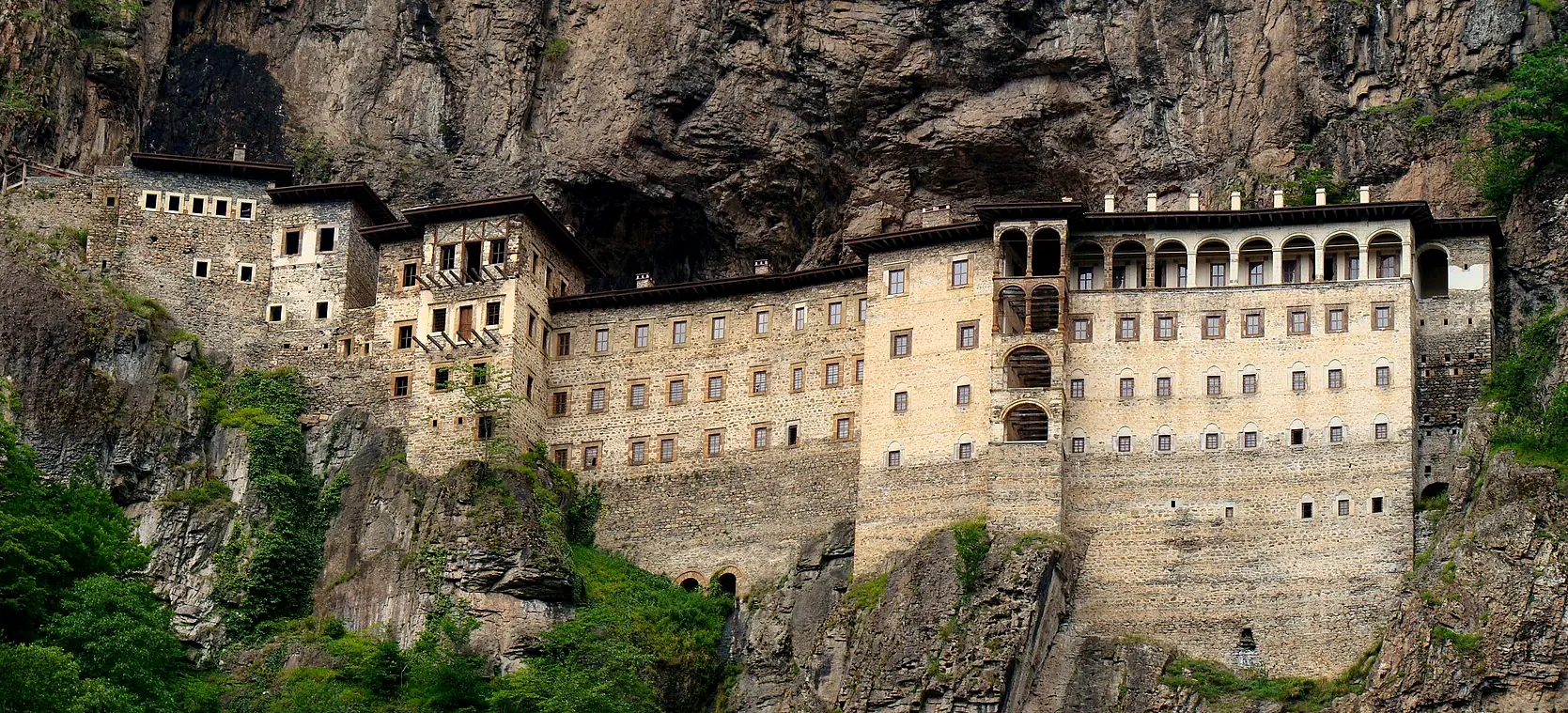
Sümela Monastery is an Orthodox monastery built into a cliff in the Altındere Valley, in the Maçka district of Trabzon, and dedicated to the Virgin Mary. Tradition dates its first foundations to the late 4th century. The Culture Portal says it has existed in its present form since the 13th century, and it has been on UNESCO’s Tentative List since 2000.
Key facts
- Location: Altındere Valley, Maçka, Trabzon
- Distance from airports and cities: 47 km from Trabzon, 17 km from Maçka (Culture Portal); Trabzon Airport is the usual arrival point
- Dedication: The Virgin Mary
- Elevation: About 1,200 m, set in a steep cliff (Wikipedia)
- Forest walk: 300 metres
- In present form since: 13th century (Culture Portal)
- Evacuated: 1923
- UNESCO status: Tentative List since 2000; not inscribed as a World Heritage Site
- Best season: Spring to autumn; the national park is busiest early April to late October
- Typical visit time: Half a day from Trabzon
- Entrance: See official page (muze.gov.tr)
What is Sümela Monastery and why visit?
Sümela is a historic Orthodox monastery dedicated to the Virgin Mary, set in a steep cliff in the Altındere Valley in Maçka, Trabzon. Visitors come for the dramatic cliff setting, the rock church frescoes and the forest approach. Wikivoyage calls it a spectacular monastery hewn into a cliff.
The complex lies 47 km from Trabzon, so it suits a half-day trip. Moreover, it pairs well with Uzungöl for a two-stop Trabzon outing.
What is the history of Sümela Monastery?
The museum directory records the belief that Barnabas and Sophronios, two priests from Athens, laid the first foundations under Emperor Theodosius I (375-395). The Culture Portal is more cautious and says the monastery in its present form has existed since the 13th century. Wikipedia states that it is not known when the monastery was founded.
The Komnenos ruler Alexios III (1349-1390) is identified as the main figure behind its establishment. The 19th century was its heyday, with new buildings. It was evacuated in 1923 after the Turkey-Greece population exchange, and its icons were taken to the Benaki Museum in Athens. Sümela was a significant pilgrimage place for the Black Sea Greeks.
The dates below summarise the sourced timeline.
- 375-395: reign of Theodosius I, linked by tradition to the first foundations.
- 13th century: monastery known in its present form (Culture Portal).
- 1349-1390: reign of Alexios III of Trabzon, linked to its establishment.
- 19th century: new buildings and its heyday.
- 1923: evacuation after the population exchange.
- September 2015: restoration begins, lasting 3.5 years.
- 2000: added to the UNESCO Tentative List.
What is there to see? Highlights at a glance
The complex includes the main rock church, several chapels, a kitchen, student rooms, a guest house, a library and a sacred spring (ayazma). Frescoes cover the rock church and the adjoining chapel. Wikipedia says their main subject is biblical scenes of Jesus and the Virgin Mary, and that they are seriously damaged by vandalism.
Therefore expect weathered walls rather than fully intact interiors.
Look out for these features.
- The main rock church with Alexios III-era frescoes.
- The chapel with early 18th-century frescoes.
- The sacred spring (ayazma).
- Guest house, library, kitchen and student rooms.
- The cliff and valley view.
The table lists the main elements and their dates.
| Element | Description | Date or note |
|---|---|---|
| Rock church | Main church, frescoes | Reign of Alexios III |
| Chapel | Adjoining chapel with frescoes | Early 18th century frescoes |
| Ayazma | Sacred spring | Part of the complex |
| Service buildings | Kitchen, student rooms, guest house, library | Expanded in the 19th century |
How do you get there and get around?
Sümela is 47 km from Trabzon and 17 km from Maçka, according to the Culture Portal. Wikivoyage says to take a minibus shuttle from the parking lot up to the site, and that you pay for both. A 300-metre forest walk leads to the monastery. Check current timetables, access and shuttle rules before travelling.
The usual starting point is Trabzon Airport or the city. See our airport transfer guide for options.
The table compares ways to reach the monastery.
| Option | How it works | Notes |
|---|---|---|
| Private transfer or guide | From Trabzon or the airport to the parking area | Flexible; can combine with Uzungöl |
| Dolmuş and minibus | Public minibuses toward Maçka and the valley | Check current routes and timetable |
| Rental car | Drive to the parking lot | Check current access; mountain road |
| Shuttle and walk | Minibus from the parking lot, then a 300 m forest walk | Per Wikivoyage and the Culture Portal |
When is the best time to visit?
The Altındere Valley National Park is busiest from early April to late October, according to the Culture Portal. Wikivoyage says spring is dry and mild, summer warm and humid with showers, and autumn is the wettest season. Therefore late spring and early autumn are often comfortable, but rain gear is wise.
Check current access and safety notices before you go, because we have not verified them.
This table outlines each season.
| Season | Weather (Trabzon area) | Crowds | Notes |
|---|---|---|---|
| Spring | Dry and mild | Moderate | Busy period starts in April |
| Summer | Warm, humid, light showers | High | Go early to avoid tour groups |
| Autumn | Wettest season | Moderate | Bring rain layers |
| Winter | Cool and damp | Low | Check access before travelling |
How long should you stay?
Plan about half a day from Trabzon, including travel, the shuttle and the walk. A full day adds Uzungöl. These are planning suggestions, not official figures.
In contrast, a rushed stop leaves little time for the frescoes and the view.
The table suggests three plans.
| Plan | What it covers | Fits who |
|---|---|---|
| Half day | Sümela only, from Trabzon | Limited time |
| 1 day | Sümela and the Altındere Valley or Uzungöl | Day-trippers |
| 2-3 days | Trabzon city, Sümela, Uzungöl and highlands | Slow travellers |
What are the practical tips?
Wear sturdy, non-slip shoes for stairs and the forest walk. Bring layers and a rain jacket. The monastery is a religious heritage site, so dress modestly and keep voices low. Photography rules may apply inside, so follow signs.
Check the official museum page for tickets and opening hours, since we have not verified them.
These tips cover the common questions.
- Tickets and fees: see the official page muze.gov.tr.
- Dress: modest, layered clothing.
- Accessibility: stairs and a forest walk; confirm access for your needs.
- Safety: follow site notices, especially after rain.
- Etiquette: do not touch frescoes or add graffiti.
Where should you stay and eat?
Trabzon city is the usual base, with hotels and restaurants around the centre. Maçka offers simpler options near the valley. Try Black Sea foods such as fried hamsi, kuymak or muhlama.
Wikivoyage describes hamsi as a staple, typically fried and eaten whole.
What is nearby, and which day trips fit?
Uzungöl is the most common pairing. Within Trabzon, Atatürk Pavilion, Hıdırnebi Plateau and Sera Lake are other options. Rize and its highlands lie further east.
Plan the day around driving time, since mountain roads are slower.
These places pair well with Sümela.
- Uzungöl Lake.
- Altındere Valley National Park.
- Atatürk Pavilion.
- Hıdırnebi Plateau.
- Sera Lake.
Plan this with TurkGT
TurkGT is an Istanbul-based travel company. We arrange private transfers from Trabzon Airport or the city, guided day trips to Sümela and Uzungöl, licensed guides and interpreter support on request. Details, availability and arrangements are confirmed by WhatsApp before you book, and we do not quote prices on this page.
Frequently asked questions
Where is Sümela Monastery?
In the Altındere Valley, Maçka district, Trabzon, 47 km from Trabzon and 17 km from Maçka.
Who built Sümela Monastery?
Tradition names Barnabas and Sophronios under Theodosius I; the Culture Portal says only that it existed in its present form from the 13th century.
Is it a UNESCO World Heritage Site?
No. It has been on the UNESCO Tentative List since 2000.
When was it abandoned?
It was evacuated in 1923 after the Turkey-Greece population exchange.
Was it restored?
Yes. Restoration began in September 2015 and lasted 3.5 years. Reopening dates vary by source.
How do I get there?
By private transfer, minibus or car to the parking area, then a shuttle and a 300 m forest walk. Check current timetables.
When is the best time to visit?
Spring to autumn; the valley is busiest early April to late October.
Where do I check tickets and hours?
On the official museums portal, muze.gov.tr. We do not quote fees or hours.
Related on TurkGT
- Part of Trabzon
- Sümela / Maçka
- Uzungöl Lake
- Uzungöl
- Atatürk Pavilion (Atatürk Köşkü)
- Hıdırnebi Plateau
- Sera Lake
Sources
- Sümela Monastery: A Sacred Marvel Carved Into the Cliffs – GoTürkiye
- Sümela Manastırı – Türkiye Kültür Portalı
- Sümela Monastery – Ministry museums directory (muze.gov.tr)
- Altındere Milli Parkı – Türkiye Kültür Portalı
- Sümela Monastery – Wikipedia
- Trabzon – Wikivoyage
Last reviewed: 2026-11-18. Opening hours, ticket prices and other changeable details are not listed because they change; check the official source before you travel.