
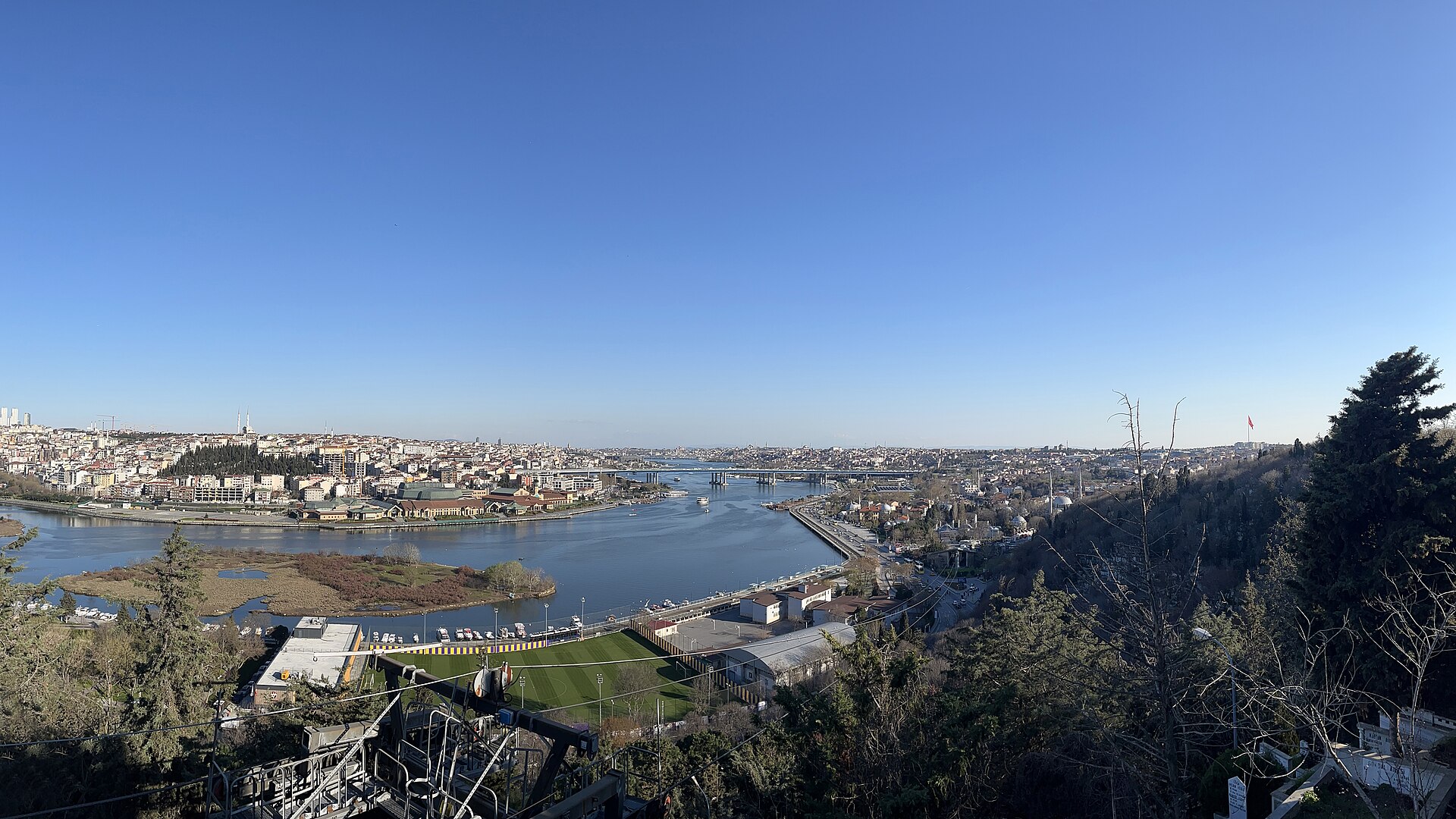
Pierre Loti Hill is a viewpoint in Istanbul’s Eyüp district with wide views over the Golden Horn. It is named after the French writer Pierre Loti. Visitors walk up past the cemeteries beside Eyüp Sultan Mosque or ride the Eyüp-Piyerloti cable car, opened in 2005.
Key facts
- Location: Eyüp district, above the Golden Horn, Istanbul
- Distance from airports and cities: Inner city, on the Golden Horn; far from both airports, so plan a transfer or public transport
- Named after: The French writer Pierre Loti
- Best known for: Golden Horn views and the Pierre Loti Café
- On foot: Steps behind the cemeteries next to Eyüp Sultan Mosque
- Cable car: Eyüp-Piyerloti line (TF2), 420 m, opened 30 November 2005
- Historic structures: Kaşgari Lodge, Çolak Hasan Lodge, Ottoman primary school, wishing well
- Best season: Spring and autumn for walking; see the season table
- Typical visit time: Two to three hours, including Eyüp Sultan Mosque
- UNESCO status: None for the hill itself
- Entrance: Open public ground; cable car fare and café prices: see official pages
What is Pierre Loti Hill and why visit?
Pierre Loti Hill is a hilltop viewpoint in Eyüp, above the Golden Horn. The Istanbul Metropolitan Municipality describes it as the spot where the Golden Horn scenery unfolds. You visit for the panorama, the old cemeteries, the wooden lodges and the short link to Eyüp Sultan Mosque.
The hill suits travellers who want a calmer, more local corner of Istanbul. Moreover, it combines easily with Eyüp’s religious sights and a Bosphorus or Golden Horn outing.
Why is it called Pierre Loti? Background and history
The hill is named after the French writer Pierre Loti. According to the Municipality, the café at the top was known as Rabia Kadın Coffeehouse until the end of the 19th century. Loti, who saw Turkey as his second nation, was a frequent visitor, and the place has been called Pierre Loti since.
Local accounts say he wrote his novel Aziyade there. However, this is a story told locally, not a documented fact. Eyüp itself is older. Wikipedia notes a settlement there already in the Byzantine period, known as Kosmidion, and the district is historically important for Turkish Muslims because of the tomb of Abu Ayyub al-Ansari.
These dates and names anchor the story.
- Byzantine era: a settlement known as Kosmidion stands at modern Eyüp.
- End of the 19th century: the café is still called Rabia Kadın Coffeehouse.
- 1997: the Municipality starts a project to build wooden mansions on the hill.
- 30 November 2005: the Eyüp-Piyerloti cable car opens.
What is there to see? Highlights at a glance
The main attraction is the Golden Horn panorama from the terrace. Behind it you will find historic wooden structures and old cemeteries. Therefore even a short visit offers views, history and atmosphere together.
The Municipality lists the wooden Kaşgari Lodge, the Çolak Hasan Lodge, an Ottoman primary school and the Wishing Well. A historic cistern, probably Byzantine, lies nearby.
These are the stops worth a look.
- Golden Horn viewing terrace.
- Kaşgari Lodge and Çolak Hasan Lodge.
- The Ottoman primary school (Sıbyan Mektebi).
- The Wishing Well.
- The cemeteries on the climb up from Eyüp.
The table below lists the main features and what each offers.
| Feature | What it is | Why it matters |
|---|---|---|
| Viewpoint | Terrace above the Golden Horn | Panorama over the inlet and old city |
| Pierre Loti Café | Hilltop café, formerly Rabia Kadın Coffeehouse | Namesake of the hill |
| Lodges | Kaşgari and Çolak Hasan lodges | Examples of local wooden and religious architecture |
| Wooden mansions | Built under a 1997 municipal project | Show the hill’s restored character |
| Cemeteries | Eyüp Cemetery along the climb | Part of the district’s historic role |
How do you get there and get around?
There are two ways up. You can climb steps behind the cemeteries beside Eyüp Sultan Mosque, or ride the Eyüp-Piyerloti cable car, line TF2. Wikipedia says the line is 420 m long and the upper station is in front of the Pierre Loti Café. The fare is paid with the Istanbulkart.
To reach Eyüp itself, use buses or Golden Horn ferries, or a taxi. Check current timetables and the cable car’s operating status before travelling, as they can change.
The table compares the options for the final ascent.
| Option | What it involves | Notes |
|---|---|---|
| Cable car TF2 | 420 m line from Eyüp shore to the café | Pay with Istanbulkart; check operating status |
| On foot | Steps behind the cemeteries next to Eyüp Sultan Mosque | Uphill; good shoes advised |
| Taxi or transfer to Eyüp | Drop near Eyüp Sultan Mosque, then cable car or steps | Handy from Sultanahmet or Taksim; traffic varies |
| Golden Horn ferry or bus | Public transport to Eyüp | Check current routes and timetable |
When is the best time to visit?
Clear days give the best views, and spring and autumn give the most comfortable walking. Summer evenings can be busy at the café. Winter brings mist and rain, which can hide the view. Check the weather and cable car status on the day.
Therefore flexible travellers should pick a clear-weather window, ideally on a weekday.
The table sets out what each season offers.
| Season | Weather | Crowds | Notes |
|---|---|---|---|
| Spring | Mild, changeable | Moderate | Good for the climb and clear views |
| Summer | Warm to hot | High at sunset | Go earlier or later in the day |
| Autumn | Mild, cooling | Moderate | Comfortable for walking in Eyüp |
| Winter | Cool, damp | Low | Views may be limited by cloud; dress warmly |
How long should you stay?
A focused visit takes about two to three hours when combined with Eyüp Sultan Mosque. A half day lets you walk up, rest at the terrace and ride down. These are planning suggestions, not official figures.
In contrast, a one-day plan can add a Golden Horn ferry or a Bosphorus cruise.
The table lists three practical itineraries.
| Plan | What it covers | Fits who |
|---|---|---|
| Half day | Eyüp Sultan Mosque, cemeteries, hill and view | Short stays |
| 1 day | Add the Golden Horn shore and Fener-Balat | Photographers and walkers |
| 2-3 days | Combine with the Bosphorus, Galata and Sultanahmet | Relaxed city breaks |
What are the practical tips?
Dress modestly around Eyüp Sultan Mosque and the cemeteries, and remove shoes if you enter the mosque. The steps are steep in places, so wear sturdy shoes. Photography is welcome on the terrace, but be discreet near graves and worshippers.
Check cable car fares and timetables on the official operator page. Café prices and opening hours are not verified here.
These tips help you plan comfortably.
- Dress: modest clothing near the mosque and cemeteries.
- Accessibility: the steps are steep; the cable car is easier, so confirm current access.
- Safety: keep valuables close in crowds.
- Photography: great from the terrace; be respectful near graves.
- Etiquette: lower your voice in the cemeteries and do not walk over graves.
Where should you stay and eat?
Eyüp itself has traditional cafés and simple restaurants near the mosque. For lodging, most visitors stay in Sultanahmet, Beyoğlu or Karaköy and travel to Eyüp for the day. Try Turkish tea, simple kebabs and desserts near the shore.
Fener and Balat on the Golden Horn offer cafés for a break on the way back.
What is nearby, and which day trips fit?
Eyüp Sultan Mosque lies at the foot of the hill. Fener and Balat are further along the Golden Horn. Galata and Sultanahmet are the next common stops, and Ortaköy and Emirgan Park suit a Bosphorus day.
For wider outings, the Princes’ Islands and Şile are possible day trips.
These nearby places pair well with the hill.
- Eyüp Sultan Mosque and the cemeteries.
- Galata Tower and Galata district.
- Ortaköy Mosque on the Bosphorus.
- Emirgan Park.
- Sultanahmet’s major monuments.
Plan this with TurkGT
TurkGT is an Istanbul-based travel company. We offer guided tours and private transfers, including a Bosphorus Cruise With Eyup and Pierre Loti Hill Half Day and an Islamic Istanbul Tour covering Eyup Sultan, Fatih and Suleymaniye. Licensed guides and interpreter support can be arranged. Details, availability and arrangements are confirmed by WhatsApp before you book, and we do not quote prices on this page.
Frequently asked questions
Why is it called Pierre Loti Hill?
It is named after the French writer Pierre Loti, said to have visited the hilltop coffeehouse often.
Did Pierre Loti write Aziyade there?
Local accounts say so, but this is a local story, not a documented fact.
How do you get to Pierre Loti Hill?
On foot by steps behind the cemeteries beside Eyüp Sultan Mosque, or by the Eyüp-Piyerloti cable car (TF2).
When did the cable car open?
On 30 November 2005. The line is 420 metres long.
What can you see from the hill?
Views over the Golden Horn, plus historic lodges, a school and the Wishing Well.
How do I pay for the cable car?
With the Istanbulkart, according to Wikipedia. Check current fares on the official operator page.
Is it suitable for photography?
Yes, the terrace is popular for views. Be respectful near cemeteries.
Which district is it in?
Eyüp, on the Golden Horn.
Related on TurkGT
Sources
- Pierre Loti – Istanbul Metropolitan Municipality (Istanbulu Seyret)
- Eyüp Gondola – Wikipedia
- Eyüp – Wikipedia
Last reviewed: 2026-11-18. Opening hours, ticket prices and other changeable details are not listed because they change; check the official source before you travel.