
Sultanahmet is the historic core of Istanbul, a neighbourhood of the Fatih district on the European side, named after Sultan Ahmed. The Blue Mosque faces Hagia Sophia across a park, beside the former Byzantine Hippodrome, and Topkapı Palace is a short walk away. These monuments belong to the UNESCO-listed Historic Areas of Istanbul, inscribed in 1985.
Key facts
- Location: Fatih district, Istanbul; the tip of the historic peninsula between the Golden Horn and the Sea of Marmara
- Distance from airports: Istanbul Airport is about 50 km away; Wikivoyage gives about 50 minutes by taxi and about 90 minutes by the Havaist bus to Aksaray, then tram (check current timetable)
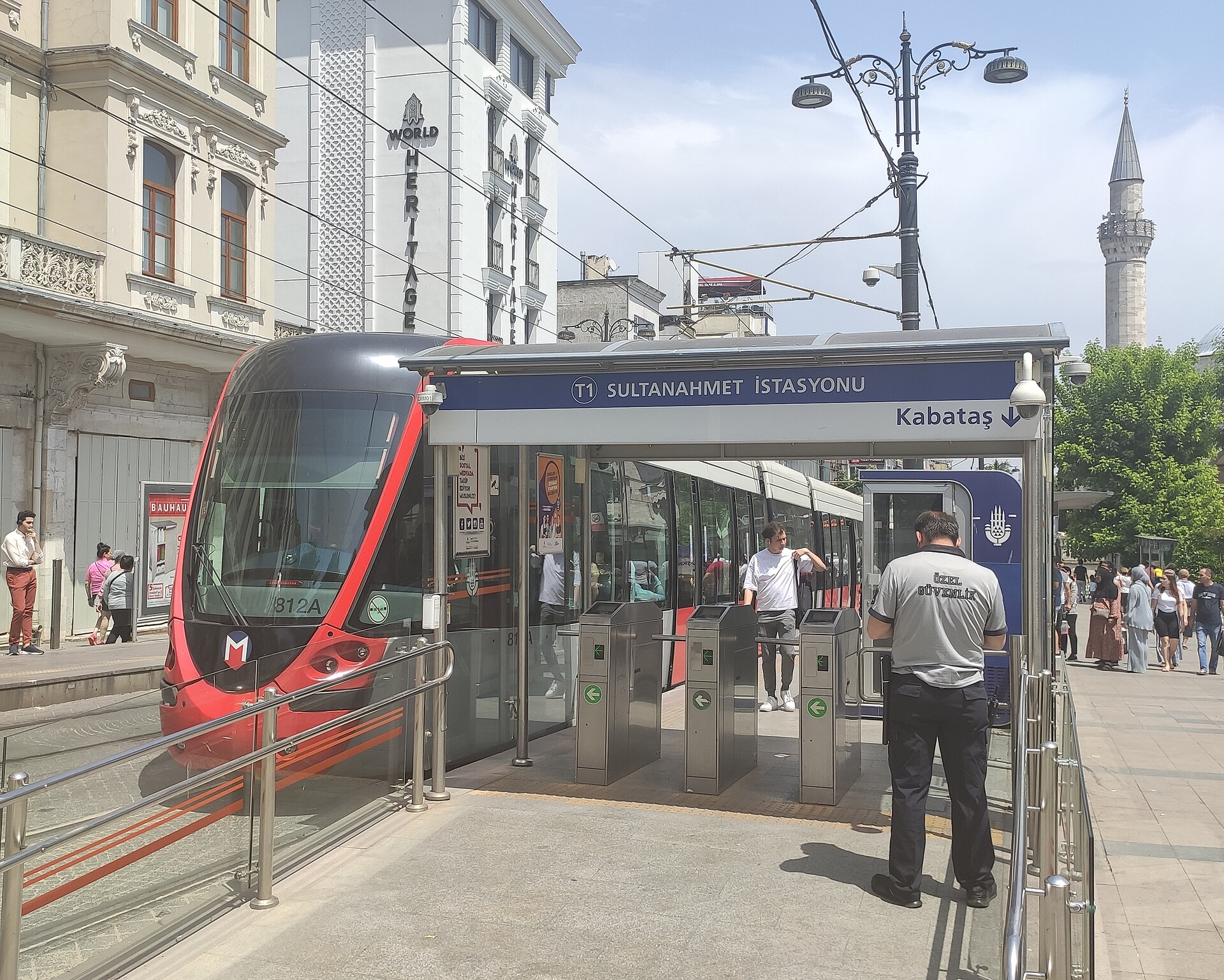
- Nearest tram stop: Sultanahmet on the T1 tram line
- Main landmarks: Sultan Ahmed (Blue) Mosque, Hagia Sophia, Topkapı Palace, Basilica Cistern, the Hippodrome
- Built environment: Blue Mosque built 1609-1617; Hagia Sophia 532-537; Hippodrome begun in AD 203
- UNESCO status: Historic Areas of Istanbul, inscribed 1985; criteria (i)(ii)(iii)(iv); boundary modified 2017
- Best season: Spring and autumn; the area is busy all year
- Typical visit time: One full day for the main sights; two days with museums
- Entrance: Public square and park free; mosque, museum and palace tickets: see official pages
What is Sultanahmet and why visit?
Sultanahmet is the old-city district of Istanbul where Byzantine and Ottoman monuments stand within walking distance. The Blue Mosque, Hagia Sophia, Topkapı Palace and the Basilica Cistern are all here. Visitors come to see the skyline, the history and the open square once used for chariot races.
Wikivoyage says most sights are concentrated in the old city on the peninsula of Sultanahmet. Moreover, the area works as a first-day orientation: the sights are close, the tram runs through it, and a guide can link them in a logical order. In contrast, other districts need more transport.
The main reasons to include Sultanahmet in an Istanbul trip are these:
- Two landmark buildings facing each other: the Sultan Ahmed Mosque and Hagia Sophia.
- The Hippodrome square, with its Egyptian obelisk, Serpent Column and German Fountain.
- Topkapı Palace and the Archaeological Park at the tip of the peninsula.
- The Basilica Cistern and nearby museums.
- A walkable area with tram access and many hotels.
What is the history of Sultanahmet?
The area was the centre of Byzantine Constantinople and later of Ottoman Istanbul. A hippodrome was first built here in AD 203 under Septimius Severus, and Constantine enlarged it after refounding the city in AD 324. Justinian built the third Hagia Sophia after the Nika riots of 532.
The Ottomans added Topkapı Palace, which UNESCO says was continually extended until the 19th century. Ahmed I built the Sultan Ahmed Mosque between 1609 and 1617. As a result, the district layers Roman, Byzantine and Ottoman history in a few hundred metres.
The table below sets the main dates in order.
| Date | Event |
|---|---|
| AD 203 | Septimius Severus rebuilds the city and expands the Hippodrome (Wikipedia) |
| AD 324 | Constantine refounds Byzantium as Nova Roma (Wikipedia) |
| 532 | Nika riots destroy the earlier Hagia Sophia (Wikipedia) |
| 532-537 | Hagia Sophia designed by Anthemios of Tralles and Isidoros of Miletus (UNESCO) |
| 1204 | Horses of the Hippodrome looted in the Fourth Crusade (Wikipedia) |
| 1609-1617 | Sultan Ahmed Mosque built under Ahmed I |
| 1985 | Historic Areas of Istanbul inscribed on the World Heritage List (UNESCO) |
| 2017 | UNESCO boundary modification |
What is there to see in Sultanahmet?
The main sights are the Sultan Ahmed Mosque, Hagia Sophia, Topkapı Palace, the Basilica Cistern and the Hippodrome. Wikivoyage says Hagia Sophia and Topkapı together should take at least three to five hours. Therefore plan the big monuments for the morning and keep the afternoon light.
The Sultan Ahmed Mosque has a central dome, four semi-domes, a large courtyard and six minarets. Its interior carries thousands of İznik tiles in mostly blue tones. Moreover, the külliye includes the tomb of Ahmed I and a madrasa.
Look for these features during your visit:
- The Blue Mosque’s six minarets, courtyard and blue tile interior.
- Hagia Sophia’s vast dome, which UNESCO links to the architecture of the 6th century.
- The Hippodrome’s monuments: the Egyptian obelisk, the Serpent Column and the Walled Obelisk.
- The German Fountain on Sultanahmet Square.
- Topkapı Palace and the grounds of Gülhane Park.
- The Basilica Cistern, built by the Romans.
This at-a-glance table summarises what to see and how long to allow.
| Highlight | What it is | Suggested time |
|---|---|---|
| Sultan Ahmed Mosque | Ottoman mosque of 1609-1617 | 45-60 minutes |
| Hagia Sophia | Byzantine dome of 532-537 | 1-1.5 hours |
| Topkapı Palace | Ottoman palace, extended to the 19th century | 2-3 hours |
| Hippodrome square | Former chariot track with monuments | 30 minutes |
| Basilica Cistern | Roman underground water store | 45 minutes |
| Islamic art museum | Museum along the side of the Hippodrome (Wikivoyage) | 1 hour |
What is the Hippodrome and what remains?
The Hippodrome was the sporting and social centre of Constantinople. Sources estimate it was about 450 m long and 130 m wide, with stands for around 100,000 spectators. Today the site is Sultanahmet Square, also called At Meydanı, meaning Horse Square.
Wikipedia says the old track lies about 2 m below the present surface, and paving shows its outline. The surviving monuments of the Spina, the two obelisks and the Serpent Column, still stand. The bronze horses were looted in 1204 and now stand at St Mark’s Basilica in Venice.
The table lists the main Hippodrome features visible today.
| Feature | What it is | Note |
|---|---|---|
| Sultanahmet Square | Open square on the former track | Free to walk |
| Egyptian obelisk | Monument from the Spina | Stands in the square |
| Serpent Column | Bronze column from the Spina | Stands in the square |
| Walled Obelisk | Monument from the Spina | Stands in the square |
| German Fountain | Ornate fountain on the square | Look for it near the obelisks |
Is Sultanahmet part of a UNESCO World Heritage Site?
Yes. Sultanahmet belongs to the Historic Areas of Istanbul, inscribed in 1985 under criteria (i), (ii), (iii) and (iv). UNESCO lists a property of 765.5 ha with a minor boundary modification in 2017. Four areas make up the site, including the Archaeological Park at the tip of the peninsula.
The Archaeological Park covers Sultanahmet’s core. The other three areas are the Süleymaniye quarter, the Zeyrek area and the Theodosian land walls. Therefore UNESCO recognition covers more than one district, and a full visit can include them.
The table summarises the UNESCO listing for context.
| Item | Detail |
|---|---|
| Property | Historic Areas of Istanbul |
| Inscribed | 1985; minor boundary modification 2017 |
| Criteria | (i), (ii), (iii), (iv) |
| Size | 765.5 ha |
| Component areas | Archaeological Park, Süleymaniye quarter, Zeyrek area, Theodosian land walls |
How do you get to Sultanahmet and get around?
The tram is the easiest way in. Sultanahmet is on the T1 tram line, and Marmaray does not stop in the Old City area. From the new Istanbul Airport, Wikivoyage describes Havaist buses to Aksaray taking about 90 minutes, then a tram. A taxi takes about 50 minutes without traffic.
Check current timetables and routes before you travel. Wikivoyage says the metro to Aksaray or Zeytinburnu connects to the tram for Sultanahmet, about 30 minutes via Aksaray. Once in the district, the sights are within walking distance.
The table compares the main ways to reach Sultanahmet.
| Option | How it works | Typical time |
|---|---|---|
| Taxi or private transfer from Istanbul Airport | Direct road transfer, about 50 km | About 50 minutes, traffic permitting (Wikivoyage) |
| Havaist bus, then metro and tram | Bus to Aksaray, then tram to Sultanahmet | About 90 minutes to Aksaray plus tram; check timetable |
| Tram T1 | Runs through Sultanahmet and Eminönü | Check current timetable |
| Marmaray | Does not stop in the Old City (Wikivoyage); change to tram | Check current timetable |
| Walking | From Hagia Sophia to the mosque and Hippodrome | 5-10 minutes between sights |
When is the best time to visit Sultanahmet?
Spring and autumn are the most comfortable seasons, with mild weather and long days. Wikivoyage notes that tulips bloom in late April in Sultanahmet Park and Gülhane Park. Summer is hot and crowded, and winter is cooler and quieter. Early morning is the quietest time in every season.
Because the area is popular all year, arrive early for the mosque and palace, and book guided entries in advance where possible. Prayer times can close the Blue Mosque to visitors, so check the official page.
The table shows what to expect by season.
| Season | Weather | Crowds | Notes |
|---|---|---|---|
| Spring (Apr-May) | Mild, some rain | High | Tulips in late April (Wikivoyage) |
| Summer (Jun-Aug) | Hot | Highest | Start early; carry water |
| Autumn (Sep-Nov) | Mild | High | Good light; shorter queues late in the season |
| Winter (Dec-Mar) | Cool, damp | Lower | Quieter; check opening hours |
How long should you stay?
Allow one full day for the main sights and two days if you add Topkapı Palace‘s harem, the Basilica Cistern and the museums. Wikivoyage says Hagia Sophia and Topkapı alone should take at least three to five hours. Therefore a half day is only enough for an overview.
The table gives three simple plans.
These sample plans show how much time each style of trip needs.
| Plan | What you do | Best for |
|---|---|---|
| Half day | Blue Mosque exterior, Hagia Sophia and the Hippodrome square | First-time overview |
| 1 day | Add Topkapı Palace, the cistern and Gülhane Park | Most visitors |
| 2-3 days | Add the Süleymaniye quarter, Zeyrek, the Grand Bazaar and the walls | History enthusiasts |
What are the practical tips for visiting?
Dress modestly for mosques, check official pages for tickets and opening times, and watch your belongings in crowds. Sultanahmet is busy, and touts operate near major sights. Wikivoyage notes a Tourism Police office on Divan Yolu Caddesi with staff who can speak English, German, French, Arabic and Russian.
Plan the Blue Mosque around prayer times and keep a headscarf and a bag for your shoes.
These tips make the visit smoother:
- Check the official pages for fees, hours and the Museum Pass options; they change.
- Dress with covered shoulders and knees; women usually cover their hair in mosques.
- Expect to remove shoes at the mosque entrance.
- Be polite but firm with touts, and agree prices before accepting services.
- Accessibility is mixed: cobbles, steps and queues are common; ask staff about ramps.
- Photography is usually allowed outdoors; follow signs inside.
- Respect worshippers and keep your voice low at mosques.
Where should you stay and eat?
Sultanahmet is the main hotel centre for the old city. Wikivoyage says it has reasonably priced hotels, many with terraces overlooking the Golden Horn or the Sea of Marmara, plus most hostels used by independent travellers. For food, restaurants cluster near the Hippodrome and on side streets.
In contrast, Karaköy, Galata and Beyoğlu offer a livelier dinner scene across the Golden Horn. Therefore many visitors stay in Sultanahmet and eat in more than one district.
Neighbourhood-level options to consider:
- Sultanahmet itself for walking access and terrace hotels.
- Eminönü and Sirkeci for ferries, the Spice Bazaar and transport.
- Karaköy and Galata for restaurants and nightlife.
- Beyoğlu and Taksim for a modern base.
What is near Sultanahmet for day trips?
Nearby, you can visit the Grand Bazaar, the Spice Bazaar, the Süleymaniye Mosque and the Istanbul Archaeological Museums on foot or by tram. Beyoğlu and Galata lie across the Golden Horn. Longer trips include the Bosphorus, the Princes’ Islands and Bursa.
Wikivoyage describes a classic Bosphorus cruise from the Eminönü terminal. Moreover, the Old City works well with a Bosphorus cruise on the second day.
Good additions to a Sultanahmet visit:
- Hagia Sophia and the Blue Mosque pages in this guide.
- Topkapı Palace and the Istanbul Archaeological Museums.
- Grand Bazaar and Spice Bazaar.
- Galata Tower and Beyoğlu across the Golden Horn.
- A Bosphorus cruise from Eminönü.
The table lists nearby places and how they relate to Sultanahmet.
| Place | Relation to Sultanahmet | Note |
|---|---|---|
| Hagia Sophia | Opposite the Blue Mosque | Byzantine dome of 532-537 |
| Topkapı Palace | Short walk north-east | Ottoman palace |
| Grand Bazaar | Short tram ride or walk | Covered market |
| Spice Bazaar | Near Eminönü | Reached by tram |
| Galata Tower | Across the Golden Horn | Views over the Old City |
Plan this with TurkGT
TurkGT is an Istanbul-based travel company. We offer guided tours, private transfers, licensed guide and interpreter services, and multi-day trips that can include Sultanahmet and the Old City. We can guide you through Sultanahmet, including the Hippodrome, Hagia Sophia, the Blue Mosque, the Basilica Cistern and Topkapı Palace, as in our Sultanahmet Walking Tour: Hippodrome, Hagia Sophia, Blue Mosque. We can also arrange the airport transfer.
Tell us your dates, group size and interests on WhatsApp. We confirm the route, timing and what is included in writing before you book, and we do not quote prices on this page.
Frequently asked questions
Where is Sultanahmet in Istanbul?
Sultanahmet is a neighbourhood in the Fatih district, on the historic peninsula of the European side.
Why is the Sultan Ahmed Mosque called the Blue Mosque?
Its interior is decorated with thousands of İznik tiles and painted floral motifs in mostly blue colours, which gave rise to the popular name.
Is Sultanahmet a UNESCO site?
Yes. It is part of the Historic Areas of Istanbul, inscribed in 1985 under criteria (i), (ii), (iii) and (iv).
What was the Hippodrome?
The Hippodrome was Constantinople’s chariot-racing arena, begun in AD 203 and enlarged by Constantine. Today it is Sultanahmet Square.
How do I get from the airport to Sultanahmet?
By taxi or private transfer in about 50 minutes without heavy traffic, or by Havaist bus to Aksaray and then tram. Check current timetables.
How long do I need in Sultanahmet?
One full day for the main sights; Wikivoyage says Hagia Sophia and Topkapı alone take three to five hours.
What is the best time to visit Sultanahmet?
Spring and autumn are the most comfortable; arrive early in every season to avoid the crowds.
What should I wear in the Blue Mosque?
Dress modestly with covered shoulders and knees, remove your shoes and follow staff instructions. Women usually cover their hair.
Related on TurkGT
Sources
- Sultanahmet – Wikipedia
- Blue Mosque, Istanbul – Wikipedia
- Hippodrome of Constantinople – Wikipedia
- Historic Areas of Istanbul – Wikipedia
- Historic Areas of Istanbul – UNESCO World Heritage Centre
- Hippodrome – GoTürkiye
- Istanbul – Wikivoyage
Last reviewed: 2026-11-18. Opening hours, ticket prices and other changeable details are not listed because they change; check the official source before you travel.