
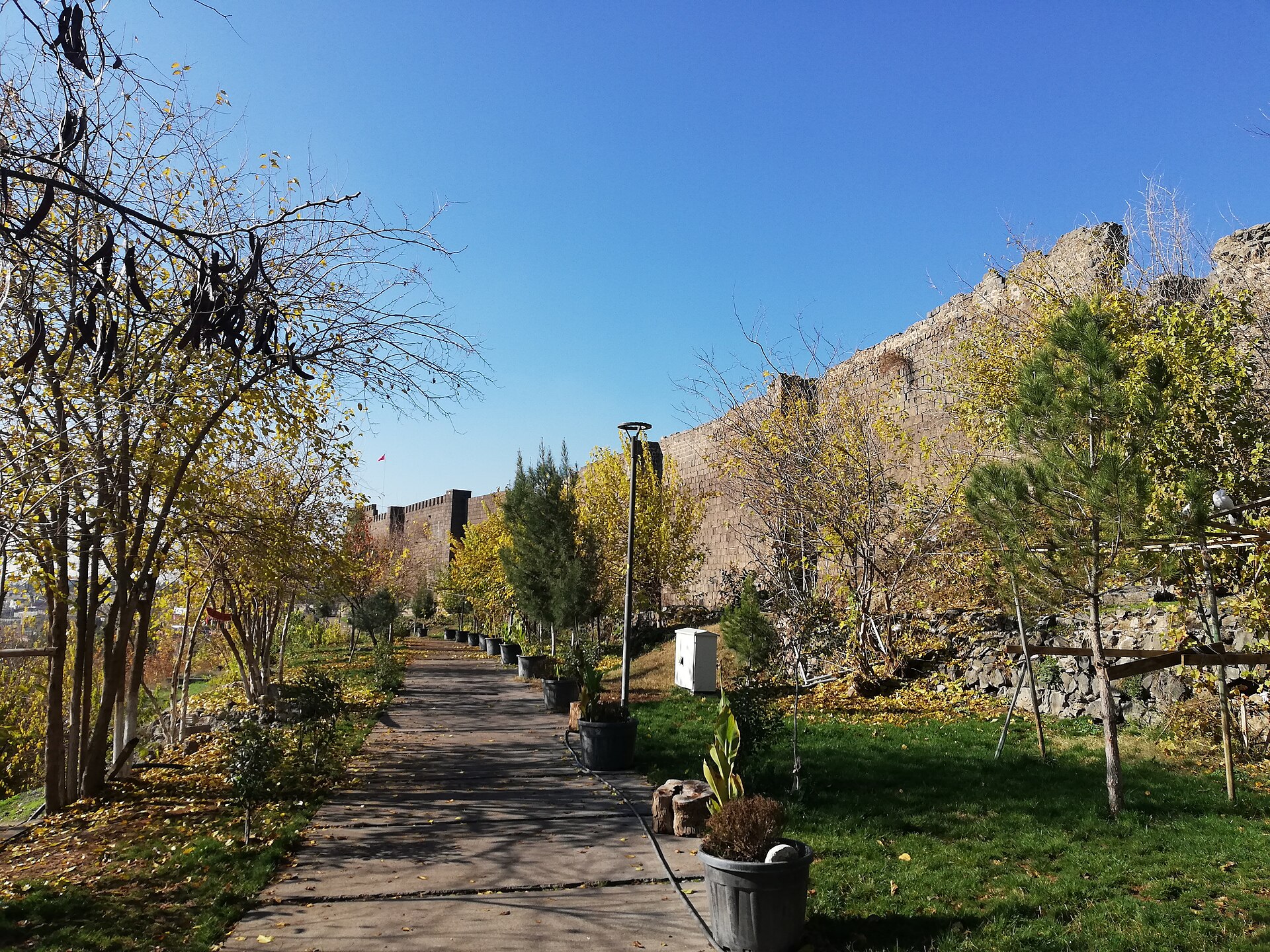
Diyarbakır is the largest city in Southeastern Anatolia and capital of Diyarbakır Province, on a plateau above the Tigris. It is known for its black basalt city walls, which are part of a UNESCO World Heritage site inscribed in 2015, and for an old town of mosques, churches and caravanserais. Allow at least two days.
Key facts
- Location: South-east Türkiye, on a plateau above the Tigris, about 675 m above sea level
- Province: 15,101 km²; 1,804,880 residents in 2022 (Wikipedia)
- Airport: Diyarbakır Airport (DIY), about 15 km from the old town; flights from Istanbul and other cities, check current timetable
- Distances: Batman 94 km east, Mardin 90 km south, Ergani (Çayönü) 40 km north-west (Wikivoyage)
- UNESCO status: Diyarbakır Fortress and Hevsel Gardens Cultural Landscape, inscribed 2015, criterion (iv)
- Best season: Spring and autumn; summers are very hot, winters cold with snow
- Typical visit time: One full day for the old town; two to three days with day trips
- Walls: About 5.5 km circuit; a 2.5 km walk from Dağ Kapı to Mardin Gate is described by Wikivoyage
- Entrance: Mosques free; museums and churches vary: see the official page
What is Diyarbakır and why visit?
Diyarbakır is a major city on the upper Tigris, famous for its black basalt walls and for a mix of Islamic, Armenian and Syriac heritage. Visitors come for the UNESCO-listed fortress, the old Sur district, caravanserais, local food and day trips to Mardin, Hasankeyf and Zerzevan Castle.
Wikivoyage calls it the largest city in Southeastern Anatolia and describes a citadel and old town encircled by great basalt walls. Moreover, GoTürkiye links the city to ancient Mesopotamia. As a result, Diyarbakır works as a cultural base for the whole Tigris region.
In contrast to resort towns, the city is busy, hot and unvarnished. However, its walls, courtyards and breakfast culture reward visitors who allow time. Heritage here also shows scars from past conflict and from the 2023 earthquakes, so expect restoration work.
What is the history of Diyarbakır?
Diyarbakır is one of the oldest continuously inhabited cities in the region. Wikipedia says people have lived in the area since the Stone Age, and the Culture Portal says research at Çayönü pushes civilisation here back to about 7500 BC. The city was known in antiquity as Amida, with Assyrian sources recording the name Amidi.
The Romans took the city in 66 BC. Wikipedia records that Shapur II of Persia captured Amida in 359 after a 73-day siege, and that the Persians later held it for twenty-six years from 602. The Arabs conquered it in 639, after which it became known as Diyar Bakr.
Marwanid, Seljuk, Artuqid, Aq Qoyunlu and Ottoman rulers followed. Wikivoyage notes Ottoman control from 1514, and the Culture Portal says the Republic fixed the name Diyarbakır by Law 7789 on 10 December 1937.
Key periods in the story of Diyarbakır:
- About 7500 BC: early settlement in the area, shown by research at Çayönü.
- 66 BC: Rome gains control of Amida.
- 297 and 349 AD: walls built and then expanded under Constantius II.
- 639: Arab conquest and the Great Mosque of Amida.
- 11th century: the Great Mosque is built, according to Wikivoyage and Wikipedia.
- 1514: Ottoman control begins.
- 2015: UNESCO inscribes the fortress and Hevsel Gardens.
What are the highlights of Diyarbakır?
The highlights of Diyarbakır are the basalt walls, the Great Mosque, the Hevsel Gardens and the Ten-Eyed Bridge, plus churches and caravanserais inside Sur. Wikivoyage suggests starting at Dağ Kapı, the Mountain Gate, and walking along the walls toward Mardin Gate.
UNESCO describes a property of 5,800 metres of walls with 63 inscriptions, together with the Hevsel Gardens that link the city to the Tigris. In addition, the Culture Portal says the gardens have existed for about 8,000 years.
Places to put on a Diyarbakır route:
- City walls: first erected in 297 AD by the Romans and repaired ever since; Dağ Kapı is a good starting gate.
- Great Mosque (Ulu Camii): built in 1091 by Malik Shah, in alternating bands of black basalt and white limestone.
- Sülüklü Han: a 17th-century caravanserai now with cafes, bookstores and souvenir shops.
- Surp Giragos Armenian Church: first built in 1519 and in its present form in 1883, restored and reopened.
- Virgin Mary (Meryem Ana) Church: a Syriac Orthodox church, with a 3rd-century structure.
- Diyarbakır Fortress and Archaeological Museum: the inner fortress holds the museum.
- Dört Ayaklı Minare: the Four-legged Minaret near the Sheikh Mutahhar Mosque.
- Ten-Eyed Bridge and Hevsel Gardens: a riverside area with tea gardens and walking.
The table gives the main stops at a glance.
| Place | Type | Why go | Planning note |
|---|---|---|---|
| City walls and gates | UNESCO fortification | 5.5 km circuit of black basalt | Walk the 2.5 km section to Mardin Gate |
| Great Mosque | Seljuk-era mosque | Banded basalt and limestone | Dress modestly; free entry |
| Sülüklü Han | Caravanserai | Courtyard cafes and shops | Good rest stop |
| Surp Giragos Church | Armenian church | Large restored church | Check visiting arrangements |
| Hevsel Gardens | Cultural landscape | Gardens above the Tigris | Part of the UNESCO property |
| Zerzevan Castle | Roman fortress | Mithraeum and rock-cut spaces | Day trip; wear sturdy shoes |
Is Diyarbakır Fortress a UNESCO World Heritage site?
Yes. UNESCO inscribed the Diyarbakır Fortress and Hevsel Gardens Cultural Landscape in 2015 under criterion (iv). The property has two main components: the city walls and the Hevsel Gardens. UNESCO lists attributes including the Inner Castle, the walls, the Tigris valley and the Ten-Eyed Bridge.
UNESCO also notes risks. Dams upstream divert water, unauthorised settlements press on the citadel base, and development threatens integrity. Wikipedia adds that the fortifications were built in stone, black basalt and adobe, and that the walls reached their present form in the mid-fourth century under Constantius II.
What to know about the UNESCO property:
- Inscription year and criterion: 2015, criterion (iv).
- Components: 5,800 metres of walls with 63 inscriptions, plus the Hevsel Gardens.
- Gates: Dağ, Urfa, Mardin and Yeni.
- Visiting: the outer fortress is open to walk; check the official page for museum hours and fees.
How do you get to Diyarbakır and get around?
Fly to Diyarbakır Airport, or arrive by long-distance bus or train. The airport lies about 15 km from the old town, and Wikivoyage says the bus terminal is 10 km west of the centre. Check current timetables for flights, buses and TCDD trains before you book.
The old town is walkable, while buses and dolmuşes serve the main avenues. By road, Wikivoyage gives about 1010 km from Ankara and says buses from Istanbul take 20 hours. Taxis or a private transfer are practical for the airport and for day trips.
Typical access options for Diyarbakır, using Wikivoyage durations:
| From | Mode | Typical time or distance | Note |
|---|---|---|---|
| Istanbul | Flight | Check current timetable | Flights from IST and SAW |
| Istanbul | Bus | About 20 hours | Overnight; confirm operators |
| Ankara | Bus | About 14 hours | Via Kayseri and Malatya |
| Ankara | Train (Güney Kurtalan Ekspresi) | About 22 h 30 min | Five days a week per Wikivoyage; check TCDD |
| Van | Bus | About 7 h 30 min | Via Tatvan and Batman |
| Batman | Regional train or road | About 2 h 10 min by train; 94 km by road | Check current timetable |
When is the best time to visit Diyarbakır?
Spring and autumn are the most comfortable seasons for Diyarbakır. Wikipedia describes very hot, very dry summers, with a record high of 46.2 °C, and chilly winters with frosty nights. Snow is common from December to March, so plan around heat or cold.
Seasonal conditions in Diyarbakır:
| Season | Weather | Crowds | Notes |
|---|---|---|---|
| Spring | Mild, some rain | Moderate | Good for walking the walls and gardens |
| Summer | Very hot and dry | Moderate | Sightsee early or late; choose air conditioning |
| Autumn | Warm, then cooler | Moderate | Comfortable; harvest foods |
| Winter | Cold; snow possible from December to March | Low | Pack warm layers |
How long should you stay in Diyarbakır?
Plan one full day for the old town and two to three days if you add day trips. A day covers the walls, Great Mosque, churches and a long breakfast. Day trips to Zerzevan Castle, Mardin or Hasankeyf need extra time.
Choose a plan by time available:
| Time | Suggested plan | Best for |
|---|---|---|
| Half day | Dağ Kapı, Great Mosque, Sülüklü Han, lunch in Sur | Stopover travellers |
| 1 day | Walls walk to Mardin Gate, churches, Hevsel Gardens and Ten-Eyed Bridge | First visit |
| 2-3 days | Add Zerzevan Castle and a day to Mardin or Hasankeyf | Culture and archaeology |
What are the practical tips for Diyarbakır?
Dress modestly in mosques and churches, carry your passport, and drink bottled water. Wikivoyage says the city is safe enough in daylight in tourist areas but advises against being out alone at night. Tickets and hours change, so see the official museum and Culture and Tourism pages.
Practical points for Diyarbakır:
- Carry your passport: Wikivoyage reports frequent police checkpoints.
- Remove shoes, cover shoulders and knees, and ask before photographing worshippers.
- Use bottled water; Wikivoyage says tap water may not be safe because of old pipes.
- Wear sturdy shoes on basalt streets and at Zerzevan.
- Choose a hotel with air conditioning in summer.
- Check current official travel advice before travelling in the south-east.
Where should you stay and eat in Diyarbakır?
Stay near Dağ Kapı for walkable access, or on the boulevards for modern hotels. Wikivoyage describes budget lodging along Süleyman Street and İnönü Boulevard near Dağ Kapı, and mid-range hotels further out. The old caravanserais, now cafes, are good for breakfast.
Local dishes include ciğer kebabı, ekşili etli dolma, meftune, içli köfte and mehir, with kadayıf and künefe for dessert. Moreover, Wikipedia says watermelons are grown locally and celebrated at an annual festival.
What are the nearby places and day trips from Diyarbakır?
Mardin, Hasankeyf, Batman, Çayönü and Zerzevan Castle are the standard day trips from Diyarbakır. Wikivoyage lists distances from the city, and each is easiest with a driver or a pre-arranged private transfer. Use the linked pages below to build a longer Tigris route.
Nearby places and distances from Diyarbakır (Wikivoyage):
| Place | Distance | What to see |
|---|---|---|
| Zerzevan Castle | 45 km south-east | Roman citadel with a Mithras temple |
| Ergani (Çayönü) | 40 km north-west | 8000-year-old Neolithic site |
| Batman | 94 km east | Oil city; gateway to Hasankeyf |
| Hasankeyf | About 40 km beyond Batman | Citadel and relocated monuments |
| Mardin | 90 km south | Stone old town on the slopes |
Plan this with TurkGT
TurkGT is an Istanbul-based travel company. We can arrange guided tours, private transfers, an English-speaking guide or an interpreter for trips to Diyarbakır and the Tigris region. Tell us your dates and interests by WhatsApp and we confirm the plan with you there. We do not publish fixed prices on this page.
Frequently asked questions
Where is Diyarbakır?
Diyarbakır is a province and metropolitan municipality in south-east Türkiye. The city sits on a plateau above the Tigris at about 675 m.
Is Diyarbakır a UNESCO World Heritage site?
Yes. The Diyarbakır Fortress and Hevsel Gardens Cultural Landscape was inscribed in 2015 under criterion (iv).
How old is Diyarbakır?
The Culture Portal says research at Çayönü shows civilisation here back to about 7500 BC. The Roman city of Amida took shape later.
How long are the Diyarbakır walls?
UNESCO lists city walls of 5,800 metres. Wikivoyage describes a circuit of about 5.5 km and a walk of about 2.5 km from Dağ Kapı to Mardin Gate.
How do I get to Diyarbakır?
Fly to Diyarbakır Airport, about 15 km from the old town, or take a long-distance bus or train. Check current timetables.
What food should I try?
Wikivoyage lists ciğer kebabı, ekşili etli dolma, meftune, içli köfte, mehir, kadayıf and künefe. Breakfast in an old caravanserai is popular.
Is Diyarbakır safe for tourists?
Wikivoyage says the tourist areas are safe enough in daylight, advises against being out alone at night, and notes frequent checkpoints. Check current official advice.
Can TurkGT organise a Diyarbakır trip?
TurkGT can arrange guided tours, private transfers, a guide or an interpreter. Contact us by WhatsApp to confirm the plan.
Sources
- Diyarbakır Province (Wikipedia)
- Diyarbakır (Wikipedia)
- Diyarbakır Fortress (Wikipedia)
- Diyarbakır (Wikivoyage)
- Diyarbakır Fortress and Hevsel Gardens Cultural Landscape (UNESCO)
- Diyarbakır: general information (Türkiye Kültür Portalı)
- Diyarbakır (GoTürkiye)
Last reviewed: 2026-11-18. Opening hours, ticket prices and other changeable details are not listed because they change; check the official source before you travel.