
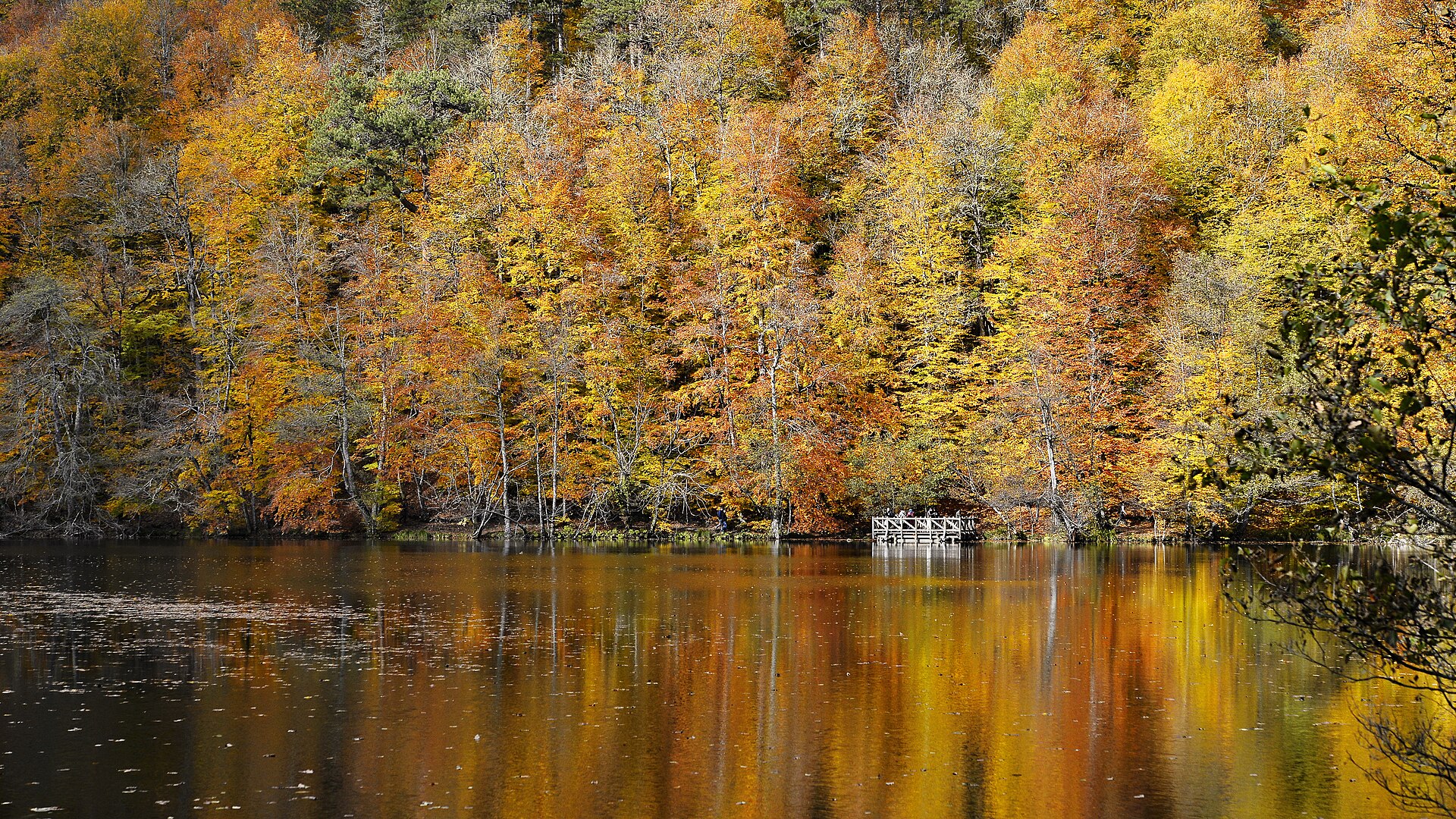
Yedigöller National Park is a forested protected area in northern Bolu Province, about 42 km north of Bolu city. Its name means Seven Lakes, and it protects seven small landslide lakes in mixed natural woodland. Visit for walking, birds and autumn colour.
Key facts
- Location: Northern Bolu Province, Western Black Sea region
- From Bolu: About 42 km north (Culture Portal)
- From Istanbul / Ankara: Drive or bus to Bolu, then transfer; check timetable
- Elevation: About 900 m (Wikipedia)
- Best season: Late spring to autumn
- Typical visit time: Half day to 1 day
- Protected status: National park since 1965
- UNESCO status: None
- Entrance: See official page
What is Yedigöller and why visit it?
Yedigöller, meaning Seven Lakes, is a national park in northern Bolu Province, about 42 km north of Bolu city. It protects seven small lakes inside dense mixed forest of beech, oak, hornbeam and fir. Visitors come for quiet walks, autumn colour, wildlife and a viewpoint over the lakes.
Moreover, the park is compact and calm. In contrast to Abant, it feels more remote and less developed.
These points explain the appeal.
- Seven lakes in a short north-south line.
- Mixed natural forest with many tree species.
- More than 100 bird species recorded.
- A viewpoint at Kapankaya.
- Strong autumn scenery, according to Wikivoyage.
What is the history and background of Yedigöller?
Yedigöller was taken under protection as a national park in 1965. The Culture Portal gives the basin as 1,642 hectares, while Wikipedia gives 1,623 hectares. Therefore, quote the area as roughly 1,600 hectares. Wikipedia says the lakes formed because of landslides.
In addition, the Culture Portal records that Türkiye’s first trout production station was set up in the park in 1969.
The key facts are short.
- 1965: protected as a national park.
- 1969: first trout production station in Türkiye, per the Culture Portal.
- IUCN category II, per Wikipedia.
- Location: Western Black Sea region, south of Zonguldak.
The table shows where sources agree and differ.
| Fact | Culture Portal | Wikipedia |
|---|---|---|
| Protected | 1965 | 1965 |
| Area | 1,642 ha | 1,623 ha |
| Distance from Bolu | 42 km north | 42 km north |
| Cause of lakes | Sliding masses blocked valleys | Landslides |
| Number of lakes | 7 | 7 |
What are the highlights of Yedigöller?
The highlights are the seven lakes, the Kapankaya viewpoint and the forest paths. The lakes are Büyükgöl, Seringöl, Deringöl, Nazlıgöl, Küçükgöl, İncegöl and Sazlıgöl. Büyükgöl is the largest. Streams, small bridges and a waterfall add variety.
However, you should expect walking, not sightseeing stops.
Plan your walk around these stops.
- Büyükgöl, the largest of the seven lakes.
- The smaller lakes in sequence along the valley.
- Kapankaya viewpoint above the lakes.
- Handmade bridges and streams.
- Deer protection area and trout farm.
The table gives the lakes and features at a glance.
| Feature | What it is | Why it matters |
|---|---|---|
| Büyükgöl | Largest lake | Main stop for most visitors |
| Seringöl, Deringöl, Nazlıgöl | Mid-park lakes | Quiet forest stops |
| Küçükgöl, İncegöl, Sazlıgöl | Smaller lakes | Longer walks |
| Kapankaya | Viewpoint | Overview of the lakes |
| Trout farm | Local heritage | Linked to the 1969 station |
How do you get to Yedigöller and get around?
Most visitors drive from Bolu. The Culture Portal places the park 42 km north of Bolu, while Wikivoyage gives 25 km, so sources differ by measurement. Wikipedia says access is from the Yenicaga road, and in winter an alternative road via Yenicaga, Mengen and Yazicik applies. Check the current road situation locally.
Furthermore, public transport is limited, so a car or private transfer is the practical choice.
Remember these transport points.
- The Bolu-Yedigöller route is closed by snow in winter, per the Culture Portal.
- Kapankaya is accessible all year, per Wikipedia.
- A private transfer removes parking and road worries.
The table compares the options.
| From | Option | Note |
|---|---|---|
| Bolu city | Car or taxi | About 42 km by the Culture Portal |
| Istanbul | Drive or bus to Bolu (4-5 hours) then transfer | Check current timetable |
| Ankara | Drive or bus to Bolu then transfer | About 3 hours to Bolu by bus per Wikivoyage |
| In the park | Walking | Paths link the lakes |
When is the best time to visit Yedigöller?
Late spring to autumn is the easiest period. Wikivoyage calls the park especially scenic in autumn. In winter snow can close the Bolu-Yedigöller route, so access changes.
As a result, check the road before you go.
The table lists the seasons.
| Season | Weather | Crowds | Notes |
|---|---|---|---|
| Spring | Cool and wet | Low | Fresh greenery; paths may be muddy |
| Summer | Mild | Moderate to high at weekends | Good for walking and camping |
| Autumn | Cool | Moderate | Forest colour; popular |
| Winter | Cold and snowy | Low | Road may be closed; check locally |
How long should you stay at Yedigöller?
A half day covers the main lakes and a viewpoint stop. A full day allows more walking and a picnic. Two days suit campers and bird watchers.
Therefore, pick the plan that matches your pace.
The table gives three plans.
| Plan | What to do | Fits who |
|---|---|---|
| Half day | Main lakes and Kapankaya | Short stop from Bolu |
| 1 day | Walk several lakes, picnic | Hikers |
| 2-3 days | Camp or stay nearby, add Abant and Bolu | Nature lovers |
What practical tips should you know?
Wear walking shoes and bring water, food and a rain layer. Entrance fees and camping rules are not confirmed here, so check the official park page. Mobile signal can be weak in forest areas, so download offline maps.
Moreover, follow national park rules: carry out litter and do not disturb wildlife.
Keep these tips in mind.
- Tell someone your route if you hike alone.
- Wildlife includes brown bears and wolves, per Wikipedia; keep food stored and do not approach animals.
- Paths may be steep or muddy; accessibility varies.
- Photography is fine for personal use; check rules for drones.
- Fires are restricted in forests; use designated areas only.
Where should you stay and eat?
The park offers tents, caravans, rest houses and bungalows, according to Wikipedia. Bolu city has hotels and restaurants. Therefore, many visitors base themselves in Bolu or at a lake resort nearby and drive in for the day.
Try trout and local Bolu dishes in Bolu city or on the way.
Choose by comfort.
- In the park: camping and bungalows.
- Bolu city: widest hotel choice.
- Karacasu: spa hotels about 7 km south of Bolu, per Wikivoyage.
- Abant: lakeside hotels and bungalows.
What is near Yedigöller for day trips?
Abant Lake is the closest comparable nature stop. Bolu city has a museum and Ottoman mosques. Zonguldak and the Black Sea coast lie to the north. Ankara and Istanbul are the main long-distance bases.
In short, combine Yedigöller with Abant for a two-day nature loop.
The table lists nearby places.
| Place | Why go | Note |
|---|---|---|
| Abant Lake | Lake loop and picnics | Mountain lake with accommodation |
| Bolu city | Museum and mosques | Gateway town |
| Karacasu | Hot springs | 7 km south of Bolu |
| Zonguldak | Black Sea province | See our province page |
| Sapanca | Lake break near Istanbul | See our Sapanca page |
Plan this with TurkGT
TurkGT is an Istanbul-based travel company. We can arrange guided tours, private transfers, a local guide or an interpreter for a trip to Yedigöller. Tell us your dates, group size and interests, and we will suggest a realistic itinerary. Everything is confirmed with you by WhatsApp before you travel.
Frequently asked questions
Where is Yedigöller National Park?
It is in northern Bolu Province, in the Western Black Sea region, about 42 km north of Bolu city according to the Culture Portal.
What does Yedigöller mean?
It means Seven Lakes. The lakes are Büyükgöl, Seringöl, Deringöl, Nazlıgöl, Küçükgöl, İncegöl and Sazlıgöl.
When was Yedigöller declared a national park?
The Culture Portal and Wikipedia both say it was protected as a national park in 1965.
How did the lakes form?
Wikipedia says landslides formed the lakes. The Culture Portal says sliding masses blocked valleys.
Is Yedigöller open in winter?
The Culture Portal says the Bolu-Yedigöller route is closed by snow in winter. Check the current road status before travelling.
What can you see at Kapankaya?
Kapankaya is a viewpoint inside the park that overlooks the lakes. Wikipedia says it is accessible all year.
Which animals live in the park?
Wikipedia lists red deer, roe deer, wild boar, brown bears, wolves, foxes, lynx, otters and squirrels. The Culture Portal records over 100 bird species.
Can you stay overnight?
Wikipedia mentions camps, tents, caravans, rest houses and bungalows. Check availability and rules with the park.
Related on TurkGT
Sources
- Türkiye Kültür Portalı: Yedigöller Milli Parkı
- Yedigöller National Park – Wikipedia
- Go Türkiye: Bolu – Listen
Last reviewed: 2026-11-18. Opening hours, ticket prices and other changeable details are not listed because they change; check the official source before you travel.