
Akçakoca is a Black Sea beach resort and district town in Düzce Province, in Türkiye’s West Black Sea region, about 200 km east of Istanbul. Its coast has beaches, a fishing shelter and the Genoese Castle on a clifftop, which is part of a serial entry on UNESCO’s Tentative List. The area is also a regional centre of hazelnut growing.
Key facts
- Location: Black Sea coast, Düzce Province, West Black Sea region
- Distance from cities: About 200 km east of Istanbul (Wikipedia); about 3 hours by road to Düzce plus 30 minutes (Wikivoyage)
- Nearest airports: No airport in town; most visitors fly into Istanbul and continue by road or bus (check current options)
- Population: 27,878 in 2022, rising in summer (Wikipedia)
- Landmark: Genoese Castle on a cliff between two bays
- Best season: Summer for the beaches; mild, humid subtropical climate (Wikipedia)
- Typical visit time: A weekend; Wikivoyage calls it too far for a comfortable day trip from the big cities
- UNESCO status: Genoese Castle site is on the UNESCO Tentative List; not inscribed
- Entrance: See official page (Culture Portal and local authorities); the castle area is listed as free on Wikivoyage, check current rules
What is Akçakoca and why visit?
Akçakoca is a Black Sea beach town in Düzce Province. It combines sand and sea, a harbour with a fishing shelter, a clifftop Genoese castle and nearby caves and waterfalls. Visitors come for summer beaches, seafood, hazelnuts and a quieter alternative to the busier Mediterranean resorts.
The Culture Portal says Akçakoca is where Türkiye’s first seaside and caravan tourism began in the 1950s. Moreover, Wikipedia says tourism became an important part of the local economy after the 1950s. As a result, the town has long experience hosting weekend visitors.
The main reasons to include Akçakoca in a trip are these:
- Beaches on the Black Sea, including Değirmenağzı and Kale Plajı.
- The Genoese Castle, on a cliff between two bays.
- A fishing shelter, sunsets and fresh seafood.
- Hazelnut country and mountain strawberries in the hinterland.
- A short coastal getaway from Istanbul.
What is the history and background of Akçakoca?
The ancient town of Dia or Diospolis stood at the site of Akçakoca, according to Wikipedia. After the Turkish conquest it was called Akçaşehir, and it took the name Akçakoca in 1934. The Genoese built a castle here after 1204, during the Latin Empire period.
Wikipedia says the Genoese established commercial bases on the Western Black Sea coast after the Fourth Crusade, and Akçakoca returned to Byzantine rule when Constantinople was retaken in 1261. In contrast, there is no evidence of an Ottoman military conquest here. Migrants from the Black Sea region and the Balkans settled in the town after the war of 1877-1878.
This table puts the main periods in order.
| Period | Event |
|---|---|
| Classical period | Town known as Dia or Diospolis (Wikipedia) |
| 1204-1261 | Genoese castle built during the Latin Empire period (Wikivoyage, Wikipedia) |
| 14th century | Ottoman rule, without recorded military action (Wikipedia) |
| 1877-1878 | Migrants settle after the Ottoman-Russian war (Wikipedia) |
| 1934 | Name changed from Akçaşehir to Akçakoca |
| 1950s | Seaside and caravan tourism begins (Culture Portal) |
| 1999 | Düzce becomes a province; Akçakoca is made a district (Wikipedia) |
What is there to see in Akçakoca?
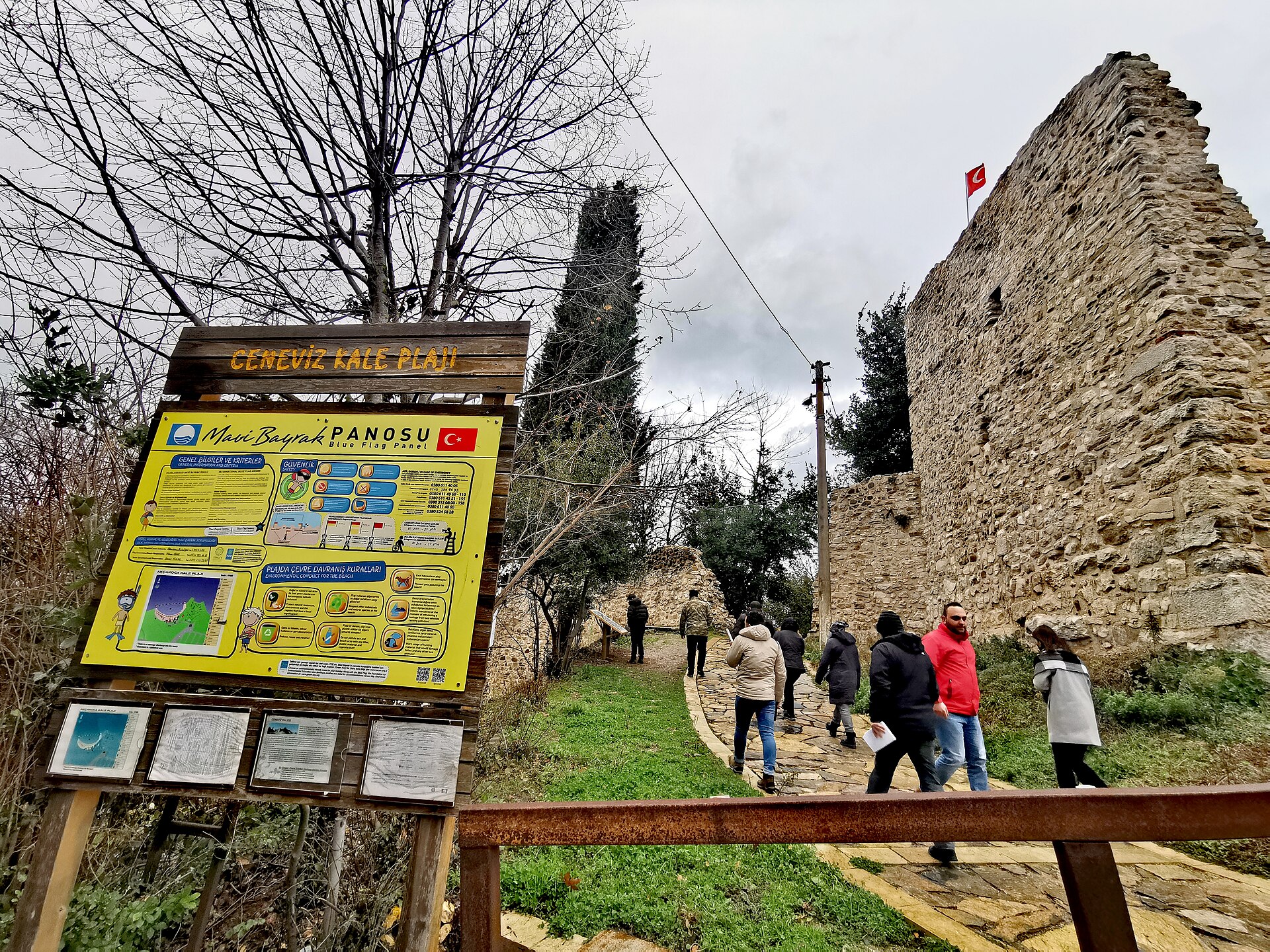
The Genoese Castle is the main landmark, standing on a cliff between two bays. Wikivoyage calls it a small crumbling bastion, but says visitors come for the clifftop location and nearby beach. The Culture Portal says the site has Hellenistic, Roman and Eastern Roman layers and is registered as an archaeological and natural conservation area.
In town, the Central Mosque of 2004 is unusual for its tent-like roof. Beyond the centre, Fakıllı Cave is a decorated karstic show cave. Therefore a visit mixes coast, a modern landmark and a short nature stop.
Look for these features during your visit:
- The Genoese Castle and the beach below, called seal rocks for the caves along its shore (Culture Portal).
- Değirmenağzı Plajı (Windmill Beach), 1 km west of the centre.
- Kale Plajı (Castle Beach), just below the castle.
- The Central Mosque, built in 2004 with a tent-like roof.
- Fakıllı Cave, a show cave of which you see about a third of 1 km.
- The harbour, lighthouse and fishing shelter.
This at-a-glance table summarises the sights and how long to allow.
| Highlight | What it is | Suggested time |
|---|---|---|
| Genoese Castle | Clifftop ruin with beach and views | 1-1.5 hours |
| Beaches | Windmill and Castle beaches | Half a day |
| Central Mosque | Modern mosque, tent-like roof | 15-20 minutes |
| Fakıllı Cave | Decorated karstic show cave | 1 hour; check opening |
| Harbour and promenade | Fishing shelter, lighthouse, sunsets | 1 hour |
How do you get to Akçakoca and get around?
Akçakoca lies at the junction of the D010 coastal highway and the D655 from Düzce. From Istanbul or Ankara, the drive is about three hours to Düzce plus another 30 minutes, according to Wikivoyage. Buses from Istanbul take four to five hours via Gebze and Düzce.
Local transport is simple. Wikivoyage says buses and dolmuşes shuttle between the centre, the bus station and outlying districts. Therefore you can reach the beaches without a car, though a car or private transfer helps with the castle and the cave. Check current timetables.
The table compares the main ways to reach Akçakoca.
| Option | How it works | Typical time |
|---|---|---|
| Private car or transfer from Istanbul | Drive east via Gebze and Düzce | About 3.5 hours (Wikivoyage); traffic varies |
| Intercity bus | Buses every couple of hours from Istanbul | 4-5 hours (Wikivoyage); check timetable |
| From Ankara | Four buses a day via Bolu and Düzce (Wikivoyage) | About 3.5 hours |
| Local dolmuş | Bus station to centre and outlying areas | Check with the driver |
When is the best time to visit Akçakoca?
Summer is the beach season. Wikipedia lists average July and August highs around 27 degrees Celsius and describes a humid subtropical climate. Winters are mild but wet, and the annual rainfall is about 1,158 mm. Therefore bring a rain layer outside July and August.
The population rises in summer because of tourism and cottage owners. In contrast, spring and early autumn are quieter, and they suit sightseeing and walks rather than swimming.
The table shows what to expect by season.
| Season | Weather | Crowds | Notes |
|---|---|---|---|
| Spring (Apr-May) | Mild, some rain | Low | Walks, castle, hazelnut hinterland |
| Summer (Jun-Aug) | Warm, highs about 27 °C | Highest | Beach season; book ahead |
| Autumn (Sep-Oct) | Mild, rain increasing | Low to moderate | Quiet coast, sea still pleasant early |
| Winter (Dec-Mar) | Cool and wet | Very low | Many seasonal places close |
How long should you stay?
A weekend is the practical minimum. Wikivoyage says Akçakoca is a weekend getaway from the big cities but too far for a day trip. A full day covers the castle, a beach and dinner by the harbour, and a second day adds the cave and the hinterland.
Therefore plan one night if you can. The table gives three simple plans.
These sample plans show how much time each style of trip needs.
| Plan | What you do | Best for |
|---|---|---|
| Half day | Castle and nearby beach | Stop on a Black Sea drive |
| 1 day | Castle, beach, harbour and seafood dinner | Short coastal visit |
| 2-3 days | Add Fakıllı Cave, the hinterland and Düzce or Bolu | Relaxed weekend break |
What are the practical tips for visiting?
Check the official pages for opening hours of the cave and any site fees, and carry swimwear, sun protection and a rain layer. Beaches are narrow, and Wikivoyage says they suffer from erosion. Follow local safety flags when swimming.
The castle path is uneven and the cliff edge has drops. Therefore wear closed shoes and keep children close.
These tips make the visit smoother:
- Check official pages for the cave’s hours and any site fees; they change.
- Beaches are narrow and eroded in places (Wikivoyage); arrive early in summer.
- Heed lifeguards and flags; the Black Sea can be rough.
- Wear closed shoes at the castle; the cliff edge is steep.
- Dress modestly when visiting mosques.
- Ask before photographing people.
- Accessibility is limited at the castle and cave.
Where should you stay and eat?
The beachfront and the town centre have the most hotels. Wikivoyage lists beach hotels, small pensions and a seafood-and-meze scene along the harbour and marina. Eating by the sea is the main pleasure, and the local hazelnuts are a good souvenir.
Therefore choose a hotel by whether you want the beach, the harbour or the bus station for easy departures.
Neighbourhood-level options to consider:
- Beachfront streets for sea views and short walks to the sand.
- The marina and harbour area for seafood restaurants.
- The town centre for shops and local dolmuş links.
- The bus-station junction for short stays before an early bus.
What is near Akçakoca for day trips?
Düzce is the provincial capital and a stop on the Istanbul to Ankara route. Bolu, with Abant Lake and Yedigöller, is a natural second stop, and Zonguldak lies along the coast. Wikivoyage notes that coastal buses continue to Zonguldak.
Moreover, Safranbolu and Amasra fit a longer Black Sea loop for travellers with several days.
Good additions to an Akçakoca trip:
- Düzce city and the province’s other sights.
- Abant Lake and Yedigöller in Bolu.
- Zonguldak and the west Black Sea coast.
- Safranbolu Old Town, a UNESCO site, on a longer loop.
The table lists nearby places and how they relate to Akçakoca.
| Place | Relation to Akçakoca | Note |
|---|---|---|
| Düzce | Provincial capital, about 30 minutes by road | On the Istanbul to Ankara route |
| Bolu | Inland; check current route time | Abant Lake and Yedigöller |
| Zonguldak | Along the coast | Coastal buses continue there (Wikivoyage) |
| Istanbul | About 200 km west | Usual starting point |
Plan this with TurkGT
TurkGT is an Istanbul-based travel company. We offer guided tours, private transfers, licensed guide and interpreter services, and multi-day trips that can include Akçakoca and the Black Sea coast. We can plan a weekend on the Düzce coast or a longer Black Sea loop with Bolu and Safranbolu, and we can arrange the private transfer and a guide.
Tell us your dates, group size and interests on WhatsApp. We confirm the route, timing and what is included in writing before you book, and we do not quote prices on this page.
Frequently asked questions
Where is Akçakoca?
On the Black Sea coast in Düzce Province, at the western end of the Black Sea region, about 200 km east of Istanbul.
What is the Genoese Castle in Akçakoca?
A castle site on a cliff between two bays, registered as an archaeological and natural conservation area and part of a serial entry on UNESCO’s Tentative List.
What is Akçakoca known for?
Its beaches, the Genoese Castle, seaside tourism that began in the 1950s, and hazelnut cultivation.
How did Akçakoca get its name?
After the Turkish conquest it was called Akçaşehir, which became Akçakoca in 1934, according to Wikipedia.
How far is Akçakoca from Istanbul?
About 200 km. Wikivoyage gives about three hours to Düzce plus 30 minutes; buses take four to five hours.
Is Akçakoca a day trip from Istanbul?
Wikivoyage says it is a weekend getaway but too far for a day trip.
When is the best time to visit Akçakoca?
Summer is the beach season, with July and August highs around 27 degrees Celsius; spring and autumn are quieter.
Is Akçakoca a UNESCO site?
No. The Genoese Castle site is on the UNESCO Tentative List as part of a serial entry, but it is not inscribed.
Related on TurkGT
- Part of Düzce
Sources
- Akçakoca – Türkiye Culture Portal (Ministry of Culture and Tourism)
- Genoese Castle, Akçakoca – Türkiye Culture Portal (Ministry of Culture and Tourism)
- Akçakoca – Wikipedia
- Top Things to See in Düzce – GoTürkiye
- Akçakoca – Wikivoyage
Last reviewed: 2026-11-18. Opening hours, ticket prices and other changeable details are not listed because they change; check the official source before you travel.