
Aphrodisias is an ancient city near Geyre in Aydın province, south-western Türkiye, inscribed by UNESCO in 2017. It grew rich on marble quarries and famous sculptors, and it kept a major sanctuary of Aphrodite. Visit it for its stadium, Sebasteion reliefs and quiet setting.
Key facts
- Location: Near Geyre, Karacasu district, Aydın province
- Distance: About 230 km south-east of İzmir; about 100 km inland from the Aegean coast
- UNESCO status: Inscribed 2017; criteria (ii), (iii), (iv), (vi)
- Components: Archaeological site and marble quarries to the north-east
- Best season: Spring and autumn; start early in summer
- Typical visit time: 2-3 hours on site; half day recommended
- Nearest towns: Karacasu 10 km, Nazilli 48 km, Denizli for Pamukkale
- Museum: Reported closed for restoration in 2024; check the official page
- Entrance: See official page (Ministry of Culture and Tourism)
What is Aphrodisias and why visit?
Aphrodisias is an ancient city near the village of Geyre in Aydın province, south-western Türkiye. It was a marble-carving centre devoted to the goddess Aphrodite, and UNESCO listed it in 2017. Visitors come for its well-preserved stadium, its carved reliefs and its quiet, uncrowded setting.
Moreover, the city shows how Greek, Roman and Anatolian traditions mixed. The marble came from quarries nearby, and the sculptors worked for patrons across the empire. As a result, the ruins feel like an open workshop of Roman art.
Unlike the busy ruins on the coast, Aphrodisias lies inland among olive groves and farmland. The ruins are spread over a wide, flat area, so you can walk at your own pace. The site also has a museum with sculpture, although it was reported closed for restoration in 2024, so check the official page.
What is the history of Aphrodisias?
Aphrodisias grew from a local cult of a fertility goddess into a Hellenistic and Roman city. UNESCO dates its founding as a city-state to the early 2nd century BC. It flourished under Roman rule, and declined after earthquakes in the 4th and 7th centuries.
The city took its name from Aphrodite, whose cult statue blended a local Anatolian goddess with the Greek goddess of love. Because Julius Caesar and Augustus claimed descent from Venus, Rome granted the city special status. Gaius Julius Zoilos, a freed slave of Caesar, funded much of the civic centre.
Marble was the basis of its wealth. Carian marble was quarried on the nearby slopes, and sculptors from Aphrodisias became famous in the Roman world. The city also had schools of sculpture and philosophy. Therefore it stayed a centre of pagan tradition until the end of the 5th century.
In late antiquity the Temple of Aphrodite became a church, and the city was renamed Stauropolis, “city of the Cross”, before 640. After the early 7th-century earthquake, only a small fortified settlement survived. Later the village of Geyre grew over part of the ruins. Paul Gaudin made the first excavations in 1904-5, and Kenan Erim started the long modern campaign in 1962.
What are the highlights of Aphrodisias, and what can you see?
The main sights are the Stadium, the Sebasteion, the Temple of Aphrodite, the Tetrapylon, the Bouleuterion, the theatre and the baths. The Stadium is the headline monument because it keeps its full oval shape. Allow time to read the sculpted reliefs and the inscriptions on the Theatre Archive Wall.
Use this list to prioritise your walk around the site.
- Stadium: about 270 m by 60 m with a capacity of around 30,000; it has two curved ends.
- Sebasteion: a cult complex for Augustus and the Julio-Claudian emperors, famed for its reliefs.
- Temple of Aphrodite: the focus of the city, converted into a church around AD 500.
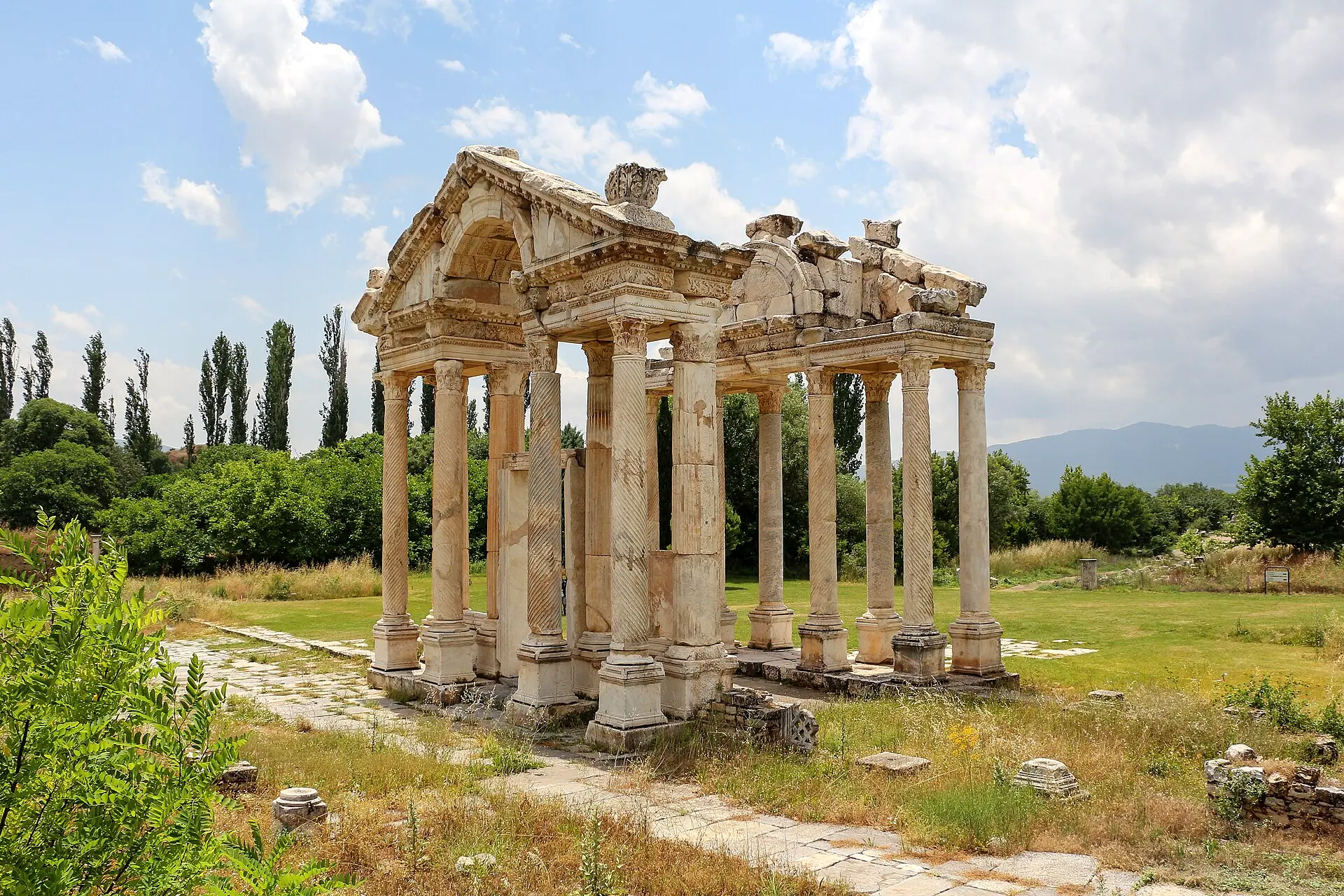
- Tetrapylon: the monumental gateway to the sanctuary forecourt, built around AD 200.
- Bouleuterion (council house): a semicircular hall that seated about 1,750 people.
- Theatre and Archive Wall: carved imperial letters and decrees relating to the city.
- Hadrian’s Baths, the Roman amphitheatre and the Bishop’s Palace: smaller stops with good detail.
The table below gives an at-a-glance summary of the key monuments.
| Monument | Date or period | Why it matters |
|---|---|---|
| Stadium | 1st century AD | Exceptionally intact oval arena |
| Sebasteion | 1st century AD | Imperial cult complex with reliefs |
| Temple of Aphrodite | Hellenistic to c. AD 500 | Cult centre, later a church |
| Tetrapylon | c. AD 200 | Gateway to the sanctuary forecourt |
| Bouleuterion | Late 2nd or early 3rd century AD | Council hall with marble seating |
| Theatre Archive Wall | Roman period | Imperial documents about the city |
Why is Aphrodisias a UNESCO World Heritage Site?
UNESCO inscribed Aphrodisias in 2017 under criteria (ii), (iii), (iv) and (vi). The serial property has two components: the walled city and the marble quarries to the north-east. Together they cover 152.25 ha, with a 1,040.57 ha buffer zone. UNESCO values the city for its sculpture, its architecture and the cult of Aphrodite.
In short, the listing protects both the city and its source of stone. As a result, the quarries and the ruins are managed together. Visitors can read both parts of the story: where the marble came from and how it was carved.
This table summarises the UNESCO listing and each criterion.
| Item | Detail |
|---|---|
| Inscription year | 2017 |
| Components | Archaeological site and marble quarries to the north-east |
| Area | 152.25 ha; buffer zone 1,040.57 ha |
| Criterion (ii) | Sculpted marble blending local, Greek and Roman traditions |
| Criterion (iii) | A leading place for the study of Roman sculpture and workshops |
| Criterion (iv) | An exceptional Greco-Roman city in inland Asia Minor |
| Criterion (vi) | Cult centre of the Aphrodite of Aphrodisias |
How do you get to Aphrodisias and get around?
The easiest way to reach Aphrodisias is by car or private transfer along the D585 between Nazilli and Tavas. Public transport is limited. The site lies about 230 km south-east of İzmir and about 100 km from the Aegean coast. Inside the site, you walk on maintained paths.
Geyre has no inter-city bus, so visitors use a dolmuş or a taxi, for example from Denizli. Ask to be dropped at the crossroads by the site entrance. Check the current timetable for dolmuş services, because they run irregularly.
This table compares options with typical durations from public sources.
| From | Mode | Typical duration | Note |
|---|---|---|---|
| İzmir | Car or private transfer | Check route time; about 230 km | Use the Aydın or Nazilli route |
| Denizli or Pamukkale | Taxi or private transfer | Check route time | Go south via Tavas |
| Nazilli | Car or taxi | About 48 km | Nearest sizable town |
| Karacasu | Dolmuş or taxi | About 10 km | Check current timetable |
| Geyre village | Walk or taxi | About 2 km | Light traffic, no pavement |
When is the best time to visit Aphrodisias?
Spring and autumn are the most comfortable seasons for Aphrodisias. The site is open-air with limited shade, and inland Aegean summers are hot. Winter is mild but can be wet. Check the weather forecast before you go, and plan the walk for early morning in summer.
This table shows weather, crowds and notes by season.
| Season | Weather | Crowds | Notes |
|---|---|---|---|
| Spring (Mar-May) | Mild, some rain | Low to moderate | Green fields around the ruins |
| Summer (Jun-Aug) | Hot and dry | Moderate | Start early, bring water and a hat |
| Autumn (Sep-Nov) | Warm to mild | Low | Soft light for photography |
| Winter (Dec-Feb) | Cool, wetter | Very low | Check access and daylight hours |
How long should you stay at Aphrodisias?
Allow half a day at Aphrodisias. Wikivoyage says exploring the site takes 2-3 hours. A full day lets you add the museum when it is open and the quarry area. A two-to-three-day trip combines the site with Pamukkale and Hierapolis or with Ephesus.
The table below suggests three plans by available time.
| Time | Plan |
|---|---|
| Half day | Stadium, Sebasteion, Temple of Aphrodite and Tetrapylon; lunch in Geyre |
| 1 day | Full site circuit, the baths and theatre, the museum if open, and the walking trail |
| 2-3 days | Aphrodisias plus Karacasu pottery street, Denizli, Pamukkale and Hierapolis |
What practical tips should you know before visiting Aphrodisias?
Check the official page for tickets, opening hours and museum status before you travel. Our fee check on 16 November 2026 showed the site on the official table as valid with the MuseumPass. Wear sun protection and sturdy shoes, because the paths are long and the shade is limited.
These tips combine public guidance and common sense.
- Tickets and fees: see the official page of the Ministry of Culture and Tourism.
- Dress: light clothing, hat and walking shoes; carry a layer for cool mornings.
- Accessibility: paths are generally in good repair, but surfaces are uneven in places.
- Water: local water is reported safe to drink, but carry bottled water for the walk.
- Photography: personal photography is usually fine; check rules for tripods and drones.
- Etiquette: do not climb on carved blocks or remove stones.
- Supplies: shops are limited, so buy snacks in Karacasu or Nazilli.
Where should you stay and eat near Aphrodisias?
Stay in Geyre for a quiet base, or in Karacasu, Nazilli or Denizli for more choice. Geyre has simple guesthouses and cafes at the village crossroads. Karacasu has a pottery street, and Denizli offers larger hotels and links to Pamukkale.
For food, expect grilled meatballs, olive-oil dishes and fresh Aegean vegetables. Moreover, the small restaurants at the crossroads serve visitors at lunch. Book accommodation ahead in peak season.
What are the nearby places and day trips from Aphrodisias?
Pamukkale and Hierapolis lie to the east, and Ephesus lies to the west. Karacasu has a pottery street and Nazilli is the closest larger town. Many visitors combine Aphrodisias with Denizli and the wider Aegean heritage route in one longer itinerary.
Consider these add-ons for a longer trip.
- Hierapolis-Pamukkale and Laodicea, near Denizli.
- Ephesus and the İzmir region.
- Karacasu pottery street and local ceramics.
Plan this with TurkGT
TurkGT is an Istanbul-based travel company. We offer guided trips, private transfers, local guides and interpreter services for Aegean heritage sites such as Aphrodisias. Send us your dates, group size and interests, and our team will propose a route and confirm every detail with you by WhatsApp.
Frequently asked questions
Where is Aphrodisias?
Aphrodisias is near the village of Geyre in Aydın province, south-western Türkiye, about 100 km inland from the Aegean coast and 230 km south-east of İzmir.
When was Aphrodisias inscribed by UNESCO?
UNESCO inscribed Aphrodisias in 2017 under criteria (ii), (iii), (iv) and (vi).
What is Aphrodisias famous for?
It is famous for its marble sculpture, its well-preserved stadium and the cult of the goddess Aphrodite.
How long does a visit to Aphrodisias take?
Wikivoyage says 2-3 hours to explore the site. A half day is a sensible minimum.
Can you reach Aphrodisias by public transport?
Only partly. Geyre is not on inter-city bus routes, so most visitors use a car, a taxi or a private transfer. Check the current timetable for dolmuş services.
Is the Aphrodisias Museum open?
Wikivoyage reported it closed for restoration as of 2024. Check the official page for the current status.
What does the UNESCO listing include?
It has two components: the archaeological site of Aphrodisias and the marble quarries north-east of the city.
Which cities can you combine with Aphrodisias?
Denizli with Pamukkale and Hierapolis is the closest pairing. Ephesus and İzmir also fit a longer Aegean route.
Related on TurkGT
- Part of Aydın
Sources
- UNESCO World Heritage Centre: Aphrodisias
- Wikipedia: Aphrodisias
- Go Türkiye: Aydın – See
- Wikivoyage: Aphrodisias
- Wikipedia: Geyre
- Wikipedia: Karacasu
- Ministry of Culture and Tourism: museum and site fees
Last reviewed: 2026-11-17.