
Ephesus is an ancient Greek and Roman city near Selçuk in İzmir province, western Turkey. UNESCO inscribed it in 2015 for its Hellenistic, Roman and early Christian monuments, including the Library of Celsus. It lies 4 km west of Selçuk and suits a half-day to one-day visit.
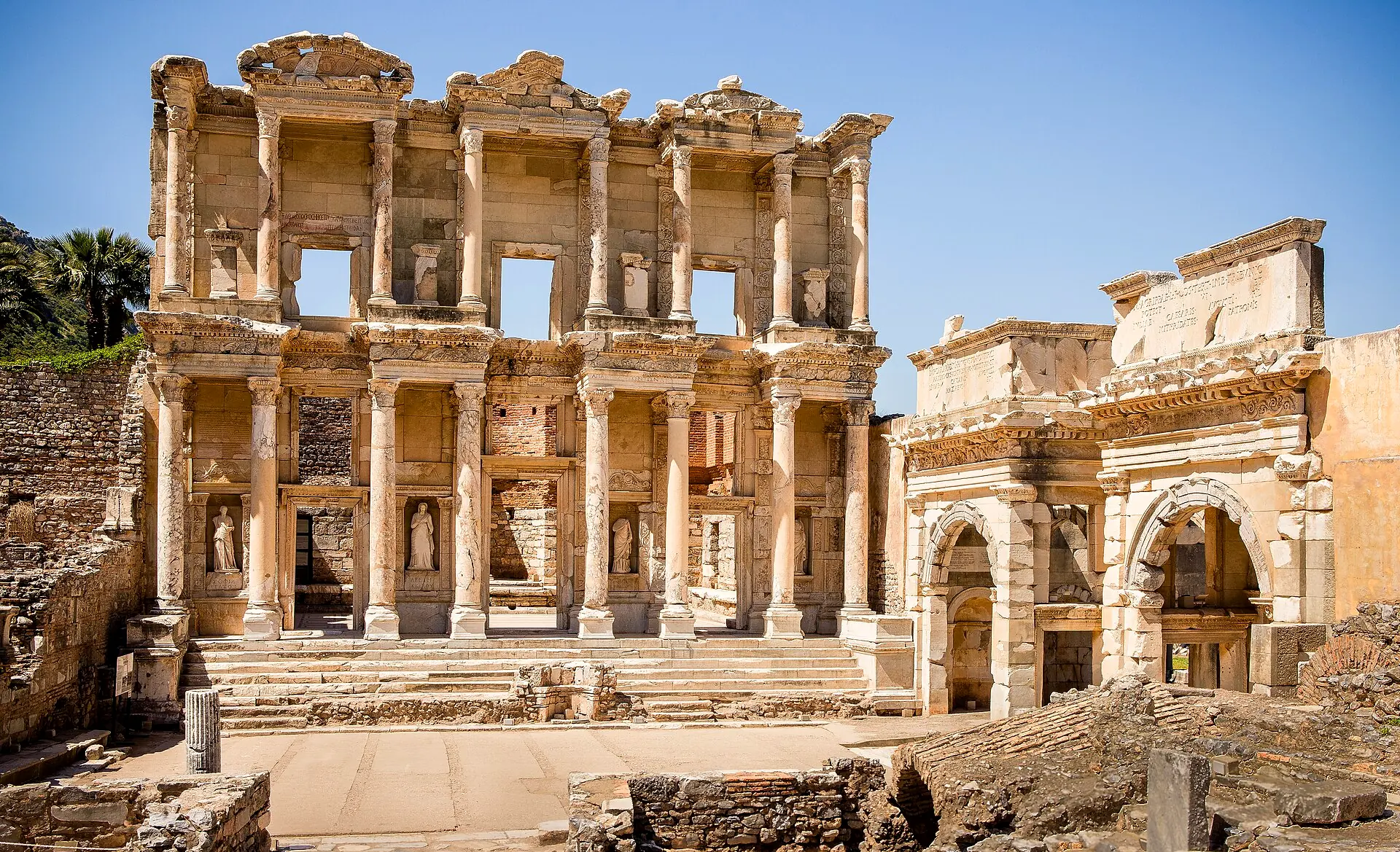
Key facts
- Location: Near Selçuk, İzmir province, Aegean Turkey
- Distance: 4 km west of Selçuk; 19 km northeast of Kuşadası
- From İzmir: İZBAN train to Selçuk, then taxi or dolmuş; check current timetable
- UNESCO status: Inscribed 2015; criteria (iii), (iv), (vi)
- UNESCO area: 662.62 ha, buffer zone 1,246.3 ha
- Best season: Spring and autumn
- Typical visit time: 90 minutes to 2.5 hours on site, plus Terrace Houses
- Entrance: See the official page for current fees
What is Ephesus and why visit?
Ephesus is an ancient Greek and Roman city near Selçuk in İzmir province, on Turkey’s Aegean coast. UNESCO inscribed it in 2015. Visitors come to walk a marble street lined with the Library of Celsus, a vast theatre and terrace houses, and to trace Christian pilgrimage history.
Moreover, the site suits many travel styles. History readers can follow Greek, Roman and early Christian layers in one walk. Families can see a theatre that once held thousands of spectators. Photographers will find strong morning and late-day light on the marble facades.
The place also works as a base for a wider Aegean trip. Selçuk town, the Basilica of St. John and the House of the Virgin Mary lie within a short ride. Therefore many travellers add Ephesus to a route that includes İzmir, Kuşadası or Pamukkale.
This page covers the following points:
- Why UNESCO listed the site and what it protects
- The long history from Neolithic mound to Ottoman town
- A walking route through the main monuments
- Transport, seasons, timing and practical advice
Why is Ephesus a UNESCO World Heritage Site?
UNESCO inscribed Ephesus in 2015 under criteria (iii), (iv) and (vi). The listing is a serial property that links the ancient city centre with Ayasuluk Hill and other components. It protects 662.62 hectares, with a buffer zone of 1,246.3 hectares around it.
In short, the committee valued Ephesus as a record of Hellenistic, Roman and early Christian traditions. It also valued the changing river and harbour landscape. Finally it recognised the city’s role in the spread of Christianity across the Roman Empire.
The table below summarises the UNESCO criteria and what each means on the ground.
| Criterion | UNESCO reasoning (summary) | What you see |
|---|---|---|
| (iii) | Exceptional testimony to Hellenistic, Roman Imperial and early Christian traditions | Celsus Library, Hadrian’s Temple, Serapeion, Terrace House 2 |
| (iv) | Settlement landscape shaped by environmental factors over time | Harbour channel and basin along the Kaystros valley |
| (vi) | Association with Anatolian cults and early Christianity | Basilica of St. John, Church of Mary, Councils of 431 and 449 CE |
What is the history of Ephesus?
Ephesus has a settlement record that runs from the seventh millennium BCE to today. The Neolithic Cukurici Mound came first, then Ayasuluk Hill, then the Greek and Roman city. Because the river silted up, the city moved several times over the centuries.
According to Wikipedia, legend names Androklos, a prince of Athens, as founder. The sanctuary of the Ephesian Artemis, however, was established by the 2nd millennium BCE. In the fourth century BCE Lysimachos founded the new city, and in 133 BCE Rome made it capital of the province of Asia.
Later, Christian communities shaped the town. Church councils met there in 431 and 449 CE. Pilgrimage to the Church of Mary and the Basilica of St. John eclipsed the Artemis temple by the 5th century. Subsequently the Selçuk and Ottoman Turks settled at Ayasuluk, where the Isa Bey Mosque still stands.
The timeline below lists the main phases.
- 7th millennium BCE: settlement at Cukurici Mound
- By the 2nd millennium BCE: sanctuary of the Ephesian Artemis
- 4th century BCE: Lysimachos founds the new city
- 133 BCE: capital of the Roman province of Asia
- 5th century CE: Christian pilgrimage grows
- Medieval and Ottoman period: Ayasuluk Hill and Isa Bey Mosque
The following table gives the history at a glance.
| Period | Key development | Where to see traces |
|---|---|---|
| Neolithic | Cukurici Mound settlement | Edge of the former estuary (outside the main route) |
| Archaic and Classical | Artemis sanctuary and Ionian confederacy | Artemision site near Selçuk |
| Hellenistic | Lysimachos founds a new city | Upper city and harbour plain |
| Roman | Provincial capital, Curetes Street, library | Main archaeological site |
| Early Christian | Councils, Church of Mary, St. John Basilica | Ancient city and Ayasuluk Hill |
| Seljuk and Ottoman | Medieval settlement and mosque | Selçuk town centre |
What should you see at Ephesus?
The main sights sit along one marble street, so you can see them in a single walk. Expect the Library of Celsus, the Great Theatre, Hadrian’s Temple and the Terrace Houses. Wikivoyage notes that the site is explored entirely on foot.
The Great Theatre has an estimated seating capacity of 25,000, according to Wikipedia, and was used for drama and later gladiatorial shows. The Terrace Houses, often called the Houses of the Rich, contain mosaics and wall paintings. Consequently, many visitors budget extra time for them.
Plan to include these stops.
- Upper (southern) gate, agora and Odeon
- Curetes Street and the Fountain of Trajan
- Temple of Hadrian and the Terrace Houses
- Library of Celsus on the marble street
- Great Theatre at the end of the main avenue
- Selçuk: Ephesus Museum, Basilica of St. John, Isa Bey Mosque
This table shows the sights at a glance.
| Sight | What it is | Why it matters |
|---|---|---|
| Library of Celsus | Roman library facade | Named in UNESCO text as a Roman monument |
| Great Theatre | Open-air theatre | Estimated capacity of 25,000 (Wikipedia) |
| Terrace Houses | Elite residences with mosaics | Show upper-class Roman living |
| Temple of Hadrian | Roman temple on Curetes Street | Cited under criterion (iii) |
| Basilica of St. John | Church on Ayasuluk Hill | Cited under criterion (vi) |
How do you get to Ephesus and get around?
Ephesus lies 4 km west of Selçuk and 19 km northeast of Kuşadası, so most visitors use a taxi, dolmuş, tour or car. The nearest rail link is the İZBAN suburban line to Selçuk, which has regular trains from İzmir. Check current timetables before travelling.
Dolmuş minibuses reach the lower (northern) gate only. Most visitors enter at the upper (southern) gate because the walk then runs downhill. In contrast, entering from the lower gate means a gentle climb against the tour groups. As a result, many people take a taxi to the upper gate and leave by the lower gate.
Use the table below to compare the main ways to reach the site.
| Option | From | Notes (typical) |
|---|---|---|
| Train + local transport | İzmir to Selçuk (İZBAN) | Service runs on a regular pattern; check the current timetable |
| Dolmuş | Selçuk or Kuşadası to the lower gate | Frequent in season; no service to the upper gate |
| Taxi | Selçuk, Kuşadası | Short ride from Selçuk; agree the fare first |
| Guided tour or private transfer | İzmir, Kuşadası, cruise ports | Pick-up and drop-off, no parking search |
| Car | D550 / D515 junction | Parking at both gates; site is signposted |
When is the right time to visit Ephesus?
Spring and autumn give the most comfortable walking weather, while midsummer is hot and busy. The site has little shade, so heat matters. Visit early in the day, carry water and plan the long walk before the midday sun arrives.
Winter is quieter, but rain can make the marble slippery. Moreover, ongoing works may close some areas in any season, as Wikivoyage warns. Therefore check the official page for opening times and closures before you go.
The table below compares the seasons.
| Season | Weather (general) | Crowds | Notes |
|---|---|---|---|
| Spring (Apr-May) | Mild, some showers | Medium, rising | Green landscape; good for walking |
| Summer (Jun-Aug) | Hot and dry | High, cruise days | Go at opening time; bring a hat |
| Autumn (Sep-Oct) | Warm to mild | Medium | Soft light for photos |
| Winter (Nov-Mar) | Cool and wet | Low | Wet marble; check closures |
How long should you stay at Ephesus?
Allow two to three hours inside the ancient city, plus extra time for the Terrace Houses. Wikivoyage gives 90 minutes to 2.5 hours for the grounds. A full day adds Selçuk‘s sights, and two or three days add the coast and nearby sites.
Because the site is large, pace yourself. Start at the upper gate, walk downhill and finish at the lower gate. Then continue to Selçuk for lunch and the museum.
This table suggests itineraries by available time.
| Time | Plan | Includes |
|---|---|---|
| Half day | Ephesus ancient city | Upper gate to lower gate, optionally Terrace Houses |
| 1 day | Ephesus plus Selçuk | Museum, Basilica of St. John, Isa Bey Mosque |
| 2-3 days | Selçuk base with day trips | Add Pergamon, Aphrodisias or Pamukkale by road |
What practical tips help at Ephesus?
Wear flat, grippy shoes, carry water and plan for sun. Buy tickets through the official page or at the gate, and check current fees there. The Ministry of Culture and Tourism sets the rules, so confirm everything before you travel.
Moreover, the main avenue is paved and suitable for wheelchairs and strollers, but Wikivoyage notes lumpy sections and potholes around ongoing works. Accessibility is therefore partial, and a guide can help plan the easiest route.
Keep these tips in mind.
- Entrance: see the official page for current fees and pass options
- Footwear: marble is slippery when wet
- Sun: bring a hat, sunscreen and water
- Photography: personal photos are normal; check site rules for drones and tripods
- Etiquette: do not climb on or remove stones
- Cash and cards: carry both; small vendors may prefer cash
- Safety: avoid unlicensed street sellers offering very cheap tours
Where should you stay and eat near Ephesus?
Selçuk is the practical base because it sits 4 km from the site and has rail, bus and dolmuş links. Kuşadası offers beach-resort lodging 19 km away. Choose a town based on whether you want village atmosphere or sea access.
For food, Selçuk town centre has simple restaurants serving Aegean dishes such as grilled meat, olive-oil vegetables and fresh fish. In addition, the area near the lower gate has cafés. Book accommodation early in summer.
Consider these neighbourhoods.
- Selçuk centre: walkable, near museum and bus station
- Near Ayasuluk Hill: quieter evenings
- Kuşadası: beaches and ferry links
- İzmir: larger hotels, airport and rail
What is nearby, and which day trips combine with Ephesus?
Selçuk is the closest base for the ruins and sits only a few kilometres away. The Ephesus Museum, the Basilica of St. John and the Isa Bey Mosque are in town. Farther afield, Pergamon, Aphrodisias, Sardis and Pamukkale make longer day trips by road, so plan an early start.
As a result, a four-day Aegean loop can link Ephesus with other World Heritage sites in the region. Check driving times before you plan, because some are long.
The table below lists nearby places.
| Place | Direction | Idea |
|---|---|---|
| Selçuk | 4 km east | Museum, Basilica of St. John |
| Kuşadası | 19 km southwest | Coast and beach time |
| Pergamon (Bergama) | North of İzmir | Hellenistic acropolis |
| Aphrodisias | Inland, Aydın region | Marble city and stadium |
| Hierapolis-Pamukkale | Inland, Denizli region | Travertines and ancient spa |
Plan this with TurkGT
TurkGT is an Istanbul-based travel company that arranges guided trips, private transfers, licensed guides and interpreters across Turkey. Tell us your dates, group size and interests, and we will propose a plan for this visit. We confirm every booking by WhatsApp, so you always know the arrangement before you travel.
Frequently asked questions
Where is Ephesus?
Ephesus is near Selçuk in İzmir province on the Aegean coast of Turkey. It lies 4 km west of Selçuk and 19 km northeast of Kuşadası.
When did Ephesus become a UNESCO site?
UNESCO inscribed Ephesus in 2015 under criteria (iii), (iv) and (vi).
How long does a visit take?
Wikivoyage gives 90 minutes to 2.5 hours for the grounds, with extra time for the Terrace Houses. Add more time for Selçuk.
How do I reach Ephesus from İzmir?
Take the İZBAN suburban train to Selçuk, then a taxi or dolmuş. A private transfer or guided tour is also an option. Check current timetables.
Which gate should I use?
Most visitors enter at the upper (southern) gate and walk downhill to the lower (northern) gate. Only the lower gate has dolmuş service.
What is the Library of Celsus?
It is a Roman monument on the old processional way, named in UNESCO’s text on Ephesus.
How much is the ticket?
Fees change, so see the official Ministry of Culture and Tourism page. Museum Pass rules also change; confirm before you travel.
Can I combine Ephesus with other sites?
Yes. Selçuk, Pergamon, Aphrodisias and Pamukkale are common additions for a multi-day Aegean route.
Related on TurkGT
- Part of İzmir
- Library of Celsus
- Şirince Village
- İzmir Clock Tower
- Kemeraltı Bazaar
- Pergamon and its Multi-Layered Cultural Landscape
- Çeşme
Sources
Last reviewed: 2026-11-17.