
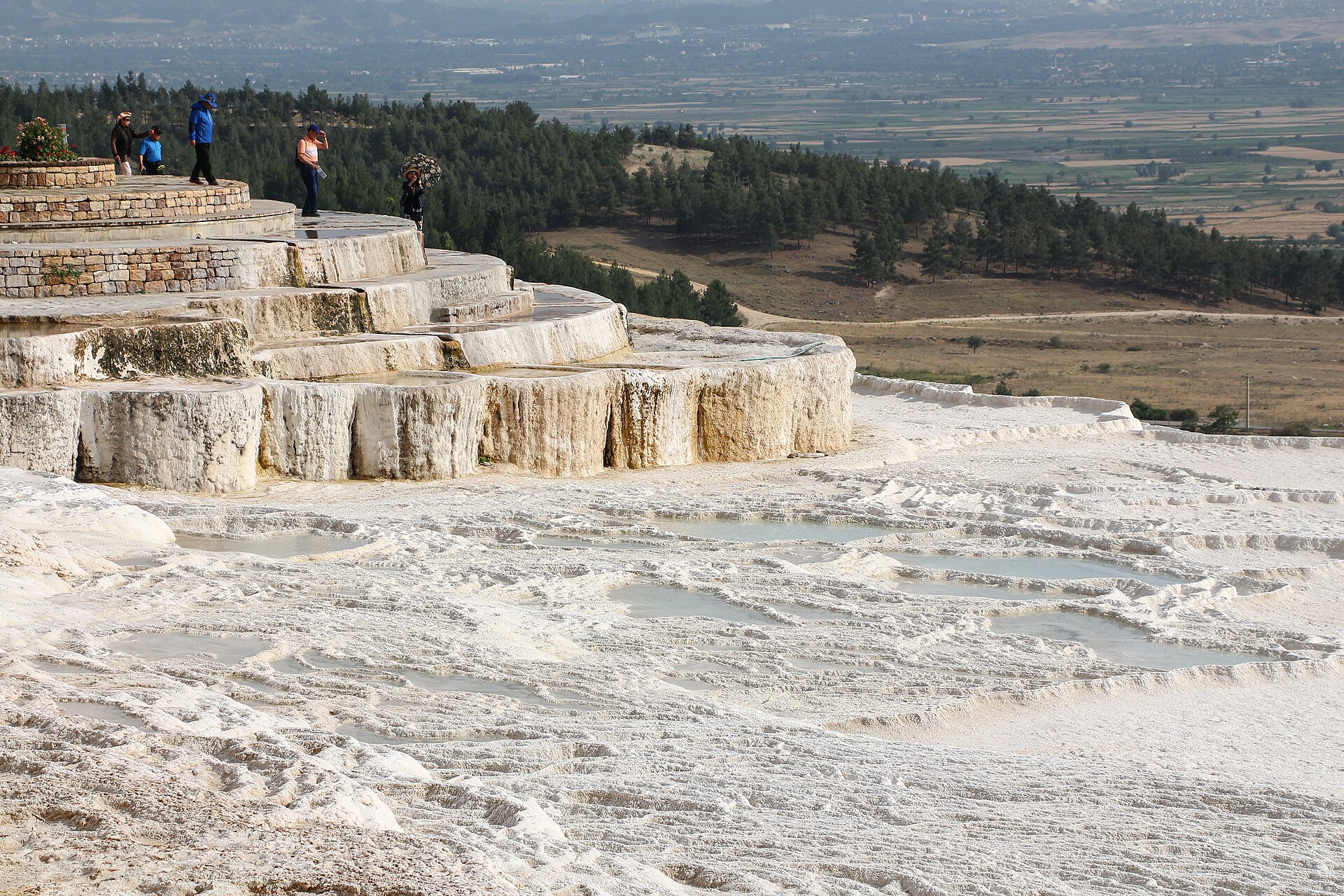
Pamukkale is a district of Denizli Province in south-western Türkiye, known for white travertine terraces and the ancient spa city of Hierapolis. UNESCO inscribed Hierapolis-Pamukkale in 1988. Visit it to walk the terraces, see the Roman theatre and necropolis and soak in thermal water.
Key facts
- Location: Denizli Province, Inner Aegean, Menderes valley
- Distance: About 20 km from Denizli; about 20 minutes by local bus (Wikivoyage; check current timetable)
- Nearest airport: Check current flights; İzmir Adnan Menderes (ADB) is a gateway by road or rail
- UNESCO status: Hierapolis-Pamukkale, inscribed 1988; criteria (iii)(iv)(vii); 1,077 ha
- Formation: Travertine about 2,700 m long, 600 m wide and 160 m high (Wikipedia)
- Best season: Late spring and early summer; summer is hot, winter cold on bare feet
- Typical visit time: Half day for the travertines and Hierapolis; 1-2 days with Karahayıt and Laodicea
- Gates: Three: Town Gate, South Gate and North Gate
- Nearby: Karahayıt 4 km north; Laodicea 10 km south; Aphrodisias 30 km west
- Entrance: See official page for tickets, hours and pool fees
What is Pamukkale and why visit it?
Pamukkale is a district of Denizli Province and the setting of the white travertine terraces and the ancient city of Hierapolis. The name means cotton castle in Turkish. Visit it to see a natural formation, Roman ruins and thermal pools in one ticketed area.
UNESCO inscribed the combined site in 1988. Moreover, Wikipedia says Pamukkale draws more than two million visitors a year. As a result, it can be crowded in summer. In contrast, early mornings and shoulder seasons feel calmer.
The district was called Akköy before 2013 and has a large population around Denizli. Wikipedia places the district centre 23 km from Denizli centre, and the usual tourist circuit covers Denizli, the Pamukkale baths and Karahayıt.
What is the history of Pamukkale and Hierapolis?
Hierapolis began as a Hellenistic spa city in the 2nd century BC and flourished under Rome. Earthquakes struck in AD 17 and AD 60, and the city was rebuilt each time. It later became a Christian centre, and it was abandoned after later earthquakes and shifts in power.
Wikipedia says Phrygians built a temple here in the 7th century BC. Hierapolis then became a healing centre. UNESCO says Attalid kings of Pergamon founded the spa town. After 133 BC the city passed to Rome. The theatre was built in 129 for Hadrian, and the Martyrium marks the tradition of St Philip.
In the 4th century Christians filled the Ploutonion with stones. In 531 Justinian raised the local bishop to metropolitan rank. Finally, the ruins were slowly covered by limestone from the springs.
Key points:
- 7th century BC: Phrygian temple.
- Early 2nd century BC: Hierapolis founded as a spa.
- AD 17 and AD 60: major earthquakes.
- 129 AD: theatre built for Hadrian.
- 4th-6th centuries: Christian monuments.
- 1988: UNESCO inscription.
What are the main things to see in Pamukkale?
The main sights are the travertine terraces, Hierapolis, the Roman theatre, the Archaeology Museum, Cleopatra Pool, the Martyrium and the necropolis. Karahayıt and Gölemezli add thermal springs. Together they fill a half day to two days.
The terraces are the natural highlight. UNESCO describes calcite-laden waters that created mineral forests, petrified waterfalls and terraced basins. Moreover, Hierapolis adds the temples, streets, baths and a necropolis that stretches about 2 km.
Highlights to plan around:
- Travertine terraces and the pools, reached by the Town Gate path.
- Roman theatre, restored between 2004 and 2014.
- Archaeology Museum inside the Roman baths.
- Cleopatra Pool, with ancient columns under the water.
- Martyrium of St Philip and the necropolis.
- Ploutonion, the gas-emitting shrine to Pluto.
- Karahayıt red springs, 4 km north.
The table below lists the main sights at a glance.
| Sight | What it is | Typical time |
|---|---|---|
| Travertine terraces | White calcite terraces and pools | 1-2 hours |
| Hierapolis theatre | Roman theatre built for Hadrian in 129 | 30-45 minutes |
| Archaeology Museum | Finds from Hierapolis and the Lycus valley | 1 hour |
| Cleopatra Pool | Natural thermal pool with submerged columns | 1-2 hours |
| Martyrium and necropolis | Early Christian monument and tombs | 1 hour |
| Karahayıt | Red springs outside the ticketed area | 1-2 hours |
| Laodicea | Roman city 10 km south | 1-2 hours |
How do I get to Pamukkale and get around?
Travel to Denizli first, then take a local bus or dolmuş to Pamukkale. Denizli has frequent buses from Istanbul, Ankara and İzmir. The local bus runs about every 20 minutes and takes 20 minutes. Check the current timetable and fares.
The site has three gates. Town Gate suits walkers, South Gate suits cars and limited mobility, and North Gate sits on the Karahayıt route. Moreover, Wikivoyage says the main sights are within a 15-minute walk from the bus stop.
The table lists the main routes to Pamukkale, with typical durations.
| From | Mode | Typical duration |
|---|---|---|
| Denizli | Local bus from Platform 76 | About 20 minutes (Wikivoyage) |
| Denizli | Car or taxi | About 20 km; check route |
| Selçuk | TCDD regional train to Denizli | About 3 hours (Wikivoyage) |
| İzmir | Intercity bus or train to Denizli | Check current timetable |
| Istanbul | Flight or intercity bus to Denizli | Check airline and bus schedules |
| Coast resorts | Tour bus within about 100 km | Check operator schedules |
When is the best time to visit Pamukkale?
Late spring and early summer give the best conditions, according to Wikivoyage. Summers are fiercely hot with no shade. Pools can be dry in late summer. Winter is cold on bare feet. Early morning and late afternoon give softer light for photos.
Therefore choose May, June or the shoulder weeks of September. Furthermore, check the water levels and any section closures before you go, because authorities rotate access to protect the formations.
Use this table to pick a season.
| Season | Weather | Crowds | Notes |
|---|---|---|---|
| Spring (Mar-May) | Mild to warm | Medium to high | Good balance; pools are usually full |
| Summer (Jun-Aug) | Fiercely hot, no shade | High | Go early or late; pools may be dry by late summer |
| Autumn (Sep-Nov) | Warm, then cool | Medium | Comfortable; water levels vary |
| Winter (Dec-Feb) | Cold | Low | Barefoot terraces are cold; thermal pools are warm |
How long should I stay in Pamukkale?
A half day covers the terraces and main Hierapolis sights. One full day adds the museum, Cleopatra Pool and Karahayıt. Two days let you add Laodicea, Aphrodisias or a balloon flight. Stay overnight to see the terraces at sunset.
In short, plan more time if you want a relaxed thermal soak. A rushed day trip often skips the necropolis.
The table suggests three plans.
| Time | Suggested plan |
|---|---|
| Half day | Town Gate terraces, theatre and the museum |
| 1 day | Terraces, Hierapolis, Cleopatra Pool and sunset viewpoint |
| 2-3 days | Add Karahayıt, Laodicea, Aphrodisias and Kaklık Caves |
What practical tips should I know before visiting Pamukkale?
Bring a swimsuit, towel and sun protection, and expect to go barefoot on the terraces. See the official page for tickets, hours and pool fees. Wikivoyage says shoes are not allowed on the travertine, and some sections close for conservation.
Moreover, the white surface reflects strong light, so wear sunglasses.
Practical points:
- Dress: swimsuit or shorts for the pools; sun hat and sunglasses.
- Tickets and fees: see the official page; check pool fees separately.
- Accessibility: South Gate suits limited mobility; the terraces are slippery.
- Safety: the Ploutonion releases carbon dioxide; keep to marked areas.
- Photography: terraces and theatre photograph well at sunrise and sunset.
- Etiquette: do not remove travertine or walk on closed sections.
- Water: carry water in summer; there is little shade.
Where should I stay and eat in Pamukkale?
Stay in Pamukkale village near Town Gate for walking access, or in Karahayıt for thermal hotels. Denizli suits transport links. Eat at the village restaurants with valley views, and try Turkish grills, meze and local wine.
Wikivoyage notes that Pamukkale is a wine-producing region. Furthermore, cotton and homewares are common local products.
Neighbourhood guide:
- Pamukkale village: walkable to Town Gate; family pensions.
- Karahayıt: thermal spa hotels and red springs.
- Denizli: more transport and city services.
- Gölemezli: mud bath and thermal springs.
What are the nearby places and day trips from Pamukkale?
Karahayıt, Laodicea, Kaklık Caves, Aphrodisias and Selçuk are the main trips. Karahayıt is closest. Aphrodisias is 30 km west but about 50 km by road. Selçuk and Ephesus need a long day or an overnight.
The table lists the options.
The table shows the main excursions.
| Destination | Why go | Notes |
|---|---|---|
| Karahayıt | Red thermal springs | 4 km north |
| Laodicea | Roman city | 10 km south |
| Kaklık Caves | Dripstone and travertine caves | 30 km east |
| Aphrodisias | UNESCO Roman site | 30 km west; about 50 km by road |
| Selçuk and Ephesus | Roman city, museum, basilica | About 3 hours by regional train |
| Denizli | Transport hub with old mosques | 20 km |
Plan this with TurkGT
TurkGT is an Istanbul-based travel company. We arrange guided trips, private transfers, local guides and interpreters across Türkiye. Tell us your dates, and we confirm Pamukkale and Aegean plans by WhatsApp.
Frequently asked questions
Which province is Pamukkale in?
Pamukkale is a district of Denizli Province in south-western Türkiye.
What is Pamukkale known for?
It is known for white travertine terraces and the ancient city of Hierapolis, a UNESCO World Heritage Site since 1988.
What does Pamukkale mean?
It means cotton castle in Turkish, a name for the white terraces.
What are the UNESCO criteria for Hierapolis-Pamukkale?
UNESCO lists criteria (iii), (iv) and (vii) for the 1,077 ha property.
Can I swim in Pamukkale?
Yes, in designated thermal pools such as Cleopatra Pool. Wikipedia says other sections are regulated or closed to protect the travertines.
Do I need to go barefoot on the terraces?
Yes. Wikivoyage says shoes are not allowed on the travertine, so carry them.
How far is Pamukkale from Denizli?
About 20 km. A local bus runs about every 20 minutes and takes about 20 minutes. Check the current timetable.
When is the best time to visit?
Wikivoyage says late spring and early summer. Summers are hot with no shade, and pools may be dry in late summer.
Related on TurkGT
Sources
- Pamukkale, Denizli – Wikipedia
- Pamukkale – Wikipedia
- Hierapolis – Wikipedia
- Pamukkale – Wikivoyage
- Hierapolis-Pamukkale – UNESCO World Heritage Centre
Last reviewed: 2026-11-18. Opening hours, ticket prices and other changeable details are not listed because they change; check the official source before you travel.