
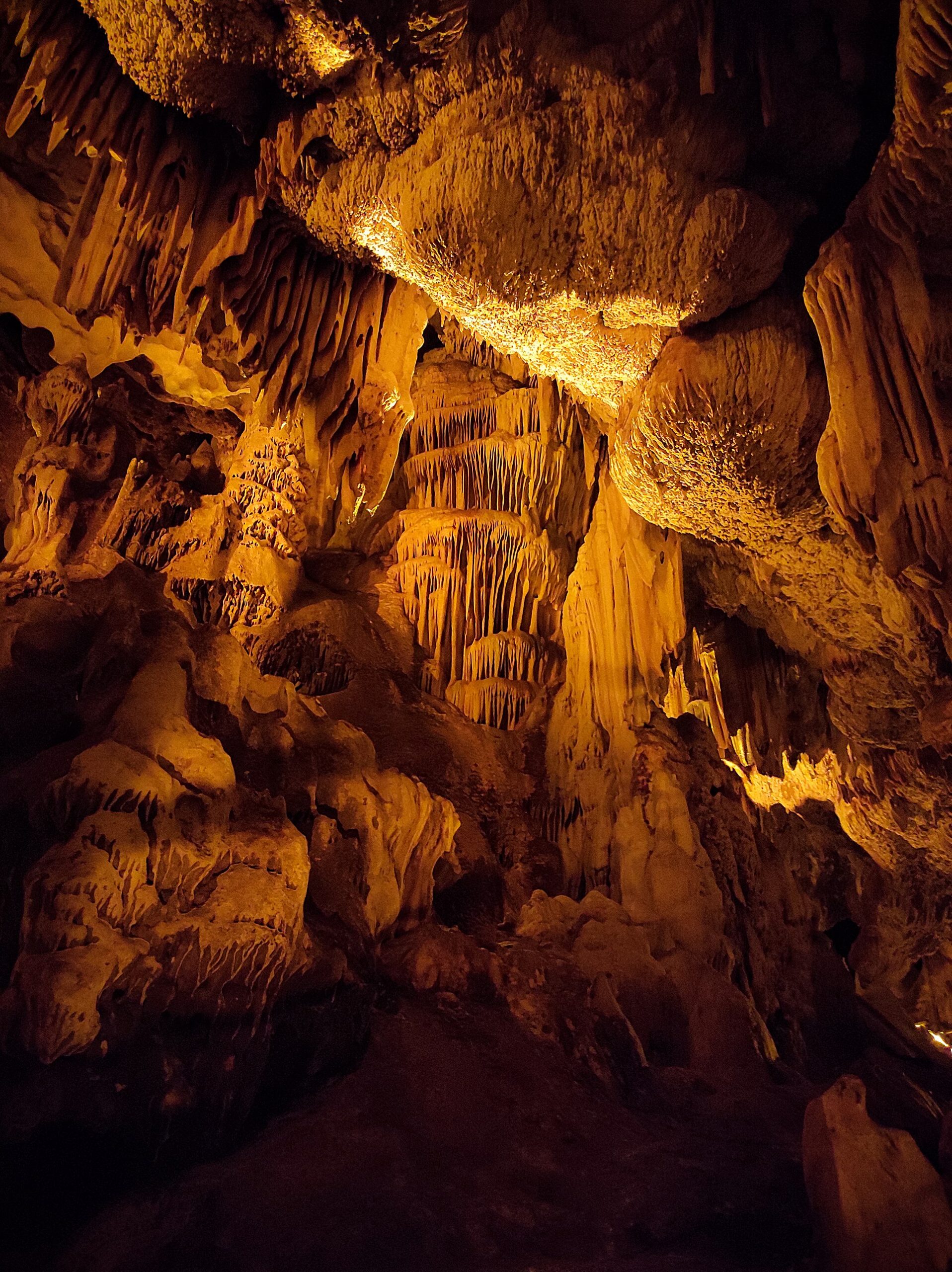
Ballıca Cave is a show cave in Ballıca village, Pazar district, Tokat Province, in the Central Black Sea region of Türkiye. Its age is estimated at about 3.4 million years. It is known for rare “onion” stalactites and dwarf bat colonies, and it has been open to visitors since 1996.
Key facts
- Location: Ballıca village, Pazar district, Tokat Province
- Distance: About 6 km south-east of Pazar (Wikipedia); Tokat city is the main base
- Nearest airport: Tokat Airport, 17 km west of Tokat city centre (Wikivoyage)
- Altitude: 1,085 m above sea level (Tokat Governorship)
- Age: About 3.4 million years (estimate)
- Structure: Five connected levels and eight large halls (Culture Portal)
- Best season: Spring to autumn; winters in Tokat are cold with snowfall
- Typical visit time: About 1 hour in the cave; half a day from Tokat with travel
- UNESCO status: Not inscribed; Tentative List status not confirmed on a page we checked
- Entrance: See official page (Tokat Governorship / Culture Portal) for fees and hours
What is Ballıca Cave and why visit?
Ballıca Cave is a limestone cave near the town of Pazar in Tokat Province. The Culture Portal says its most important feature is the “onion” stalactite formations, and that dwarf bats live in colonies inside. Lighting, walkways and viewing terraces make it a show cave for ordinary visitors.
The cave suits travellers who combine Tokat’s old mosques and caravanserais with a nature stop. Moreover, it is cool inside, so it works well as a break from summer heat. Sources give different figures for its length, so rely on the official page for details.
These are the main reasons to visit:
- Onion-shaped stalactites that the Culture Portal calls the cave’s key characteristic.
- Colonies of dwarf bats, which Wikipedia says can be heard and smelled but are not often seen.
- Named halls with distinct formations, including the Pool Hall and the Great Dripstone Hall.
- A cool, lit walk on prepared paths and terraces.
What is the history of Ballıca Cave?
Research and mapping began in 1987, and walkways and lighting followed in 1995. The cave opened to visitors in 1996. The Tokat Governorship puts its age at about 3.4 million years and says it formed in crystallised limestone.
Wikipedia describes it as a fossil cave and notes marble and lime of Permian-Triassic age in the upper sections. In contrast, the New Hall holds remains of earlier use, including plastered walls. Therefore people used the space before it became a show cave.
The table below sets out the key dates and facts.
| Item | Detail |
|---|---|
| Estimated age | About 3.4 million years |
| Research and mapping begin | 1987 |
| Walkways and lighting | 1995 |
| Opened to visitors | 1996 |
| Structure | Five levels, eight large halls |
What is there to see in Ballıca Cave?
The route passes named halls connected on several levels. The Culture Portal lists the Pool Hall, Great Dripstone Hall, Fossil Hall, Bat Hall, Mushroom Hall, Column Hall and New Hall. Formations include stalactites, stalagmites and columns, and some parts are still forming and closed to visitors.
As a result, a slow walk with time to look at the formations gives more than a quick pass.
Look for these highlights:
- Onion-type stalactites, the signature feature.
- The Pool Hall with its water pond.
- The Fossil Hall and Bat Hall on the second level (Wikipedia).
- The Mushroom, Column and New halls in the Magnificent Gallery.
- The plastered remains in the New Hall that show earlier use.
This at-a-glance table summarises the halls and what to notice.
| Hall | What to notice |
|---|---|
| Pool Hall | Water pond and dripstone |
| Great Dripstone Hall | Large stalactite and stalagmite formations |
| Fossil Hall | Fossil-bearing section |
| Bat Hall | Dwarf bat colonies |
| Mushroom and Column halls | Mushroom-shaped and column formations |
| New Hall | Wide space with traces of old use |
How do you get to Ballıca Cave?
Travel to Tokat, continue to Pazar, then take a taxi to the cave. The Culture Portal says buses run from central Tokat to Pazar, and visitors then take a taxi. The cave lies about 6 km south-east of Pazar, according to Wikipedia.
Tokat Airport is 17 km west of the city and has daily flights from Istanbul taking two hours, per Wikivoyage. Buses from Istanbul take about 12 hours. Check current timetables before you travel.
The table below compares the main routes to Tokat and the cave.
| Option | How it works | Typical time |
|---|---|---|
| Flight to Tokat | Daily flights from Istanbul (Wikivoyage); airport 17 km from city | About 2 hours flying |
| Bus from Istanbul | Intercity bus to Tokat | About 12 hours (Wikivoyage) |
| Drive from Ankara | D200 / 190 / 180 road to Tokat | About 5 hours (375 km) |
| Tokat to Pazar to cave | Bus to Pazar, then taxi | Check current timetable |
| Private transfer or tour | Driver and guide handle the route | Arranged in advance |
When is the best time to visit?
Spring to autumn is the most comfortable period. Wikipedia describes Tokat‘s climate as hot-summer Mediterranean or continental, with cold winters and significant snowfall. Check road and access conditions in winter.
In summer, the cool cave interior is a welcome change from the heat outside. However, weekends and holidays can be busier.
The table shows what to expect by season.
| Season | Weather | Crowds | Notes |
|---|---|---|---|
| Spring | Mild, some rain | Moderate | Good for combining with Tokat sights |
| Summer | Hot outside, cool inside | Highest | Cave is a shaded break |
| Autumn | Mild | Low to moderate | Comfortable walking weather |
| Winter | Cold, snow likely | Low | Check access and opening first |
How long should you stay?
Allow about one hour in the cave and half a day from Tokat including the drive. Add a second half-day for Tokat’s old town if you have time.
Therefore a one-day trip can combine the cave and the city’s main sights.
These sample plans show how to use your time.
| Plan | What you do | Best for |
|---|---|---|
| Half day | Cave visit from Tokat by taxi or car | Short trip |
| 1 day | Cave in the morning; Tokat museum, Ali Paşa Mosque and Taş Han in the afternoon | Most visitors |
| 2-3 days | Add Niksar, Zile or Amasya | Culture and nature |
What are the practical tips for visiting?
Wear shoes with good grip, because cave floors can be damp. Take a light jacket, since the interior is cooler than outside. Check the official page for tickets, fees and hours.
Do not touch the formations, and keep to the lit walkways. Moreover, avoid loud noise, because bats live in the cave. Photography rules may apply, so follow staff guidance.
Practical tips:
- Check the official page for fees, hours and any seasonal closures.
- Wear non-slip shoes and bring a light layer.
- Keep to the walkways and do not touch formations.
- Keep noise low near the bat colonies.
- Expect steps and slopes; the cave is not fully step-free.
- Confirm taxi return arrangements at Pazar.
Where should you stay and eat?
Most visitors stay in Tokat city. Wikivoyage describes hotels along Gaziosmanpaşa Boulevard and in restored caravanserais near the old town. Tokat’s local dishes include Tokat kebab, made with lamb, aubergine, potato, peppers and tomato, per Wikivoyage.
Therefore plan lunch in Tokat’s central streets before or after the cave.
Neighbourhood-level options:
- Gaziosmanpaşa Boulevard for shops and cafes.
- The old town around Sulusokak for restored caravanserai stays.
- Pazar town for a quick stop near the cave.
What else is near Ballıca Cave?
Tokat city has several old buildings. Wikivoyage lists Tokat Castle, the Grand Mosque, Ali Paşa Mosque (1572), Taş Han (1631) and the Gök Medrese from the 1270s. The Mahperi Sultan Caravanserai, dated to 1238, stands on the road to the cave, per the Tokat Governorship.
Amasya, Sivas and Niksar are good onward stops.
Good additions to a Tokat trip:
- Tokat Museum on Sulusokak.
- Ali Paşa Mosque and its hamam complex.
- Taş Han, a caravanserai now used as a shopping centre.
- Yazma (hand-printed cloth) shops.
- Amasya’s Ottoman old town.
- Sivas for rail connections.
The table lists nearby places and links.
| Place | Direction | Note |
|---|---|---|
| Pazar | 6 km north-west of the cave | Gateway town |
| Tokat city | Main base | Museums, mosques, hotels |
| Amasya | West of Tokat (Wikivoyage) | Ottoman old town |
| Sivas | South of Tokat | Rail connections |
Plan this with TurkGT
TurkGT is an Istanbul-based travel company. We offer guided tours, private transfers, licensed guide and interpreter services, and multi-day trips that can include Ballıca Cave and Tokat. We can arrange a Tokat trip with transfers to the cave, a guide for the old town, and onward travel to Amasya or Sivas.
Tell us your dates, group size and interests on WhatsApp. We confirm the route, timing and what is included in writing before you book, and we do not quote prices on this page.
Frequently asked questions
Where is Ballıca Cave?
In Ballıca village, Pazar district, Tokat Province. Wikipedia says it is about 6 km south-east of Pazar.
How old is Ballıca Cave?
Its age is estimated at about 3.4 million years, according to the Culture Portal and the Tokat Governorship.
When did Ballıca Cave open to visitors?
In 1996, after lighting, walkways and terraces were added.
What is special about Ballıca Cave?
The Culture Portal highlights its onion-shaped stalactites and colonies of dwarf bats.
How do I get there?
Take a bus from Tokat to Pazar and then a taxi, as the Culture Portal describes. Check current options.
How long does a visit take?
About one hour inside, or half a day from Tokat.
Is it open in winter?
Please check the official page. Tokat has cold winters with snow, so confirm access first.
How much is the ticket?
Please check the official Tokat Governorship or Culture Portal page for current fees and hours.
Related on TurkGT
- Part of Tokat
Sources
- Ballıca Cave – Türkiye Culture Portal (Ministry of Culture and Tourism)
- Ballıca Mağarası – Tokat Governorship
- Ballıca Cave – Wikipedia
- Tokat – Wikipedia
- Tokat – Wikivoyage
Last reviewed: 2026-11-18. Opening hours, ticket prices and other changeable details are not listed because they change; check the official source before you travel.