
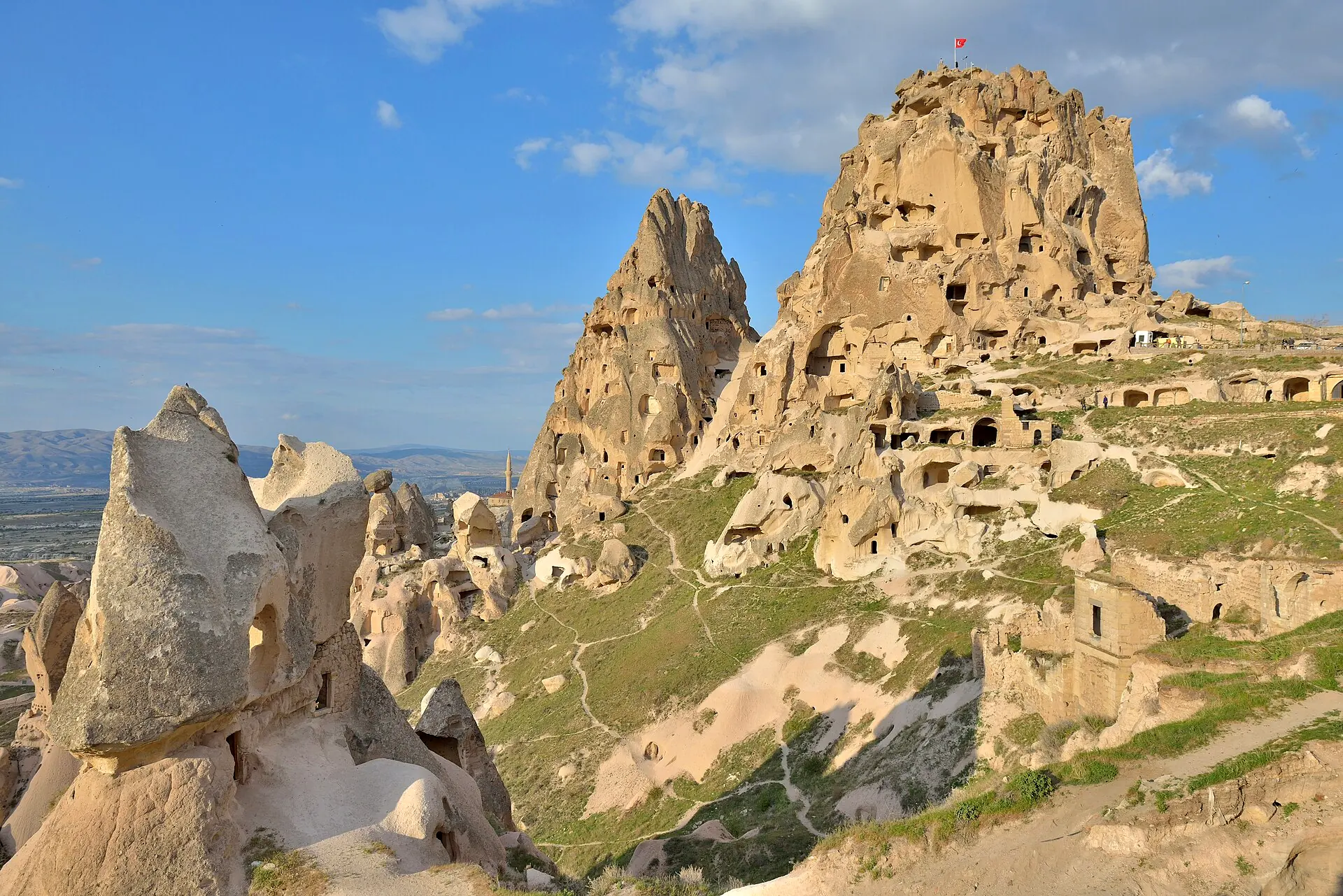
Göreme National Park and the Rock Sites of Cappadocia is a UNESCO World Heritage property in Nevşehir Province, central Türkiye, inscribed in 1985. It combines a volcanic landscape of fairy chimneys with rock-cut churches, cave villages and underground cities. Visit it to see how erosion and centuries of Byzantine monastic life shaped one region.
Key facts
- Location: Nevşehir Province, between Nevşehir, Ürgüp and Avanos, Central Anatolia
- UNESCO status: World Heritage Site, inscribed 1985 (dossier 357), mixed cultural and natural
- Criteria: (i), (iii), (v), (vii)
- Property size: 9,883.81 ha
- From airports: Nevşehir Kapadokya Airport about 30 km north of Nevşehir; Kayseri Erkilet Airport about 70 km east of Göreme; Istanbul by road about 10 hours by bus
- Best season: Spring and autumn; September is mild and dry
- Typical visit time: 2-3 days
- Main sights: Göreme Valley churches, Kaymaklı and Derinkuyu underground cities, Soğanlı
- Entrance: Varies by site; see the official museum page
What is Göreme National Park and why visit?
Göreme National Park and the Rock Sites of Cappadocia is a UNESCO property where erosion, volcanic rock and human settlement meet. The park covers valleys, fairy chimneys, painted rock-cut churches and underground refuges. People visit for the scenery, the Byzantine art and the cave-dwelling tradition.
UNESCO describes a volcanic landscape sculpted by erosion into mountain ridges, valleys and pinnacles known as fairy chimneys. It adds that human settlement makes this one of the world’s most striking and largest cave-dwelling complexes. Moreover, the area is bounded by two extinct volcanoes: Erciyes Dağ at 3,916 m and Hasan Dağ at 3,253 m.
As a result, visitors can combine open-air museum visits, valley hikes, village stays and sunrise views in one trip.
What is the history of Cappadocia?
Cappadocia has a layered history that runs from the Hittites to the Byzantines and the Seljuk Turks. UNESCO dates the first monastic activity to the 4th century and the main rock-church boom to after 842. The Seljuk arrival in 1071 ended the Byzantine period.
Wikipedia notes that Cappadocia was known as Hatti in the late Bronze Age and was the homeland of the Hittite power centred at Hattusa. It was included in the third Persian satrapy in the division established by Darius, and Vespasian joined Armenia Minor to Cappadocia in 70 AD. Between the 7th and 10th century it was a border region of the Byzantine Empire.
UNESCO explains that communities banded together in troglodyte villages and subterranean towns such as Kaymaklı and Derinkuyu, which served as places of refuge. After 842 many rupestral churches were dug and richly decorated with brightly coloured figurative painting. Churches in the Göreme Valley such as Tokalı Kilise and El Nazar Kilise date from the 10th century. Wikipedia adds that Göreme became a Christian monastic centre in 300-1200 AD.
The main historical stages are listed below.
- Late Bronze Age: the region is known as Hatti, homeland of the Hittites.
- 4th century: first signs of monastic activity.
- 7th-10th century: border region of the Byzantine Empire.
- After 842: many rock-cut churches are dug and painted.
- 1071: arrival of the Seljuk Turks.
- 1985: UNESCO inscription.
What does UNESCO protect and how did the landscape form?
UNESCO protects the rock formations, the churches and the traditional settlements across about 9,884 ha. The park lies in Nevşehir Province, between Nevşehir, Ürgüp and Avanos. It also names Karain, Karlık, Yeşilöz, Soğanlı and the subterranean cities of Kaymaklı and Derinkuyu.
Wikipedia explains that soft tuff left by volcanic ash was capped by lava and eroded over millennia into multi-coloured cliffs, rock towers, pillars, tent rocks and fairy chimneys. The park occupies nearly 100 km2. In addition, Wikipedia mentions ignimbrites of Miocene age in the area.
The table shows the four criteria and what they mean in practice.
| Criterion | UNESCO focus | What you see |
|---|---|---|
| (i) | Quality and density of rock-cut sanctuaries | Painted churches of the Göreme Valley |
| (iii) | Rock dwellings of a Byzantine province, 4th century to 1071 | Cave houses and monasteries |
| (v) | Traditional settlement vulnerable to erosion and tourism | Village life in cave homes |
| (vii) | Erosional hoodoo landforms | Fairy chimneys and valleys |
What are the main highlights?
The main highlights are the Göreme Open Air Museum, the fairy chimneys of Paşabağ, Uçhisar Castle, the Red Valley and the underground cities. Together they show the churches, the geology and the defensive tunnels. Visit the valleys early for cooler light.
The Göreme Valley churches carry frescoes in strong colour. The underground cities at Derinkuyu and Kaymaklı extend several levels and were used as refuges. However, the passages are narrow, so allow extra time in busy months.
These are the highlights to prioritise.
- Göreme Open Air Museum: rock-cut churches and monastic rooms.
- Paşabağ (Monks Valley): multi-headed fairy chimneys.
- Uçhisar Castle: a rock outcrop with wide valley views.
- Red Valley (Kızıl Vadi): walking trails at sunset.
- Love Valley: tall chimneys on short walks.
- Derinkuyu and Kaymaklı: multi-level underground cities.
This at-a-glance table sorts the sights by type.
| Sight | Type | Best for |
|---|---|---|
| Göreme Open Air Museum | Rock-cut churches | Byzantine art |
| Derinkuyu / Kaymaklı | Underground cities | Defensive history |
| Red and Love Valleys | Hiking | Landscape and photography |
| Uçhisar Castle | Viewpoint | Panoramas |
| Soğanlı | Valley churches | Quieter visits |
How do you get to Cappadocia and get around?
Fly to Nevşehir Kapadokya or Kayseri Erkilet, or take an overnight bus from Istanbul. Göreme is the usual base. Villages are linked by dolmuş minibuses, and many visitors also use tours or taxis. Check current timetables for flights and buses.
Wikivoyage states that Nevşehir Kapadokya Airport is 30 km north of Nevşehir town and that Kayseri Erkilet Airport is 70 km east of Göreme with flights from Istanbul. It adds that buses from Istanbul to Nevşehir run every couple of hours and take 10 hours. Dolmuş services link the villages and are frequent enough for sightseeing.
The table lists the common arrival options.
| From | Option | Typical duration | Note |
|---|---|---|---|
| Istanbul | Flight to Nevşehir or Kayseri, then transfer | About 1.5 hours flight plus transfer | Check current timetable |
| Istanbul | Intercity bus to Nevşehir | About 10 hours | Overnight options exist |
| Ankara | Bus or car | Several hours | Check current timetable |
| Kayseri Airport | Shuttle, taxi or private transfer | About 1 hour | Distance about 70 km to Göreme |
| Between villages | Dolmuş, taxi or tour | 10-30 minutes | Frequent in season |
When is the best time to visit?
Spring and autumn are the best seasons, because days are mild and valleys are walkable. Summers are hot and winters are cold and snowy. Wikipedia describes a markedly continental climate with hot, dry summers and cold, snowy winters, and Wikivoyage calls autumn mild and dry, especially September.
Balloons launch at sunrise for the lightest winds, according to Wikivoyage, so sunrise is the busiest time.
The table compares the seasons.
| Season | Weather | Crowds | Notes |
|---|---|---|---|
| Spring | Mild, some rain | Medium to high | Green valleys |
| Summer | Hot and dry | High | Hike early morning |
| Autumn | Mild and dry | High | September is often cited as ideal |
| Winter | Cold and snowy | Lower | Snow on chimneys; some paths slippery |
How long should you stay?
Two to three days cover the main sights, while four or more add hiking and day trips. One day is possible but rushed. Therefore decide first whether you want museums, valleys or ballooning.
A longer stay also lets you handle weather changes that can affect valley walks.
The sample plans below show what fits.
| Stay | Suggested plan |
|---|---|
| 1 day | Göreme Open Air Museum, Uçhisar viewpoint, one valley walk |
| 2 days | Add an underground city and the Red Valley |
| 3+ days | Add Soğanlı, Avanos, Ürgüp and a longer hike |
What practical tips should you know?
Wear sturdy shoes, bring water, and check official pages for tickets and hours. Churches may restrict photography, and some trails are uneven. Respect the cave dwellings, because many are private homes.
UNESCO warns that the traditional settlement has become vulnerable under the combined effects of natural erosion and tourism, so stay on marked paths.
Keep these tips in mind.
- Tickets: see the official museum page; museum passes exist for Cappadocia.
- Footwear: grippy shoes for rock paths.
- Accessibility: valleys and underground cities involve steps and narrow passages.
- Safety: do not climb fairy chimneys; weather can change fast.
- Photography: follow signs inside churches.
- Ballooning: operators set safety rules; confirm with a licensed provider.
Where should you stay and eat?
Stay in Göreme, Uçhisar, Ürgüp or Avanos depending on the mood you want. Göreme is central, and Uçhisar has the castle views. Wikivoyage notes that cave hotels are the specialty of Cappadocia.
For food, try testi kebap, meat and vegetables cooked in a clay pot sealed with bread dough, as Wikivoyage describes. Local wine and pottery dishes from Avanos are also common.
What can you visit nearby?
Nearby you can visit Avanos for pottery, Ortahisar, Ürgüp, Kayseri and Mount Erciyes. Longer routes lead to Hattusha and Ankara.
Plan this with TurkGT
TurkGT is an Istanbul-based travel company. We offer the Cappadocia Short Trip From Istanbul by Flight (2-3 days), private transfers and guide or interpreter services. Contact us on WhatsApp to confirm availability and details.
Frequently asked questions
When did Göreme and Cappadocia become a UNESCO site?
UNESCO inscribed it in 1985, dossier 357.
Which criteria apply?
Criteria (i), (iii), (v) and (vii).
How big is the property?
UNESCO gives 9,883.81 ha.
What are fairy chimneys?
They are pinnacles formed when erosion shapes soft volcanic tuff capped by lava.
Which underground cities are included?
UNESCO names Kaymaklı and Derinkuyu.
How do I get to Göreme from Istanbul?
Fly to Nevşehir or Kayseri, or take a bus of about 10 hours; check current timetables.
What is the best time to visit?
Spring and autumn are mild; Wikivoyage names September as especially good.
How much does entry cost?
Fees vary; see the official museum page.
Related on TurkGT
- Part of Nevşehir
- Göreme Open Air Museum
- Uçhisar Castle
- Derinkuyu Underground City
- Kaymaklı Underground City
- Love Valley
- Göreme
Sources
- UNESCO World Heritage Centre: Göreme National Park and the Rock Sites of Cappadocia
- Wikipedia: Göreme National Park
- Wikipedia: Cappadocia
- Wikivoyage: Cappadocia
Last reviewed: 2026-11-17. Opening hours, ticket prices and other changeable details are not listed because they change; check the official source before you travel.