
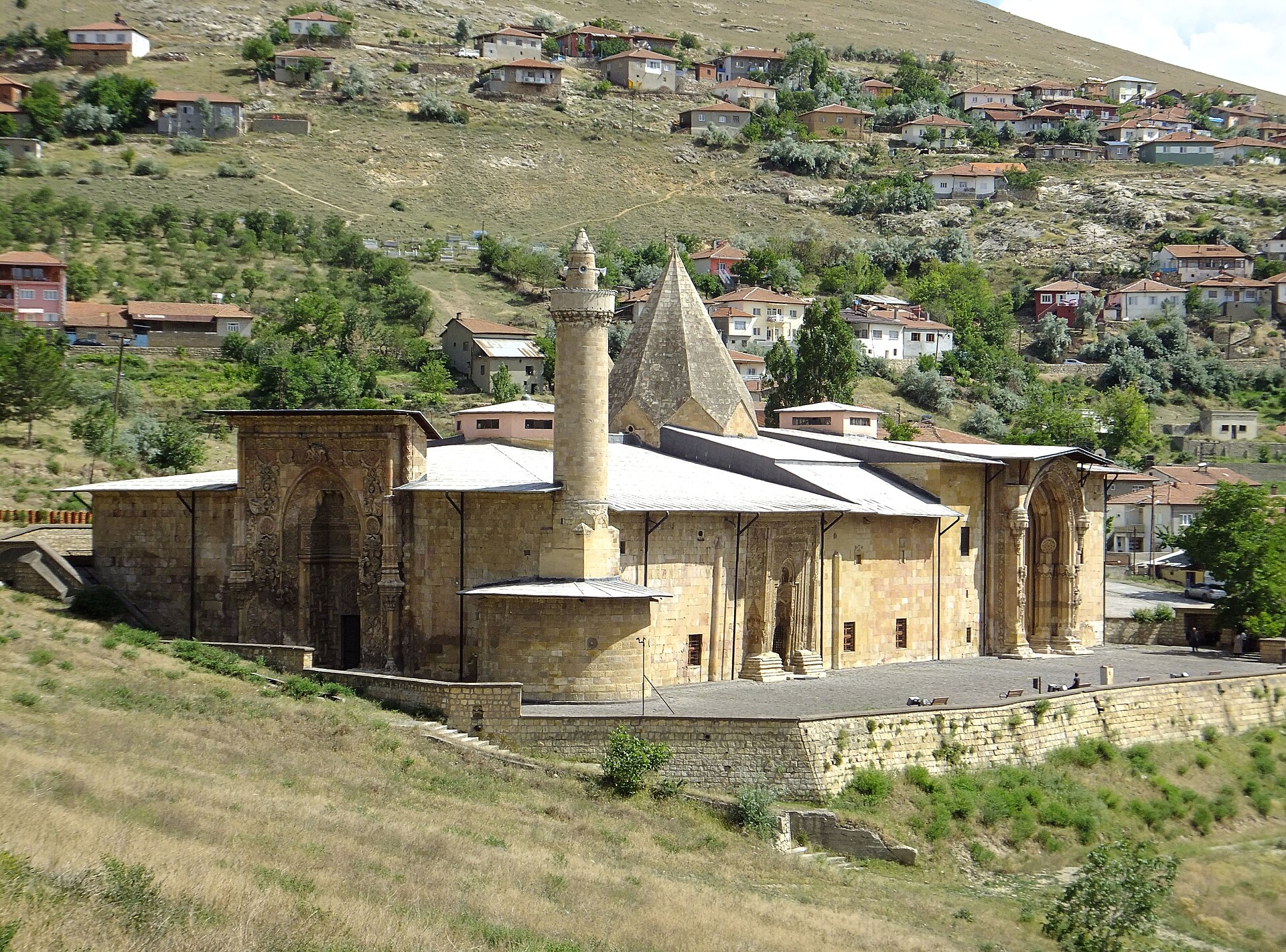
The Great Mosque and Hospital of Divriği is a mosque-and-hospital complex in the small town of Divriği, Sivas Province, inscribed by UNESCO in 1985 under criteria (i) and (iv). It is known for three richly carved stone portals and a hospital built in 1228-1229. Visit it to see some of the finest stone carving of medieval Anatolia.
Key facts
- Location: Divriği, Sivas Province, on the slopes below the citadel
- UNESCO status: World Heritage Site, inscribed 1985
- Criteria: (i) and (iv)
- Components: Great Mosque (Ulu Cami) and the Darüşşifa hospital with a tomb
- Distance: About 180 km southeast of Sivas by bus or train; Sivas has flights from Istanbul of about 90 minutes
- Best season: Late spring to early autumn; winters are cold and snowy
- Typical visit time: 1-2 hours at the complex; half a day with the town and citadel
- Patrons: Mengücek dynasty: Ahmed Shah (mosque), Turan Melek (hospital)
- Entrance: See the official page of the Ministry of Culture and Tourism
What is the Great Mosque and Hospital of Divriği and why visit?
It is a Seljuk-era Anatolian complex that joins a mosque and a hospital in one enclosed ensemble. The site stands in Divriği, in Sivas Province. Visitors come for its elaborate stone portals, which UNESCO and Wikipedia both praise.
UNESCO calls it a remarkable building combining a monumental hypostyle mosque with a two-storey hospital, which includes a tomb. It also describes it as an outstanding example of a Seljuk mosque in Anatolia. In contrast to many large monuments, Divriği is quiet, and a visit gives time to study details.
Therefore the complex suits travellers interested in architecture, stone carving and the Mengücek dynasty.
What is its history?
The complex dates to the early 13th century under the Mengücek dynasty. UNESCO says the mosque was founded by the emir Ahmed Shah after the Seljuk victory at Malazgirt in 1071. The hospital, the Darush-shifa, was founded by his wife Turan Melek and dated 1228-1229.
Wikipedia states that the complex was built in 1228-1229 by the local dynasty of the Mengujekids. It adds that the north portal gives the date 626 AH, equal to 1228-9. The Turkish Culture Portal says the complex was built under the Mengücek Beylik, linked to the Anatolian Seljuk state, with the mosque commissioned by Ahmet Şah and the hospital by his wife Turan Melek.
UNESCO credits the architect Hurrem Shah. Wikipedia reads the architect’s name as Khurramshāh ibn Mughīth al-Khilātī, a name that indicates origin in Ahlat. Restoration work began in 2015 when the first tender was held, according to Wikipedia.
In context, the foundation links the complex to the Turkish presence in Anatolia after 1071. Consequently, the buildings are often read as a monument of the early Anatolian Turkish-Islamic period, and its carving is a major reference for later stone architecture in the region.
The key dates are summarised below.
- 1071: Seljuk victory at Malazgirt, cited by UNESCO as context for the foundation.
- 1228-1229: construction of the hospital and the date given on the north portal.
- 1985: UNESCO World Heritage inscription.
- 2015: restoration work begins, according to Wikipedia.
What does the World Heritage listing cover?
The listing covers the mosque and the hospital as one complex on the slopes below Divriği Castle. Both buildings were inscribed in 1985. UNESCO cites two criteria: (i) a unique artistic achievement and (iv) an outstanding example of a Seljuk mosque that organises all religious functions in an enclosed area.
UNESCO also warns that the stone ornamentation is vulnerable to atmosphere, humidity and salt.
The table summarises the two components.
| Component | Founder | Date | Notable features |
|---|---|---|---|
| Great Mosque (Ulu Cami) | Emir Ahmed Shah | Early 13th century | Hexagonal pointed dome over the mihrab; north and west portals |
| Hospital (Darüşşifa) | Turan Melek | 1228-1229 | Two storeys; includes a tomb |
What are the highlights to see?
The highlights are the carved portals, the stone-vaulted prayer hall and the hospital. The sculpture is concentrated on the three doorways, in contrast to the unadorned interior walls. UNESCO says each portal design is distinct.
Inside the mosque, four rows of four piers create five naves roofed by intricately carved stone vaults. Moreover, the Culture Portal notes that none of the tens of thousands of motifs repeats itself. As a result, a slow visit rewards careful looking.
Take time at each portal before entering. First, compare the north and west doorways, because the carving styles differ. Next, step inside and look up at the vaults, where the stonework continues the decoration of the entrances. Finally, visit the hospital, which shares the same enclosed ensemble as the mosque.
Moreover, the architecture shows how a hypostyle prayer hall and a medical institution were planned as one group. In contrast to a courtyard mosque, UNESCO notes that the design keeps all religious functions in an enclosed area. For that reason, the complex rewards visitors who read the building as a whole rather than as a series of separate rooms.
Look for these details.
- The north portal, with its dated inscription.
- The west portal, with dense high-relief carving.
- The hexagonal pointed dome over the mihrab.
- Five naves formed by four rows of four piers.
- The hospital court and tomb.
- The citadel above the town.
This at-a-glance table lists the key elements.
| Element | What to notice |
|---|---|
| Portals | Three doorways, each with a distinct design |
| Interior | Unadorned walls and carved stone vaults |
| Dome | Hexagonal, pointed roof above the mihrab |
| Hospital | Two-storey Darush-shifa with a tomb |
How do you get to Divriği and get around?
Divriği is reached by bus or train from Sivas, about 180 km to the southeast. Fly to Sivas from Istanbul in about 90 minutes, then continue by road or rail. Check current timetables for buses and trains.
Wikivoyage says a regional train runs twice daily between Erzincan, Divriği and Sivas, and that the Doğu Express runs via Divriği to Kars. It also notes two daily flights from Istanbul (IST and SAW) take about 90 minutes.
The table lists the common routes.
| From | Option | Typical duration | Note |
|---|---|---|---|
| Istanbul | Flight to Sivas, then bus or train to Divriği | About 90 minutes flight plus road or rail | Check current timetable |
| Sivas | Bus or regional train | Several hours | About 180 km |
| Erzincan | Regional train | Check current timetable | Twice-daily service per Wikivoyage |
| Within Divriği | Walking | 10-20 minutes | Complex lies below the citadel |
When is the best time to visit?
Late spring to early autumn is the best time, because winters are bitterly cold. Wikivoyage says Sivas stands on a high plain with hot, dry summers and bitterly cold, snowy winters. Therefore plan a winter visit only with weather checks.
Since the site is small, crowds are rarely a problem in any season.
The table compares the seasons.
| Season | Weather | Crowds | Notes |
|---|---|---|---|
| Spring | Cool to mild | Low | Good light on stone |
| Summer | Hot and dry | Low | Midday sun is strong |
| Autumn | Mild | Low | Pleasant for walking |
| Winter | Cold and snowy | Very low | Roads can be difficult |
How long should you stay?
One to two hours suffice for the complex, and a half day adds the town. Most travellers combine it with Sivas, so allow a full day for the round trip from Sivas.
The table gives sample plans.
The plans below fit different schedules.
| Stay | Suggested plan |
|---|---|
| Half day | Mosque, hospital and town walk |
| 1 day | Add the citadel and road views from Sivas |
| 2-3 days | Combine Sivas, Divriği and Erzincan |
What practical tips should you know?
Dress modestly, remove shoes in prayer areas and check the official page for tickets and opening hours. The complex may be an active mosque, so follow signs and respect worshippers.
Bring water and layers, because the plain is exposed. Moreover, carving is fragile, so do not touch the stone.
A small guidebook or guide helps, because on-site information may be limited. Visit in the morning for even light on the carved portals. In addition, allow time for the town of Divriği, which has a quiet, small-town character. Check the official page for any restoration work, since scaffolding or closed areas can affect access. Finally, keep your itinerary flexible when winter weather affects roads.
Keep these tips in mind.
- Tickets: see the official page.
- Dress: shoulders and knees covered; scarf for women.
- Photography: follow signs inside.
- Accessibility: the town is hilly; ask locally about access.
- Etiquette: stay quiet at prayer times.
Where should you stay and eat?
Base yourself in Sivas for the widest choice, or stay in Divriği for a short visit. Choices in Divriği are limited. In Sivas, look for local kebab and meat dishes in the city centre. Kangal, on the road to Divriği, is known for its sheepdog breed, according to Wikivoyage.
What can you visit nearby?
Nearby you can visit Sivas city, Erzincan and Kayseri. Longer routes lead to Cappadocia and Hattusha.
Plan this with TurkGT
TurkGT is an Istanbul-based travel company. We offer guided trips, private transfers and guide or interpreter services across Türkiye. Contact us by WhatsApp to confirm availability and details for a Divriği itinerary.
Frequently asked questions
Where is the Great Mosque and Hospital of Divriği?
It is in Divriği, Sivas Province, on the slopes below the castle.
When was it inscribed by UNESCO?
UNESCO inscribed it in 1985 under criteria (i) and (iv).
When was the hospital built?
UNESCO dates the Darush-shifa to 1228-1229.
Who built it?
The Mengücek dynasty: Ahmed Shah the mosque and his wife Turan Melek the hospital.
What is special about the portals?
Each of the three doorways has a distinct design with dense carving.
How far is Divriği from Sivas?
About 180 km southeast, according to Wikivoyage.
What is the best season to visit?
Late spring to early autumn; winters are bitterly cold.
How much does entry cost?
See the official page.
Sources
- UNESCO World Heritage Centre: Great Mosque and Hospital of Divriği
- Wikipedia: Great Mosque and Hospital of Divriği
- Divriği Ulu Camii ve Darüşşifası – Kültür Portalı
- Wikivoyage: Sivas
Last reviewed: 2026-11-17. Opening hours, ticket prices and other changeable details are not listed because they change; check the official source before you travel.