
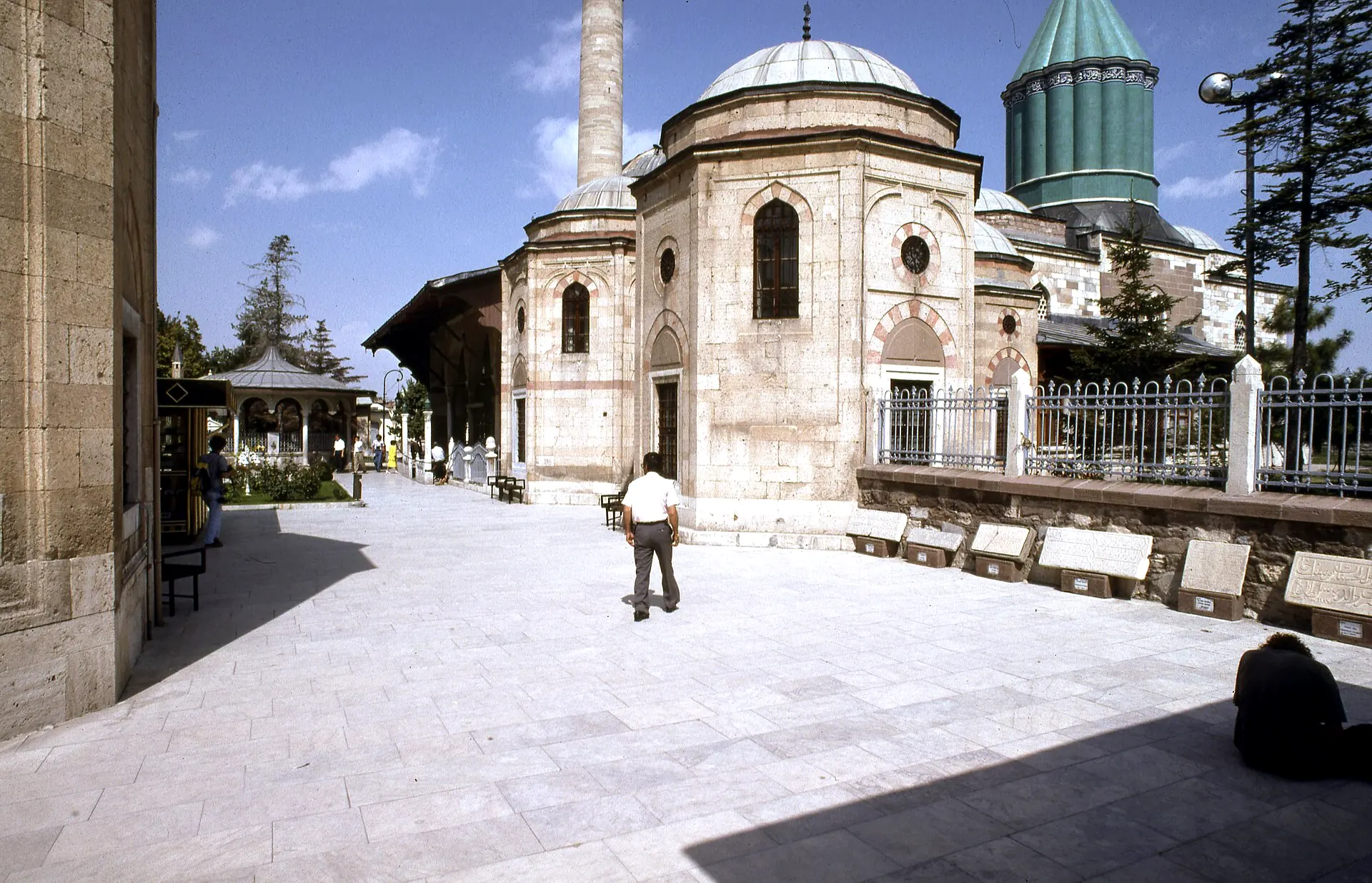
The Mevlana Museum (Mevlânâ Müzesi) in Konya, Türkiye, began as the dervish lodge of the Mevlevi order, known as the whirling dervishes. It houses the mausoleum of the Sufi poet Jalal ad-Din Rumi (Mevlâna), completed in 1274, under a dome covered with turquoise tiles. It opened as a museum in 1927 and is easy to combine with other Seljuk sights in central Konya.
Key facts
- Location: Mevlana Caddesi, central Konya, Central Anatolia
- Distance from airport and cities: Konya Airport is about 18 km north; Ankara is 1 hr 45 min by YHT; Istanbul 4 hr 45 min by YHT
- Origin: Dervish lodge (tekke) of the Mevlevi order
- Mausoleum: Rumi died 17 December 1273; mausoleum completed 1274
- Museum status: Atatürk decree of 6 April 1926; opened 2 March 1927; renamed Mevlâna Museum in 1954
- Distinctive feature: Turquoise-tiled dome, a symbol of Konya
- UNESCO status: Not a separate World Heritage Site; Mevlevi Sema ceremony is on UNESCO’s intangible heritage list
- Best season: Spring and autumn; December for the Şeb-i Arûs commemoration
- Typical visit time: About 1 to 2 hours
- Entrance: See official page (check current fees, hours and dress rules)
What is the Mevlana Museum and why visit?
The Mevlana Museum is the former dervish lodge and mausoleum of Rumi in the centre of Konya. It is the spiritual heart of the Mevlevi order and one of Türkiye’s most visited museums. Visitors come for the turquoise dome, the tomb chambers, the ritual hall and the atmosphere of pilgrimage.
Wikipedia reports that the museum received 3.4 million visitors in 2019, making it Turkey’s most visited museum that year. Moreover, GoTürkiye calls Konya one of Türkiye’s most important pilgrimage centres. As a result, visitors meet both tourists and worshippers inside the complex.
In contrast to many museums, the site is also an active place of memory. GoTürkiye says the mausoleum and former lodge can be visited by people of all faiths, so quiet and respectful behaviour is expected.
What is the history of the Mevlana Museum?
The complex grew around the grave of Rumi, who died on 17 December 1273 and was buried beside his father. His successor Hüsamettin Çelebi had the Seljuk mausoleum built, and it was completed in 1274. The lodge expanded for centuries, and Atatürk’s 1926 decree turned it into a museum that opened in 1927.
Wikipedia explains that the Seljuk sultan Alâeddin Keykubad gave his rose garden as a burial place for Rumi’s father, Baha’ ud-Din Walad, who died in 1231. The mausoleum architect was Badr al-Din Tabrizi, and construction costs were met by Gurju Khatun and Emir Alameddin Kayser.
GoTürkiye says the semahane, masjid, dede cells, kitchen and fountain were built in the 16th century, and Wikipedia says sections were added until 1854. Therefore the complex shows Seljuk origins with strong Ottoman additions. Wikipedia adds that the museum was officially renamed Mevlâna Museum in 1954.
Key dates:
- 1231: Baha’ ud-Din Walad dies and is buried in the rose garden.
- 1273: Rumi dies on 17 December.
- 1274: mausoleum completed.
- 16th century: ritual hall, kitchen, cells and fountain built.
- 1926-1927: museum decree and opening.
- 1954: renamed Mevlâna Museum.
The table summarises the building story.
| Date | Event | Detail |
|---|---|---|
| 1231 | Burial of Rumi’s father | Garden given by Sultan Alâeddin Keykubad |
| 1273-1274 | Rumi dies; mausoleum completed | Architect Badr al-Din Tabrizi |
| 16th c. | Lodge buildings added | Semahane, cells, kitchen, fountain |
| 1926 | Atatürk decree | Lodge becomes a museum |
| 1927 | Museum opens | 2 March 1927 |
What are the highlights of the Mevlana Museum?
The highlights are the turquoise dome, the marble courtyard, the ritual hall, the sarcophagi and the small mosque with its manuscripts. Together they show how the order lived, prayed and performed the sema, the whirling ritual, which the lodge hosted for centuries.
Wikipedia describes a marble-paved courtyard entered through the main gate, with the dervishes’ kitchen and 17 small domed cells. The ritual hall displays musical instruments such as the ney, kudüm and rebab, dervish clothing and rare manuscripts. In addition, Mevlâna’s sarcophagus lies under the dome, covered with gold-embroidered brocade, and next to it rest his father and his son.
The adjoining small mosque exhibits illuminated Korans and prayer rugs. Therefore the visit moves from outdoor courtyard to ritual hall to tomb chamber, and each space has a distinct purpose.
Look out for these features:
- The turquoise-tiled dome over the tomb.
- The marble-paved courtyard and the ablutions fountain.
- 17 small domed dervish cells.
- The semahane (ritual hall) with instruments and old manuscripts.
- The silver lattice and sarcophagi in the mausoleum.
- Illuminated Korans in the small mosque.
A quick overview of the main areas.
| Area | What it is | Why it matters |
|---|---|---|
| Courtyard | Marble-paved entrance space | Fountain, kitchen and cells around it |
| Semahane | Ritual hall | Where the sema was performed |
| Mausoleum | Tomb chamber under the dome | Sarcophagi of Rumi and family |
| Small mosque | Display of Korans and rugs | Illuminated manuscripts |
| Dervish cells | 17 domed rooms | Show daily life in the lodge |
How do you get to the Mevlana Museum and get around?
Konya is reached by high-speed YHT train, plane or bus, and the museum is central on Mevlana Caddesi, within walking distance of many sights. Wikivoyage lists YHT trains from Istanbul taking 4 hr 45 min and from Ankara taking 1 hr 45 min. Check the current TCDD timetable before booking.
Konya Airport is 18 km north of the city and has flights from both Istanbul airports, according to Wikivoyage. Buses from Istanbul take about 11 hours, from Ankara about 4 hours and from Göreme in Cappadocia about 3 hours 30 minutes. Moreover, the central district is walkable, with most sites within about 1 km.
Trams run through the centre and loop Alaaddin Hill, and they need a KonyaKart rather than cash. Therefore many visitors walk from the hill to the museum along Mevlana Caddesi.
Plan your journey with these notes:
- YHT train: Ankara and Istanbul connect to Selçuklu station, 4 km north of downtown.
- Plane: Konya Airport, 18 km north, with a Havaş bus link on some flights.
- Bus: terminal is 7 km north; tram or dolmuş to the centre.
- Tram: Lines 1 and 2 serve the centre, with a KonyaKart.
- On foot: most central sights are within about 1 km.
Typical journeys to Konya (check current timetables).
| From | Mode | Typical duration |
|---|---|---|
| Ankara | YHT train | 1 hr 45 min |
| Istanbul | YHT train | 4 hr 45 min |
| Istanbul | Intercity bus | About 11 hours |
| Göreme (Cappadocia) | Bus | About 3 hr 30 min |
| Antalya | Bus | About 6 hours |
When is the best time to visit the Mevlana Museum?
Spring and autumn are the most comfortable seasons in Konya, while December brings the Şeb-i Arûs commemoration of Rumi’s death. Summers are hot and dry, and winters are cold with frequent light snow, so the best weather for walking falls between April-May and September-October.
Wikivoyage describes a continental climate: hot, arid summers; cold winters with snow; and cool to mild spring and autumn. Konya lies at about 1,016 m elevation, so nights can be chilly even in summer. Therefore pack layers.
The Şeb-i Arûs, the ‘reunion night’ on 17 December, brings extra ceremonies and many visitors. Wikivoyage says sema ceremonies are held more often in the weeks leading up to it. Book ahead and check official event dates.
Season guide for the Mevlana Museum.
| Season | Weather | Crowds | Notes |
|---|---|---|---|
| Spring (Apr-May) | Cool to mild, showers | Moderate | Good walking weather |
| Summer (Jun-Aug) | Hot, dry, cooler nights | Moderate to high | Go early or late in the day |
| Autumn (Sep-Nov) | Mostly dry, cool | Moderate | Comfortable for sightseeing |
| Winter (Dec-Mar) | Cold, grey, snow | High in December | Şeb-i Arûs around 17 December |
How long should you stay at the Mevlana Museum?
Plan one to two hours at the museum itself. A short visit covers the courtyard, mausoleum and ritual hall; a full half day adds the Mevlana Cultural Centre, Selimiye Mosque and Alaaddin Hill. A two-day stay lets you add Sille village, the Karatay Medresesi and an evening sema.
Because the site is a place of devotion, queues can build during busy periods, and visitors may linger by the tomb. Moreover, quiet corners in the courtyard make good rest stops. Therefore arrive early if you want calmer spaces.
If you travel from Cappadocia, Konya works as a day trip, but an overnight lets you attend an evening sema and see the old city in better light.
Suggested plans by time available.
| Time | Plan | Covers |
|---|---|---|
| Half day | Mevlana Museum, Selimiye Mosque, lunch near Mevlana Caddesi | Core Rumi sites |
| 1 day | Add Alaaddin Hill, İnce Minare, Karatay Medresesi, Archaeology Museum | Seljuk Konya |
| 2-3 days | Add Sille, evening sema, Çatalhöyük day trip | Konya and region |
What practical tips should you know before visiting?
Dress modestly, remove or cover shoes as instructed and keep your voice low. Check the official page for current fees, hours and dress rules, because they can change. Allow extra time on weekends and holidays, when worshippers and school groups visit in large numbers.
Wikivoyage notes that Konya has a conservative outlook, and conservative dress is common. Therefore shorts and sleeveless tops are not suitable in mosques or the mausoleum, and women may wish to carry a light scarf. In contrast, casual walking clothes are fine for the streets.
Photography rules vary by room, so follow signs and staff instructions, and do not photograph worshippers praying. The courtyard and building have steps and uneven floors, so accessibility is limited in some areas. Ask staff which routes are suitable.
Etiquette and logistics checklist:
- Dress modestly; carry a scarf if you wish.
- Follow shoe-covering and silence rules.
- Check the official page for fees and hours.
- Do not photograph people at prayer.
- Expect queues in December and on public holidays.
Where should you stay and eat near the Mevlana Museum?
Stay in the central district around Mevlana Caddesi and Alaaddin Hill, so you can walk to the museum. Konya is an inland Anatolian city, so ask locally for regional specialities and bread-based dishes. Evenings are quieter than in beach resorts.
The central area has many options from modest guesthouses to larger hotels, and tram lines connect the hill with the outskirts. Moreover, the compact centre means most meals are within a short walk of the museum. We do not name individual businesses here because they change often.
Therefore choose by location and read recent reviews. Ask your host about restaurants that open late if you plan to attend an evening sema.
What are the nearby places and day trips?
Nearby sights include Selimiye Mosque, Alaaddin Hill and Mosque, İnce Minare Museum, Karatay Medresesi and the Archaeology Museum, with Sille village about 11 km northwest. A longer day trip reaches the Neolithic site of Çatalhöyük, described on a separate page of this site.
Wikivoyage says the Archaeology Museum displays regional finds, especially carved sarcophagi and discoveries from Çatalhöyük, though it noted temporary closures in 2023, so check the current status. Sille is a well-preserved Greek village with rock-cut churches.
As a result, Konya fits a route between Cappadocia and Antalya or the Aegean.
Related places on this site:
- Konya province guide
- Neolithic Site of Çatalhöyük
- Göreme and Cappadocia
Plan this with TurkGT
TurkGT is an Istanbul-based travel company that offers guided trips, private transfers, local guides and interpreter support across Türkiye. Tell us your dates, group size and interests, and we will propose a route and confirm the details with you by WhatsApp. Prices, timings and availability are agreed directly with our team, so please message us before you book anything non-refundable.
Frequently asked questions
What is the Mevlana Museum in Konya?
It is the former dervish lodge of the Mevlevi order and houses the mausoleum of Jalal ad-Din Rumi (Mevlâna). It has been a museum since 1927.
When was Rumi’s mausoleum built?
Rumi died on 17 December 1273 and the mausoleum was completed in 1274.
When did the lodge become a museum?
An Atatürk decree of 6 April 1926 ordered it, and the museum opened on 2 March 1927.
Can visitors of any faith enter?
GoTürkiye says the mausoleum and former lodge can be visited as a museum by visitors of all faiths.
How do I get from Ankara to Konya?
Wikivoyage lists YHT trains taking 1 hr 45 min. Check the current TCDD timetable.
How long should I plan for the visit?
One to two hours is typical, longer if you add other central sights.
What should I wear?
Dress modestly and follow the rules posted at the entrance; see the official page.
When is the Şeb-i Arûs commemoration?
It marks Rumi’s death on 17 December; check official sources for the current programme.
Related on TurkGT
Sources
- Mevlâna Museum – Wikipedia
- Konya (Wikivoyage)
- Mevlana Museum – GoTürkiye
- The Sufi Path of Love: Mevlana – GoTürkiye
Last reviewed: 2026-11-17. Opening hours, ticket prices and other changeable details are not listed because they change; check the official source before you travel.