
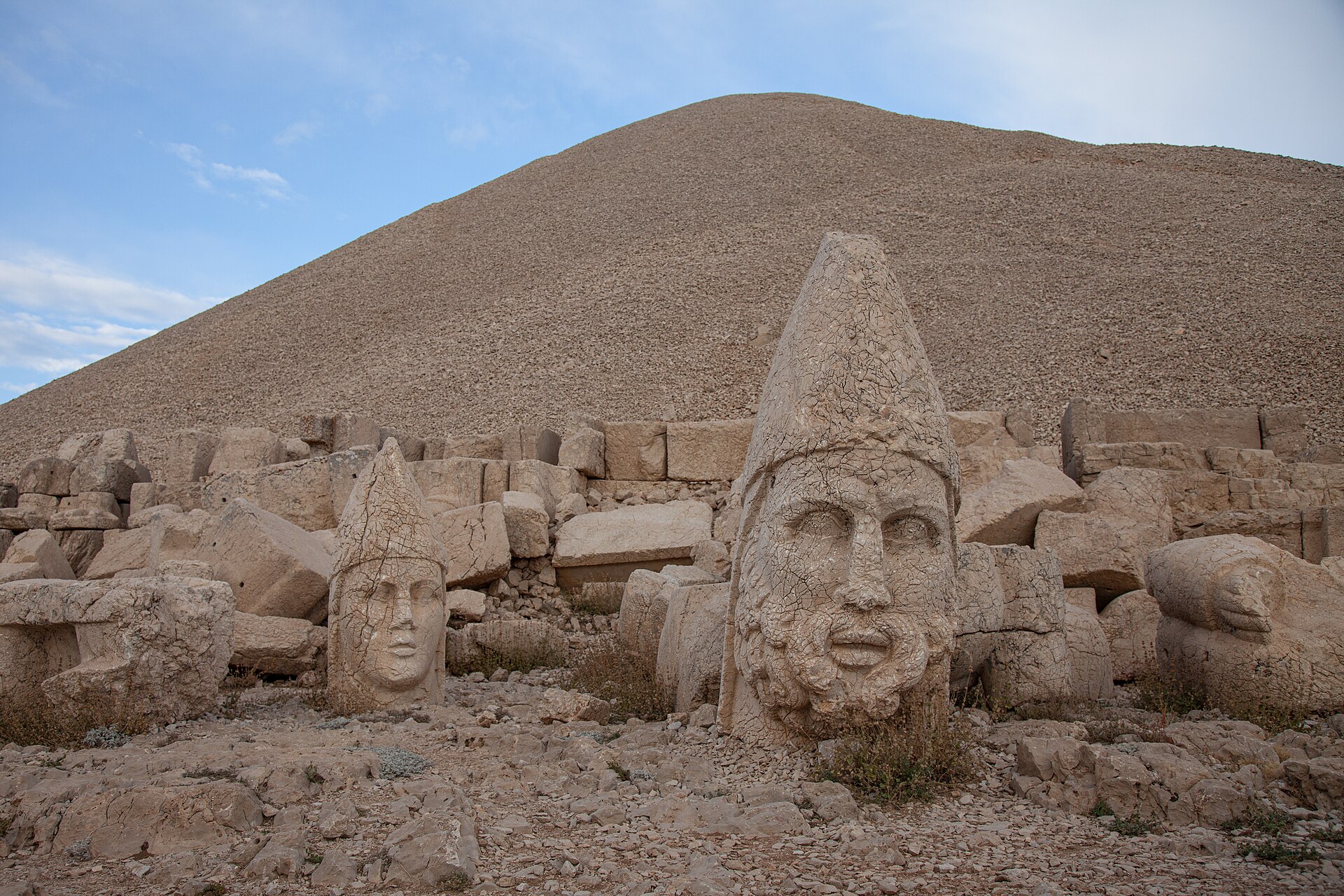
The Mount Nemrut statues are five giant seated limestone figures of deities on the east and west terraces of Nemrut Dağ, in Kahta district, Adıyaman, south-east Türkiye. King Antiochos I of Commagene (69-34 BC) built the sanctuary as a monument to himself. UNESCO has listed the site since 1987 under criteria i, iii and iv.
Key facts
- Location: Nemrut Dağ, Kahta district, Adıyaman Province, south-east Türkiye
- Altitude: 2,150 m (Ministry of Culture and Tourism)
- Builder: King Antiochos I of Commagene (69-34 BC, per UNESCO)
- Statues: Five seated limestone deities, flanked by a lion and an eagle at each end
- UNESCO status: World Heritage Site, inscribed 1987; cultural criteria i, iii, iv
- Nearest bases: Adıyaman, Kahta and Malatya (tour departures); no fixed distances given here
- Best season: April to October, per Wikipedia
- Typical visit time: Half day to a full day with transfer; many people add an overnight stay
- Entrance: See the official page of the Ministry of Culture and Tourism
What are the Mount Nemrut statues and why visit?
The Mount Nemrut statues are giant seated limestone figures on the terraces of Nemrut Dağ, in Adıyaman Province. King Antiochos I of Commagene built them as part of a tomb-sanctuary around 2,000 years ago. UNESCO calls the site a Hierotheseion, a sanctuary built as a monument to the king himself.
Visitors come for the scale of the heads, the mountain setting and the mix of Greek and Persian traditions. Moreover, the site is a World Heritage Site with a clear story. As a result, it suits history lovers and photographers alike.
Why people travel here:
- Five colossal seated statues of deities
- A 50 m high funerary mound of stone chips
- Views over the Eastern Taurus mountains
- Greek and Persian gods shown side by side
- A short list of nearby Commagene sites such as Arsameia
What is the history of Mount Nemrut and Commagene?
King Antiochos I of Commagene, who ruled 69-34 BC, built the sanctuary as a monument to himself. Wikipedia describes Commagene as a kingdom founded north of Syria and the Euphrates after the breakup of Alexander’s empire. The king mixed Greek and Persian gods in his dynastic cult.
The site was excavated in 1881 by Karl Sester, a German engineer assessing transport routes for the Ottomans. After her first visit in 1947, Theresa Goell dedicated her life to the site. However, later excavations have failed to reveal the tomb of Antiochos.
The table summarises the main dates from the sources.
| Date | Event | Source |
|---|---|---|
| 69-34 BC | Reign of Antiochos I of Commagene | UNESCO |
| Hellenistic period | Hierotheseion built as a monument to the king | UNESCO |
| 1881 | Excavated by Karl Sester | Wikipedia |
| 1947 | Theresa Goell’s first visit | Wikipedia |
| 1987 | UNESCO inscription | UNESCO, Wikipedia |
What can you see at Mount Nemrut?
The main sights are the east and west terraces, the tumulus and the fallen heads. UNESCO describes five giant seated limestone statues of deities facing outwards on the upper level of each terrace. A lion and an eagle flank them at each end, and the heads have fallen to the lower level.
The Ministry names the east terrace figures: Commagene near Antiochos I, Zeus-Orosmasdes in the middle, Apollo-Mithras and Herakles-Artagnes on the far right. The Culture Portal adds that the east and west terraces are identical apart from small details.
Highlights to look for:
- East terrace: the best preserved of the three terraces
- West terrace: a large slab with a lion, and the head of Antiochos in snow at sunset in Wikipedia’s photo caption
- The tumulus: a 50 m high mound of stone chips
- Fallen heads on the lower level
- Lions and eagles as guardians
This table gives the main features at a glance.
| Feature | What it is | Note |
|---|---|---|
| East terrace | Best-preserved terrace, five seated gods | Ministry and Culture Portal |
| West terrace | Similar statues, lion slab | Wikipedia |
| Tumulus | 50 m high funerary mound (UNESCO) | Other sources give other heights |
| Guardian animals | Lion and eagle at each end | UNESCO |
| Burial chamber | Not found to date | Culture Portal |
How do you get to Mount Nemrut and get around?
Most visitors use a guided trip or a private car from Adıyaman, Kahta or Malatya. Wikipedia says the town of Adıyaman is a popular place for car and bus trips to the site, and overnight tours also run out of Malatya or Kahta. Check current services and road access before you go.
The Culture Portal places the site in Kahta district. The mountain road and the final climb on foot depend on the season, so ask your operator about current arrangements. We give no fixed journey times, because they vary by route and weather.
The options below summarise the usual ways to reach the site.
| Option | How it works | Duration |
|---|---|---|
| Guided tour from Adıyaman | Car or minibus trip to the site | Check with operator |
| Overnight tour from Malatya or Kahta | Tour that includes the mountain and nearby sites | Check with operator |
| Private car or transfer | Drive to Kahta district and up the mountain road | Check current road conditions |
| Flight plus road | Fly to a regional airport, then transfer | Check current timetable |
When is the best time to visit Mount Nemrut?
The usual season runs from April through October. Wikipedia says tourists typically visit Nemrut during this period. At 2,150 m, the summit is cold in winter and snow can close access. Many visitors time the visit around sunrise or sunset, so ask your operator about current arrangements.
Summer days can be hot in the surrounding region, whereas the summit stays cooler. Therefore bring layers in every season.
The table compares the seasons.
| Season | Weather | Crowds | Notes |
|---|---|---|---|
| Spring (April-May) | Cool, variable | Moderate | Start of the usual season |
| Summer | Warm below, cooler on the summit | Busiest | Early starts help avoid heat |
| Autumn (to October) | Cooler, clearer days | Moderate | End of the usual season |
| Winter | Cold, snow likely | Very quiet | Access may be restricted; check first |
How long should you stay?
Plan at least a half day for the statues alone, and a full day if you add other Commagene sites. Many travellers stay one or two nights in Adıyaman or Kahta, so they can reach the summit early. Choose by your starting point and the season.
As a result, a rushed day trip from far away is not ideal. In contrast, a calm two-day plan lets you see more.
The plans below match common time budgets.
| Time | Plan | Good for |
|---|---|---|
| Half day | Statues and terraces from a nearby base | Visitors already in Adıyaman or Kahta |
| 1 day | Nemrut plus one or two Commagene sites | Most visitors |
| 2-3 days | Nemrut, Arsameia and the wider Adıyaman region | History enthusiasts |
What practical tips should you know?
Dress warmly, wear sturdy shoes and carry water. The summit is exposed and conditions change quickly. Tickets and fees are set by the Ministry of Culture and Tourism, so see the official page. We list no prices or opening hours here.
Moreover, the terraces involve walking on uneven stone. Respect the monument and stay on marked paths. Follow site staff instructions.
Practical points:
- Tickets and fees: see the official page
- Dress: layers, hat, windproof jacket
- Accessibility: uneven stone and a final climb; ask your operator
- Photography: allowed for most visitors; check on-site rules for tripods and drones
- Etiquette: do not climb on or touch the statues
- Safety: weather can change fast at altitude
Where should you stay and eat?
Most visitors stay in Adıyaman town, Kahta or Malatya, where hotels and restaurants are available. Some travellers choose basic lodging near the mountain for an early start. Check current availability yourself, and we do not name businesses here. Southeastern cooking is the main draw at mealtimes.
Expect kebabs, grilled meats and regional breads, among other dishes.
Where to base yourself:
- Adıyaman town: widest choice
- Kahta: closest town in the Culture Portal listing
- Malatya: another tour departure point per Wikipedia
What are the nearby places and day trips?
Arsameia on Nymphaios is the closest related Commagene site. Wikipedia says similar statue arrangements have been found there at the hierothesion of Antiochos’ father. Adıyaman and Kahta are the main towns. Hatay and other southeastern provinces lie farther away. Therefore plan Nemrut with a second Commagene stop if time allows.
Nearby options:
- Arsameia on Nymphaios
- Adıyaman town and its museum
- Kahta district
- Other World Heritage sites in the region (see our pages)
Plan this with TurkGT
We can arrange guided trips and private transfers to Mount Nemrut as part of southeastern itineraries. TurkGT is an Istanbul-based travel company. It offers guided trips, private transfers, a local guide or an interpreter on request. Send us your dates and group size on WhatsApp, and we confirm the details with you there.
We do not publish fixed prices on this page.
Frequently asked questions
Where is Mount Nemrut?
It is in Kahta district, Adıyaman Province, in the Eastern Taurus range of south-east Türkiye.
How high is Mount Nemrut?
The Ministry of Culture and Tourism gives an altitude of 2,150 m.
Who built the statues?
King Antiochos I of Commagene, who ruled 69-34 BC, built the sanctuary as a monument to himself.
Is Mount Nemrut a UNESCO site?
Yes. UNESCO inscribed it in 1987 under cultural criteria i, iii and iv.
When should I go?
Wikipedia says tourists typically visit from April through October.
Is the tomb of Antiochos found?
No. The Culture Portal says the burial chamber has not been found to date.
How do I get there?
Most visitors join a tour or drive from Adıyaman, Kahta or Malatya. Check current services.
How much is the entrance?
See the official page of the Ministry of Culture and Tourism for current fees.
Related on TurkGT
- Part of Adıyaman
- Nemrut Dağ
Sources
- Nemrut Dağ – UNESCO World Heritage Centre
- Mount Nemrut Archaeological Site – Ministry of Culture and Tourism
- Nemrut Ören Yeri – Türkiye Kültür Portalı
- Wikipedia: Mount Nemrut (Nemrut Dağ)
- Wikipedia: Mount Nemrut
Last reviewed: 2026-11-18. Opening hours, ticket prices and other changeable details are not listed because they change; check the official source before you travel.