
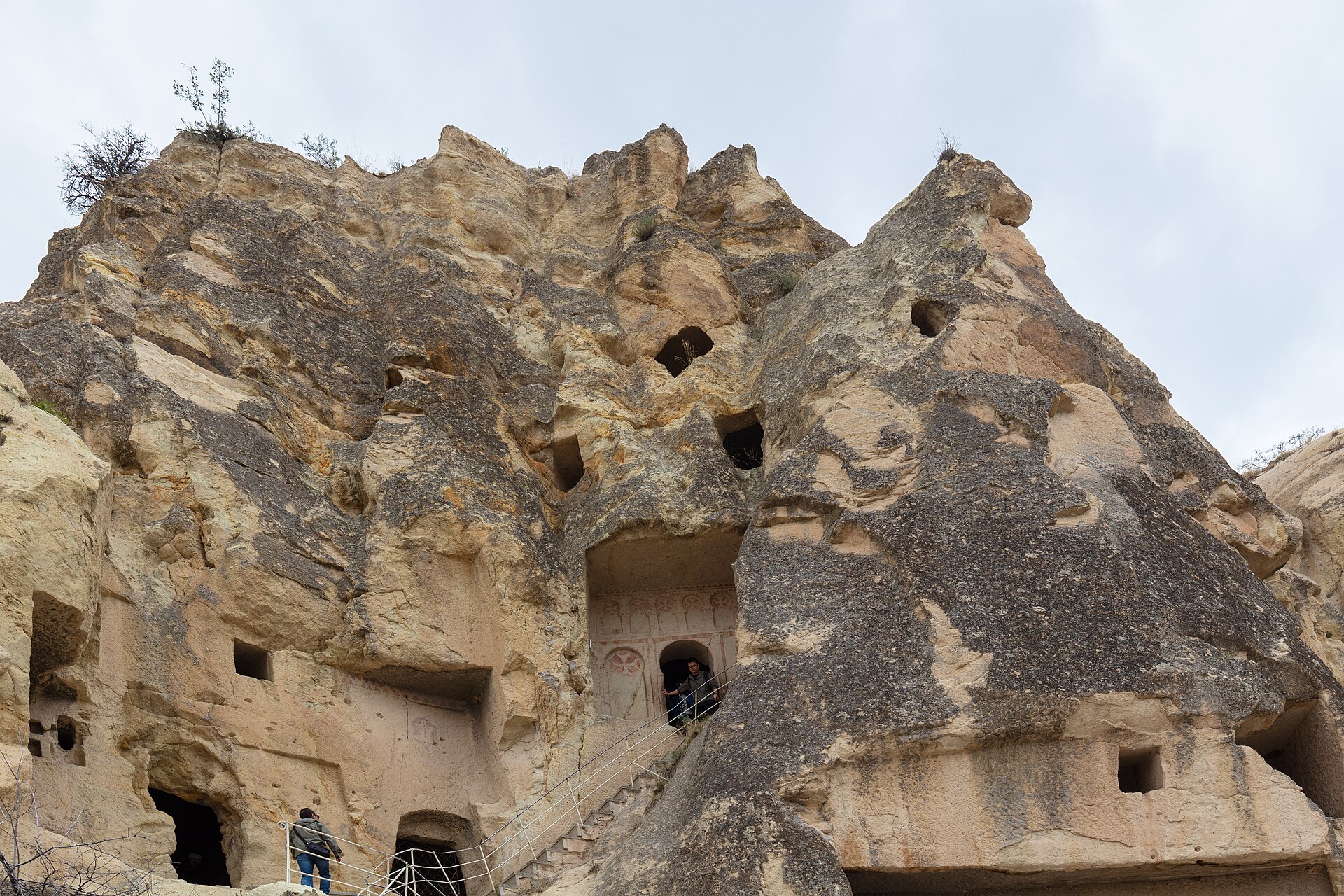
Paşabağ, also called Monk’s Vineyard or Monks Valley, is a group of multi-headed fairy chimneys near Zelve and Çavuşin in Cappadocia, Türkiye. People carved some of the chimneys into chapels and living spaces. The best known has three heads, a chapel of St. Simeon and a hermit’s cell.
Key facts
- Also known as: Monk’s Vineyard, Monks Valley; formerly the Valley of the Priests
- Location: Avanos district, Nevşehir Province, about 1 km off the Göreme-Avanos road to Zelve
- From airports: Nevşehir airport is 30 km north of Nevşehir town; Kayseri airport is 70 km east of Göreme (Wikivoyage)
- Best season: Autumn, especially September (Wikivoyage)
- Typical visit time: A short stop, often combined with Zelve; check locally
- Main sight: Three-headed chimney with St. Simeon chapel and cell
- Listing: Zelve-Paşabağlar Archaeological Site (Ministry of Culture and Tourism)
- UNESCO status: Within the wider Göreme National Park area inscribed in 1985; exact boundary not confirmed here
- Entrance: See the official page
What is Paşabağ and why visit?
Paşabağ is a valley of multi-headed fairy chimneys in Cappadocia, near Zelve and Çavuşin. It is also called Monk’s Vineyard. People carved the chimneys into chapels and cells, so the site mixes natural and human history. Visitors come for the unusual shapes and the St. Simeon chapel.
Moreover, the site is short and easy to fit into a Cappadocia day. In contrast to larger museums, it feels compact. As a result, it suits travellers who want a close look at fairy chimneys.
Reasons to visit:
- Multi-headed fairy chimneys with caps of harder rock
- A three-headed chimney with a chapel and a cell
- Cross-decorated cell entrance
- Easy pairing with Zelve
- Short stop on the Göreme-Avanos road
What is the history of Paşabağ?
The Ministry of Culture and Tourism says Paşabağı was formerly known as the Valley of the Priests. Humans carved the multi-bodied chimneys into chapels and living spaces. A chapel in the name of St. Simeon honours a saint who lived an ascetic life near Aleppo in the fifth century.
According to the Ministry, Simeon sought refuge first on a two-metre column and then on a fifteen-metre one. Neighbouring Zelve has three valleys on the northern slopes of Aktepe. However, the Ministry says the date of the first settlement at Zelve is uncertain, so we give no founding date.
The table lists the sourced background facts.
| Topic | Fact | Source |
|---|---|---|
| Former name | Valley of the Priests | Ministry |
| Saint Simeon | Ascetic near Aleppo, fifth century | Ministry |
| Columns | Two-metre, then fifteen-metre | Ministry |
| Zelve | Three valleys on the northern slopes of Aktepe | Ministry |
| First settlement at Zelve | Date uncertain | Ministry |
What can you see at Paşabağ?
The main sights are the capped fairy chimneys and the St. Simeon chimney. GoTürkiye says the capped chimneys have a conical body of tuff and volcanic ash. The cap is harder rock than the body, which explains the shape. The cell is reached through a narrow chimney-like tunnel.
The entrance of the cell is decorated with crosses, according to GoTürkiye. In addition, the chimneys were hollowed out from top to bottom, creating rooms 10 to 15 m high. The Ministry lists the area as part of the Zelve-Paşabağlar Archaeological Site.
Highlights:
- The three-headed St. Simeon chimney
- The hermit’s cell and its cross-decorated entrance
- Capped chimneys of tuff and volcanic ash
- Rock-hewn rooms hollowed from the top
- Views toward Zelve and Çavuşin
This table shows the sights at a glance.
| Sight | What it is | Source |
|---|---|---|
| Three-headed chimney | Chapel of St. Simeon with a cell | Ministry |
| Cell entrance | Narrow chimney-like tunnel, crosses | GoTürkiye |
| Capped chimneys | Tuff body with harder cap | GoTürkiye |
| Hollowed interiors | Rooms 10 to 15 m high | GoTürkiye |
| Nearby Zelve | Three valleys, open-air museum | Ministry |
How do you get to Paşabağ and get around?
Paşabağ lies about 1 km off the Göreme–Avanos road to Zelve. Most visitors arrive by car, tour or taxi from Göreme. Wikivoyage says the hoodoo landscape starts a few km south at Paşabağ valley. Check current transport and site access before you go.
Wikivoyage lists Nevşehir airport 30 km north of Nevşehir town and Kayseri airport 70 km east of Göreme. From Kayseri, buses take 90 minutes via Avanos, by the same source. Therefore Avanos is a convenient gateway.
The options below summarise how to arrive.
| Option | Route | Duration |
|---|---|---|
| Flight | Istanbul to Nevşehir or Kayseri, then road | Check current timetable |
| Bus from Kayseri | Via Avanos | About 90 minutes (Wikivoyage) |
| Bus from Istanbul | Intercity service | About 10 hours (Wikivoyage) |
| Car or tour from Göreme | Along the Göreme-Avanos road | Check with operator |
When is the best time to visit Paşabağ?
Autumn offers the best conditions. Wikivoyage says fall is mild and dry, making it the best time to visit, especially in September. Summers are hot and dry with chilly nights, winters are cold and snowy, and spring can bring heavy downpours.
The site is open-air, so weather matters. However, stone surfaces can be slippery after rain.
The table compares the seasons.
| Season | Weather | Crowds | Notes |
|---|---|---|---|
| Spring | Thunderstorms and downpours possible | Moderate | Bring waterproofs |
| Summer | Hot, dry | Busy | Visit early or late |
| Autumn | Mild, dry | Moderate | Best per Wikivoyage |
| Winter | Cold, snowy | Quiet | Check access |
How long should you stay?
Paşabağ works as a short stop of about the time needed to walk the chimneys and look inside the chapel. Combine it with Zelve for a half day. Add Çavuşin and Göreme for a full day. Choose by pace. As a result, you rarely need more than a short block of time here.
The plans below match common time budgets.
| Time | Plan | Good for |
|---|---|---|
| Half day | Paşabağ and Zelve | Quick Cappadocia visit |
| 1 day | Add Çavuşin and a viewpoint | Most visitors |
| 2-3 days | Add Göreme museum, valleys and underground city | Slower itineraries |
What practical tips should you know?
Wear sturdy shoes and expect uneven rock and steps. Fees and opening times are set officially, so see the official page. We list no prices or hours. Some cell entrances are narrow, so check whether climbing is allowed. Moreover, protect the monuments.
Do not touch painted or carved surfaces.
Practical points:
- Tickets and fees: see the official page
- Dress: sun protection, closed shoes
- Accessibility: stairs and narrow tunnels limit access
- Photography: allowed in most outdoor areas; check chapel rules
- Etiquette: the chapel is a religious heritage site
- Safety: watch footing and loose stone
Where should you stay and eat?
Göreme is the main tourist base, with the biggest concentration of operators, according to Wikivoyage. Avanos and Çavuşin are quieter alternatives. Check current availability yourself, and we do not name businesses here. For meals, local restaurants serve Central Anatolian food.
Avanos has a pottery tradition, so you may combine a meal with a craft stop.
Neighbourhood options:
- Göreme: widest choice
- Avanos: riverside town
- Çavuşin: village with rock-cut churches
- Uçhisar: village with castle views
What are the nearby places and day trips?
Zelve, Çavuşin and Red Valley are the nearest sights. Göreme Open Air Museum, Uçhisar Castle and Love Valley are within a short drive. Wikipedia says Çavuşin is about five kilometres north of Göreme. Therefore Paşabağ fits well into a loop of valleys and villages.
Nearby places:
- Zelve Open Air Museum area
- Çavuşin churches
- Red Valley
- Göreme Open Air Museum
- Uçhisar Castle
Plan this with TurkGT
We offer a Cappadocia short trip from Istanbul by flight, with guided options. TurkGT is an Istanbul-based travel company. It offers guided trips, private transfers, a local guide or an interpreter on request. Send us your dates and group size on WhatsApp, and we confirm the details with you there.
We do not publish fixed prices on this page.
Frequently asked questions
What is Paşabağ?
A group of multi-headed fairy chimneys near Zelve and Çavuşin, carved into chapels and living spaces.
Why is it called Monks Valley?
GoTürkiye gives the name Monk’s Vineyard, and the Ministry says it was formerly known as the Valley of the Priests.
Who was Saint Simeon?
The Ministry says he lived an ascetic life near Aleppo in the fifth century.
Where is Paşabağ?
About 1 km off the Göreme-Avanos road to Zelve, in Avanos district.
How were the chimneys formed?
GoTürkiye says the harder cap protects the softer tuff body, which gives the chimney shape.
When should I visit?
Wikivoyage says autumn is the best time, especially September.
Can I enter the cell?
We have not verified access rules. Ask on site.
How much is the entrance?
See the official page of the Ministry of Culture and Tourism.
Related on TurkGT
- Part of Nevşehir
- Göreme National Park and the Rock Sites of Cappadocia
- Göreme Open Air Museum
- Uçhisar Castle
- Derinkuyu Underground City
- Kaymaklı Underground City
- Love Valley
Sources
- Zelve-Paşabağlar Archaeological Site – Ministry of Culture and Tourism
- Top Things to See in Cappadocia – GoTürkiye
- Çavuşin – Wikipedia
- Wikivoyage: Cappadocia
Last reviewed: 2026-11-18. Opening hours, ticket prices and other changeable details are not listed because they change; check the official source before you travel.