
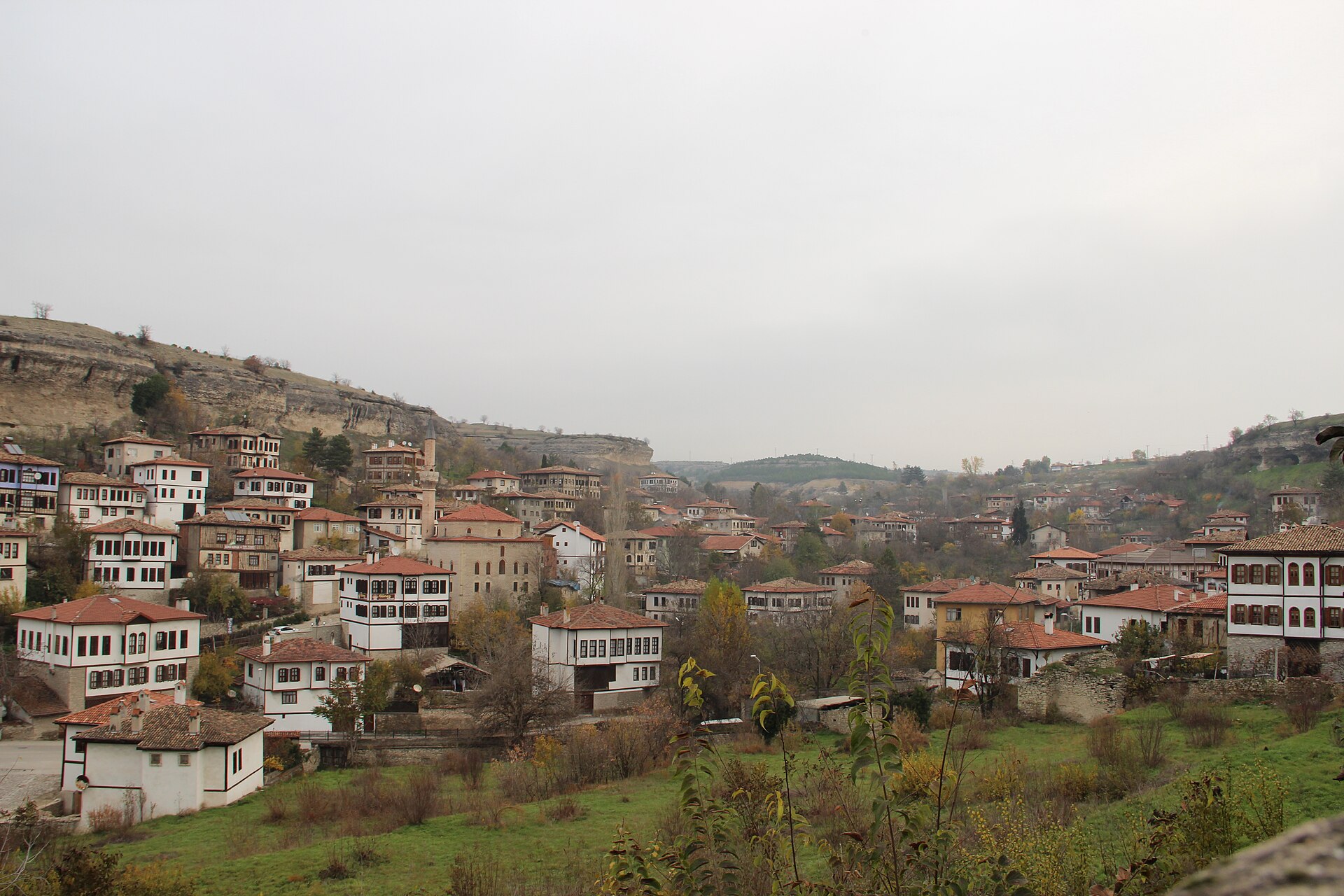
Safranbolu Old Town is the historic core of Safranbolu in Karabük Province, in the Western Black Sea region of Türkiye, about 200 km north of Ankara. UNESCO lists the City of Safranbolu as a World Heritage Site, inscribed in 1994, for its well-preserved Ottoman-era houses and caravan-town layout. It suits a one- or two-day stop between Istanbul and Ankara.
Key facts
- Location: Safranbolu, Karabük Province, about 9 km north of Karabük city
- Distance from cities: About 200-220 km north of Ankara; about 100 km south of the Black Sea coast
- Historic districts: Çukur (Çarşı), Kıranköy and Bağlar
- UNESCO status: World Heritage Site, inscribed 1994 (City of Safranbolu)
- Early monuments: Old Mosque, Old Bath and Süleyman Pasha Medrese, built 1322
- Peak period: 17th century, according to UNESCO
- Elevation: About 508 m
- Best season: Spring and autumn; summer weekends are busy
- Typical visit time: 4 hours to 2 days
- Entrance: Streets are open to walk; for museums and houses see the official page
What is Safranbolu Old Town and why visit?
Safranbolu Old Town is a protected Ottoman-era town in Karabük Province, listed by UNESCO in 1994. It matters because its timber-and-brick houses, markets and caravan-trade layout survive in a deep ravine. Visitors come to walk the lanes, see restored mansions and taste local sweets.
The town takes its name from saffron, which was grown locally and traded here. Wikipedia explains that the name comes from ‘saffron’ and the Greek word polis. Moreover, Wikivoyage says Safranbolu was among the first towns in Türkiye to see the heritage value of its old town and protect it.
In contrast to many busy sights, the old town is a walking destination without one single ticketed monument. As a result, it works well for slow travel, photography and overnight stays in restored konaks.
What is the history of Safranbolu Old Town?
Safranbolu grew as a caravan station on the main East-West trade route from the 13th century until the railway arrived in the early 20th century. UNESCO says the Old Mosque, Old Bath and Süleyman Pasha Medrese were built in 1322, and the town’s architecture reached its peak in the 17th century.
Wikivoyage explains that in the 18th and 19th centuries, merchants prospered from trade and built mansions. The most successful kept two homes: a winter residence in Çarşı, sheltered in a gully, and a summer home among the vineyards (Bağlar). A new district, Kıranköy or Yenişehir, appeared on the ridge in the 20th century.
Wikipedia adds that Safranbolu has been known under several names, including Theodoroupolis and Saphrampolis. Therefore its history reaches beyond the Ottoman period, although the surviving architecture is mostly Ottoman. UNESCO notes that the town’s architecture influenced urban development across much of the Empire.
Key points in the town’s story:
- 1322: Old Mosque, Old Bath and Süleyman Pasha Medrese built.
- 17th century: peak of the caravan town.
- 18th-19th centuries: merchants build mansions.
- Early 20th century: railway ends the caravan role.
- 1994: UNESCO inscription.
The table puts the town’s eras in order.
| Era | What happened | Visible today |
|---|---|---|
| 13th-early 20th c. | Caravan station on East-West route | Han and market layout |
| 1322 | Old Mosque, Old Bath, medrese built | Early monuments |
| 17th c. | Peak of the town | Architectural influence across the Empire |
| 18th-19th c. | Merchant mansions | Konaks in Çarşı and Bağlar |
| 1994 | UNESCO listing | Protected old town |
What are the highlights of Safranbolu Old Town?
The highlights are Çarşı with its old bazaar, Cinci Han caravanserai, the İzzet Paşa Mosque, Hıdırlık Hill viewpoint, mansion museums and the İncekaya Aqueduct outside town. Together they show how a caravan town, its merchants and its timber houses worked, and each can be reached on foot or with a short taxi ride.
UNESCO describes three districts: Çukur, the market area in the lower town; Kıranköy; and Bağlar, ‘the Vineyards’. Çukur lies in a triangle defined by two rivers, and Kıranköy was formerly a non-Muslim district. Moreover, GoTürkiye describes timber-and-brick houses with distinctive stucco decoration and overhanging upper floors.
Wikivoyage lists Cinci Han, built in 1645, the Ulu Cami, and the Köprülü Mehmet Paşa Mosque built in 1661 among Çarşı sights. In addition, the İncekaya Aqueduct, commissioned in the 1790s by İzzet Mehmet Paşa, crosses Tokatlı Canyon.
Do not miss these places:
- Eski Çarşı, the old bazaar.
- Cinci Han caravanserai (1645).
- Hamamönü Sokak, the scenic lane north of Cinci Han.
- Hıdırlık Hill viewpoint.
- A mansion museum such as Kaymakamlar Gezi Evi.
- İncekaya Aqueduct above Tokatlı Canyon.
At-a-glance table of the three districts.
| District | Character | What to do |
|---|---|---|
| Çukur / Çarşı | Market area in the lower town | Bazaar, han, mosques, mansions |
| Kıranköy | Formerly non-Muslim district | Quieter streets and houses |
| Bağlar | Vineyard suburb, summer homes | Konak hotels, views, mixed modern area |
How do you get to Safranbolu Old Town and get around?
Safranbolu is reached by road from Ankara or Istanbul, usually by intercity bus or car. Wikivoyage lists about 2 hours 45 minutes by bus from Ankara and about 7 hours from Istanbul. Inside the old town you walk, and dolmuşes link the old town, new town and bus station.
The bus station is about 1 km south of the town centre and 2 km from the old quarter, so a dolmuş or taxi covers the last stretch. The nearest railway station is in Karabük. Wikivoyage says rail service has partly reopened but is limited, so check the current TCDD timetable.
By car, Ankara is about 220 km away via the D755 through Karabük. Moreover, outlying sights such as the aqueduct and caves are best reached by taxi or a rented car. Therefore decide on transport before booking a stay.
Choose your route:
- Ankara: bus about 2 hr 45 min or car about 220 km.
- Istanbul: bus about 7 hours via Düzce and Bolu.
- Karabük railway station: 10-15 km away; limited services.
- Local dolmuş: bus station, new town and old town.
- Taxi or car: needed for outlying canyon and cave sights.
Typical journeys (check current timetables).
| From | Mode | Typical duration |
|---|---|---|
| Ankara | Bus | About 2 hr 45 min |
| Ankara | Car | About 220 km |
| Istanbul | Bus | About 7 hours |
| Karabük station | Taxi or dolmuş | 10-15 km |
| Bus station to old town | Dolmuş | About 2 km |
When is the best time to visit Safranbolu Old Town?
Spring and autumn are the most comfortable seasons for walking the old town, while summer weekends bring many visitors from Ankara and Istanbul. Winter can be quiet and atmospheric but cooler. The town sits at about 508 m elevation and lies in a ravine, so evenings can feel fresher.
Wikivoyage says summer weekends see a stream of city dwellers heading to the town by road. In contrast, weekdays and shoulder seasons are calmer. Therefore plan an overnight stay midweek if you want quiet lanes at dusk.
Check the weather forecast before you go, because steep, cobbled streets are slippery in rain and snow. Official sources list opening hours for museums and houses.
Season guide.
| Season | Weather | Crowds | Notes |
|---|---|---|---|
| Spring (Apr-May) | Mild, green | Moderate | Good light and walking weather |
| Summer (Jun-Aug) | Warm | High on weekends | Go early or on weekdays |
| Autumn (Sep-Nov) | Cool, mild | Moderate | Colourful hills; comfortable walking |
| Winter (Dec-Mar) | Cold, possible snow | Low | Slippery cobbles; check hours |
How long should you stay in Safranbolu Old Town?
Plan four hours for a quick walk through Çarşı, and one night to feel the town after the day-trippers leave. Two days let you add Bağlar, the İncekaya Aqueduct and a canyon viewpoint. A half-day stop works when you are driving between Ankara and the Black Sea.
The streets are cobbled and sloped, so walking takes longer than the map suggests. Moreover, many mansions and museums keep their own hours, so check before you plan a tight schedule. Therefore leave a margin for tea stops and photography.
If you stay overnight in a restored mansion, you experience the quiet evening streets and the early morning light on the roofs.
Suggested plans.
| Time | Plan | Covers |
|---|---|---|
| Half day | Çarşı, bazaar, Cinci Han, Hıdırlık Hill | Core old town |
| 1 day | Add a mansion museum, Hamamönü, Bağlar and a local meal | Full old town |
| 2-3 days | Add İncekaya Aqueduct, Tokatlı Canyon viewpoint, Yörük village | Old town and countryside |
What practical tips should you know before visiting?
Wear flat shoes with grip, because the streets are steep and cobbled. Check the official page for museum and house hours and fees. Many lanes are narrow and mostly pedestrian, so accessibility is limited on slopes. Respect residents, since many houses are private homes.
Photograph the streets and façades freely, but do not enter private yards. Dress modestly in mosques and remove shoes. Moreover, bargain politely in the bazaar and compare gift boxes before you buy sweets, since Wikivoyage warns that some boxes hold little lokum.
For safety, carry water in summer and a rain jacket in other seasons. Therefore pack light layers and a small day bag.
Quick checklist:
- Wear flat, grippy shoes.
- Check official pages for house and museum hours.
- Respect private homes and gardens.
- Dress modestly in mosques.
- Compare gift boxes of lokum before buying.
Where should you stay and eat in Safranbolu?
Stay in Çarşı for atmosphere or Bağlar for a quieter setting. Many restored konaks operate as small hotels. Eat in Çarşı or in the new town, where Wikivoyage lists clusters of restaurants and a patisserie selling lokum and Turkish desserts.
Cafes and restaurants serve alcohol, and wine is produced in the hills around town according to Wikivoyage. Try Turkish delight and local sweets, but avoid expecting one single famous dish. We do not name businesses here, because they change often.
Therefore the choice is mainly between old-house atmosphere and modern comfort. Book ahead for summer weekends.
What are the nearby places and day trips?
Nearby places include the İncekaya Aqueduct, Tokatlı Canyon, Bulak Mencilis Cave, Taş Teras viewpoint and the village of Yörük. Farther away, Amasra on the Black Sea coast and Kastamonu to the east are common onward stops for travellers continuing a regional loop by road.
Wikivoyage describes Yörük as a miniature and less touristy version of Safranbolu, about 15 km east. Amasra is another historic town with beaches and sea views. Moreover, the İncekaya Aqueduct spans Tokatlı Canyon with a main arch and five auxiliary arches.
As a result, Safranbolu can anchor a Black Sea loop of two to four days.
Related places on this site:
- City of Safranbolu (UNESCO page)
- Karabük province
Plan this with TurkGT
TurkGT is an Istanbul-based travel company that offers guided trips, private transfers, local guides and interpreter support across Türkiye. Tell us your dates, group size and interests, and we will propose a route and confirm the details with you by WhatsApp. Prices, timings and availability are agreed directly with our team, so please message us before you book anything non-refundable.
Frequently asked questions
What are the three districts of Safranbolu?
Çukur (the market area), Kıranköy and Bağlar (the Vineyards).
When did Safranbolu become a UNESCO World Heritage Site?
UNESCO lists the City of Safranbolu with a date of inscription of 1994.
Why was Safranbolu important?
It was an important caravan station on the main East-West trade route from the 13th century until the early 20th century.
Where is Safranbolu?
In Karabük Province, about 9 km north of Karabük city and about 200 km north of Ankara.
How long do I need in Safranbolu?
Four hours for a quick walk; one night or two days is more relaxed.
How do I get there from Ankara?
Wikivoyage lists buses taking about 2 hr 45 min. Check current timetables.
Is Safranbolu named after saffron?
Yes. The name comes from saffron and the Greek word polis, according to Wikipedia.
Do I need tickets?
The streets are open to walk; for museums and houses see the official pages.
Related on TurkGT
- Part of Karabük
Sources
- City of Safranbolu – UNESCO World Heritage Centre
- A Guide to Karabük’s Historic Safranbolu Town – GoTürkiye
- Safranbolu – Wikipedia
- Safranbolu – Wikivoyage
Last reviewed: 2026-11-17. Opening hours, ticket prices and other changeable details are not listed because they change; check the official source before you travel.