
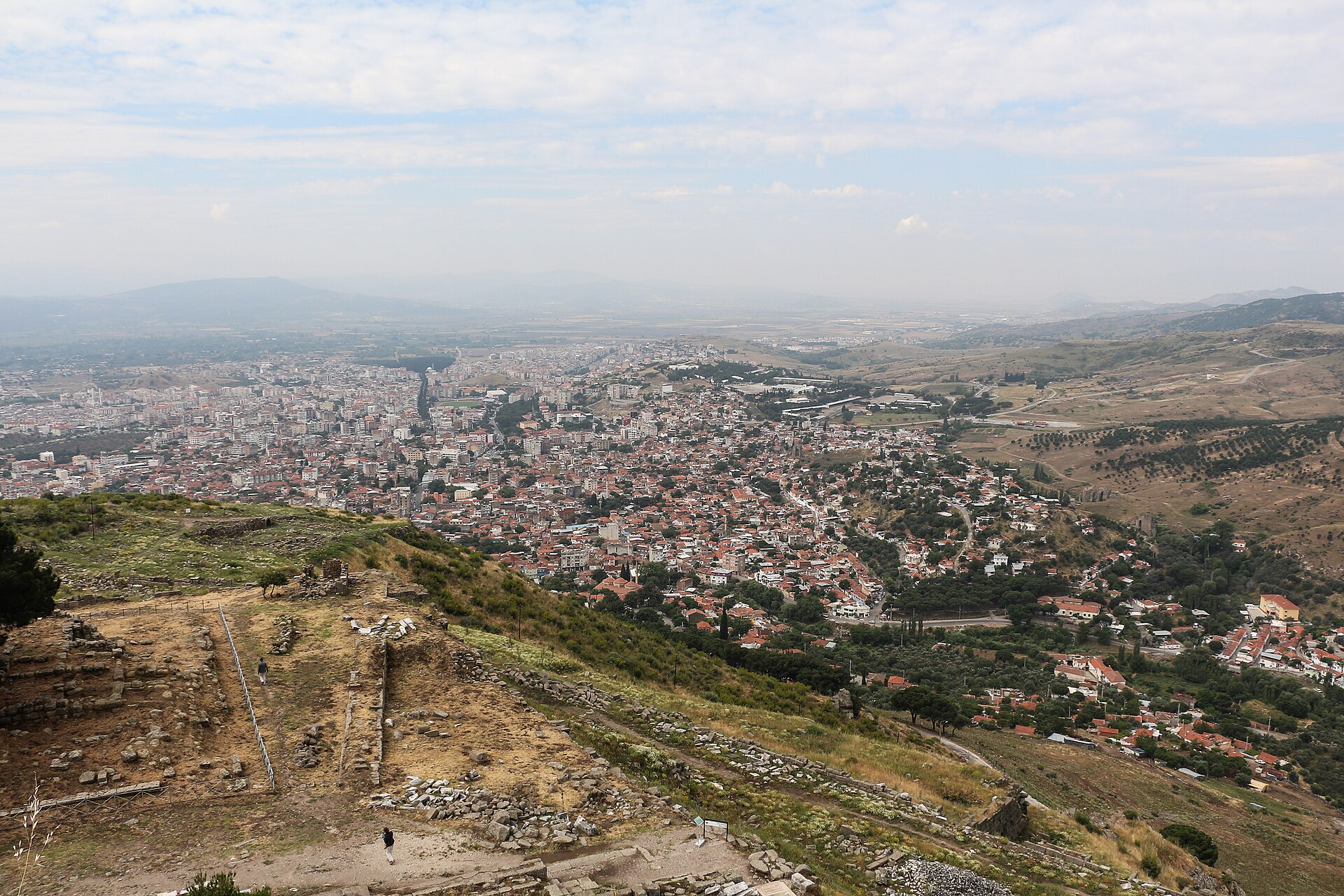
Bergama is a district town in İzmir Province, 118 km north of İzmir, and the home of ancient Pergamon. UNESCO inscribed Pergamon and its Multi-layered Cultural Landscape in 2014. Visit it for the hilltop Acropolis, the Asklepion healing sanctuary, the Red Basilica and an Ottoman old quarter.
Key facts
- Location: Northern Aegean, İzmir Province, 27 km inland from Dikili
- Distance: About 118 km north of İzmir; about 2 hours by IZBAN train and bus 835 (Wikivoyage; check current timetable)
- Nearest airport: İzmir Adnan Menderes (ADB)
- Population: 105,754 for the district (2022)
- UNESCO status: Pergamon and its Multi-layered Cultural Landscape, inscribed 2014; criteria (i)(ii)(iii)(iv)(vi)
- Extent: Serial property of 332.5 ha with a 476.9 ha buffer zone
- Best season: Spring and autumn; summers are very hot and the Acropolis has little shade
- Typical visit time: 1 day; 2 days with Kozak or Dikili
- Main sites: Acropolis, Asklepion, Red Basilica, Archaeology Museum
- Entrance: See official page for each site
What is Bergama and why visit it?
Bergama is a district town in İzmir Province and the modern successor to Pergamon, the Attalid capital. It lies 118 km north of İzmir. People visit for the Acropolis on Kale Hill, the Asklepion healing sanctuary, the Red Basilica and an Ottoman old quarter.
The district covers 1,544 km2 and has about 105,800 residents. Moreover, the town sits 27 km inland from the sea. As a result, the visit feels quieter than the coastal resorts to the south.
UNESCO inscribed the cultural landscape in 2014. The property is serial, which means it has several components, not a single site. In contrast to many ruin sites, you can combine ancient monuments with a living market town on the same day.
What is the history of Bergama and Pergamon?
Pergamon was the capital of the Attalid kingdom from 281 BC to 133 BC, then a Roman provincial centre. Later came Byzantine, Karasid and Ottoman rule. Wikipedia says Bergama probably became Ottoman around 1341. The town kept a mixed population until 1922.
Wikivoyage says the ruler Eumenes II fortified the settlement into a grand Acropolis. After the Romans took over in 133 BC, Pergamon grew into a metropolis. Roman Pergamon is believed to have held about 150,000 people in the 1st century AD. Hadrian and Trajan then added major buildings.
The name is thought to come from a Luwian word meaning high. Therefore the name fits the hilltop acropolis. Furthermore, UNESCO describes later Ottoman mosques, baths, bridges and markets layered over the earlier city.
Key periods:
- 3rd century BC: UNESCO dates the founding of Pergamon as the Attalid capital.
- 281-133 BC: Attalid kingdom.
- 133 BC: Pergamon passes to Rome.
- About 110-130 AD: Trajan and Hadrian add temples and the Red Basilica.
- About 1341: Ottoman rule begins, possibly.
- 2014: UNESCO inscription.
What are the main things to see in Bergama?
The key sights are the Acropolis, the Asklepion, the Red Basilica, the Archaeology Museum and the Ottoman old quarter. The Acropolis alone takes about two hours. Start with the museum for orientation, then visit the sites in a logical order.
The Acropolis holds the theatre, the Temple of Trajan and the remains of the library. Its theatre is very steep and seats about 10,000. The Altar of Zeus was moved to Berlin, and a replica stands on site. In addition, the Asklepion shows how Romans combined medicine, water and ritual.
Highlights to plan around:
- Acropolis: Theatre, Temple of Trajan, library remains and upper agora.
- Asklepion: colonnaded Via Tecta, theatre for 3,500 and healing precinct.
- Red Basilica: Roman brick temple complex over the Selinus River.
- Archaeology Museum: small and informative; a good first stop.
- Old quarter: Ottoman houses, Great Mosque (1399) and caravanserais.
- Kızıl Avlu bridges: Roman tunnels beneath the sanctuary.
The table below lists the main sights at a glance.
| Sight | What it is | Typical time |
|---|---|---|
| Acropolis (Kale Hill) | Hellenistic and Roman citadel with theatre and temples | About 2 hours |
| Asklepion | Roman healing sanctuary, restored under Hadrian | 1-1.5 hours |
| Red Basilica | 2nd-century brick temple complex | 45 minutes |
| Archaeology Museum | Local finds and orientation | 1 hour |
| Great Mosque (1399) | Ottoman mosque in the town | 20 minutes |
| Old quarter and caravanserais | Ottoman houses, Çukurhan, Taşhan | 1-2 hours |
How do I get to Bergama and get around?
Reach Bergama by bus, by IZBAN train plus a local bus from İzmir, or by car. İzmir is 118 km south. Wikivoyage says the rail and bus route takes about 2 hours in total. Istanbul buses take 8-9 hours, so many visitors fly to İzmir first.
The bus station lies 7 km from downtown. In contrast, the centre is walkable. Moreover, the Acropolis is a 3 km hike from town, so use a taxi, car or the Acropolis cable car. Check the current timetable and the cable car operating dates.
The table lists the main routes to Bergama, with typical durations.
| From | Mode | Typical duration |
|---|---|---|
| İzmir | IZBAN to Aliağa, then bus 835 | About 2 hours in total (Wikivoyage) |
| İzmir | Car or taxi via the highway | Check route; 118 km |
| Istanbul | Intercity bus via Bursa | 8-9 hours (Wikivoyage) |
| Istanbul | Flight to İzmir, then road | Check airline and bus schedules |
| Bus station to centre | Local bus or taxi | 7 km; check current timetable |
| Town to Acropolis | Taxi, car or cable car | About 3 km; check operating dates |
When is the best time to visit Bergama?
Spring and autumn are the most comfortable seasons. Summers are very hot and dry, and the Acropolis offers little shade. Winters are cool to mild and moderately wet. Wikipedia classifies the climate as hot-summer Mediterranean.
Therefore start early in summer and carry water. In addition, mid-June brings the Bergama Kermesi festival, which makes the town livelier and busier.
Use this table to pick a season.
| Season | Weather | Crowds | Notes |
|---|---|---|---|
| Spring (Mar-May) | Mild, some rain | Medium | Comfortable for the Acropolis; fields are green |
| Summer (Jun-Aug) | Very hot and dry | Medium | Start early; Kermesi festival in June |
| Autumn (Sep-Nov) | Warm, then cooler | Low to medium | Good light for photos and walking |
| Winter (Dec-Feb) | Cool to mild, wetter | Low | Quiet; check site opening hours |
How long should I stay in Bergama?
One day covers the museum, Asklepion, Red Basilica and Acropolis if you start early. Two days let you add the old quarter, Kozak Plateau and Dikili. A half day works only for the Acropolis and Asklepion.
In short, give the Acropolis at least two hours. Add more time if you want to read the site panels.
The table suggests three plans.
| Time | Suggested plan |
|---|---|
| Half day | Acropolis and Asklepion, with a taxi between them |
| 1 day | Museum, Red Basilica, Asklepion, Acropolis and an old-quarter walk |
| 2 days | Add Great Mosque, caravanserais, Kozak Plateau and a beach stop at Dikili |
What practical tips should I know before visiting Bergama?
Wear sturdy shoes, bring water and use sun protection on the exposed Acropolis. See the official page for current tickets, opening times and cable car rules. Wikivoyage says the city is safe and advises normal care of valuables and traffic.
Moreover, keep time to rest between sites, because the slopes are steep.
Practical points:
- Dress: sun hat, light layers and closed shoes; cover up for mosques.
- Tickets and fees: see the official page for each site.
- Accessibility: steep ground and uneven stone limit access; the cable car helps on the approach.
- Safety: use normal care for valuables and traffic; protect against sun.
- Photography: the theatre and Temple of Trajan photograph well in morning light.
- Etiquette: do not climb on fragile stones or remove fragments.
- Heritage: respect conservation signage across the UNESCO components.
Where should I stay and eat in Bergama?
Stay in the old town near the Red Basilica for easy walking, or at a countryside lodge for quiet. Eat at small family restaurants on the main street. Choose by smell and crowd, as Wikivoyage suggests.
Local products include kilims, carpets and Kozak pine nuts. Furthermore, the region grows wine, so ask about local vineyards.
Neighbourhood guide:
- Old town near the Red Basilica: Ottoman houses, guesthouses and cafes.
- Near the Archaeology Museum: bars and evening dining.
- Kozak Plateau: pine forests and village stays.
- Dikili: beach hotels on the coast.
What are the nearby places and day trips from Bergama?
Dikili, Kozak Plateau, Foça, İzmir, Selçuk and Ephesus make good extensions. Dikili has beaches. Kozak has pine forests and textiles. İzmir is the main hub for onward travel.
Allianoi, the Roman spa, now lies under a reservoir, so it is not a practical visit.
The table lists the main excursions.
| Destination | Why go | Notes |
|---|---|---|
| Dikili | Nearest beach resort | Short drive |
| Kozak Plateau | Pine forests, pine nuts, hand-made textiles | About 20 km north |
| Foça | Coastal town south of Bergama | Check route |
| İzmir | Museums, bazaar and transport hub | 118 km south |
| Selçuk and Ephesus | Roman city and sanctuaries | Plan as a separate trip |
| Çeşme and Alaçatı | Aegean resort peninsula | Plan as a separate trip |
Plan this with TurkGT
TurkGT is an Istanbul-based travel company. We offer guided trips, private transfers, local guides and interpreters across Türkiye. Tell us your dates and interests, and we confirm Bergama or Aegean plans by WhatsApp.
Frequently asked questions
What is Bergama famous for?
Bergama is the home of ancient Pergamon, capital of the Attalid dynasty, and a UNESCO World Heritage cultural landscape inscribed in 2014.
How far is Bergama from İzmir?
About 118 km north of İzmir. Wikivoyage gives about 2 hours by IZBAN train and bus 835. Check the current timetable.
What are the UNESCO criteria for Pergamon?
UNESCO lists criteria (i), (ii), (iii), (iv) and (vi) for the Pergamon and its Multi-layered Cultural Landscape property.
Is the Altar of Zeus in Bergama?
No. Its frieze fragments were reassembled in Berlin. A replica stands on the Acropolis, according to Wikivoyage.
What is the Asklepion?
It was a healing sanctuary of the god Asklepios. The visible remains are mostly from the 2nd century AD, when Hadrian restored the site.
Can I walk to the Acropolis?
It is about a 3 km hike up from town, so most visitors use a taxi, car or the cable car. Check operating dates.
When is the Bergama Kermesi?
Wikipedia says it runs 18-24 June each year. Check the official page for current dates.
How long do I need in Bergama?
One day covers the main sites if you start early. Two days allow the old town and Kozak Plateau.
Related on TurkGT
- Part of İzmir
- Library of Celsus
- Şirince Village
- İzmir Clock Tower
- Kemeraltı Bazaar
- Pergamon and its Multi-Layered Cultural Landscape
- Ephesus
Sources
- Bergama – Wikipedia
- Bergama – Wikivoyage
- Pergamon and its Multi-Layered Cultural Landscape – UNESCO World Heritage Centre
Last reviewed: 2026-11-18. Opening hours, ticket prices and other changeable details are not listed because they change; check the official source before you travel.