
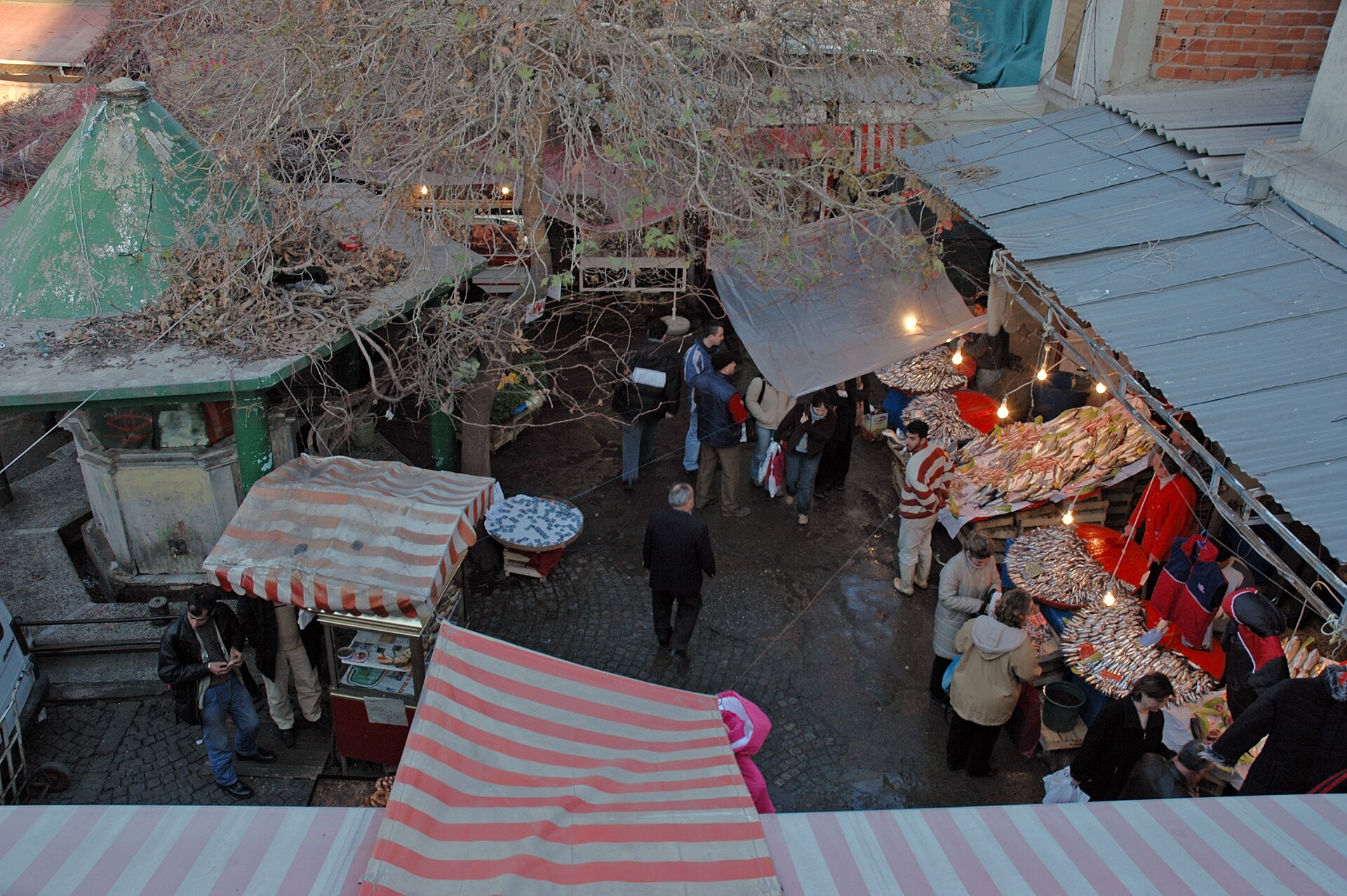
Kemeraltı is the historic bazaar district of İzmir, extending from the level of the Agora of Smyrna to the seashore along Konak Square. It remains one of the liveliest districts of the city, and its market took shape in the 17th century when the shallow inner bay was filled in. Visit it for hans, mosques, synagogues, shops and local food.
Key facts
- Fuller name: Kemeraltı Çarşısı
- Location: Konak district, İzmir, from Konak Square inland towards the Agora of Smyrna
- From the airport: İzmir Adnan Menderes Airport lies about 16 km south of the centre (Wikivoyage)
- Market formed: From fill of the inner bay in 1650-1670
- Landmarks: Hisar Mosque (1592), Kızlarağası Han (1744), Konak Square
- Best season: Spring and autumn; summers are hot and humid
- Typical visit time: Half a day; a full day with Konak and Alsancak
- UNESCO status: Tentative List since 2020, as part of the Historical Port City of Izmir
- Entrance: Free to walk; museums and venues: see official page
What is Kemeraltı Bazaar and why visit?
Kemeraltı is the old market district of İzmir, a maze of streets, hans and mosques east of Konak Square. It is described as a historic bazaar and as İzmir’s most important shopping centre by the official Culture Portal. Visitors come for atmosphere, local food and layered history.
Moreover, the bazaar is not a single building. It is a district of lanes, courtyards and small squares, with trade, worship and daily life side by side. In contrast to a modern mall, it rewards slow walking and curiosity.
These are the main reasons to include Kemeraltı in a plan.
- A bazaar with roots in the 17th century
- Ottoman hans, such as Kızlarağası Han, still standing
- Hisar Mosque, the oldest significant Ottoman landmark in İzmir
- A cluster of historic synagogues on and near Havra Sokağı
- A short walk from Konak Square, the Clock Tower and the waterfront
What is the history and background of Kemeraltı?
Kemeraltı grew on land won from the sea. Wikipedia explains that the market came into existence between 1650 and 1670, when the shallowest parts of the inner bay were filled in. The bay silted up through the 18th century, and the shoreline took its present straight form in the early 19th century.
Earlier, the bazaar formed around a long street called the Street of the Mevlevis in medieval times, after a dergah. Today that street is Anafartalar Caddesi. In addition, Hisar Mosque was built in 1592, and Kızlarağası Han followed in 1744, becoming the nucleus of the market together with older hans.
However, the 20th century brought losses. After the 1922 Great Fire of Smyrna, only a dozen of the hundreds of hans remained in full or in part, and the Yellow Barracks was demolished in 1955.
A short timeline places the main dates.
- 1592: Hisar Mosque built
- 1650-1670: inner bay filled and the market begins
- 1744: Kızlarağası Han built
- 1829: the Yellow Barracks built by the sea
- 1922: the Great Fire of Smyrna destroys many hans
- 2020: Kemeraltı joins the Tentative List as part of the Historical Port City of Izmir
What are the highlights of Kemeraltı?
The highlights are the hans, the mosques, the synagogues and the lanes themselves, which together show how a Mediterranean trading town worked. Wikipedia lists Başdurak, Hisar, Kemeraltı, Kestanepazarı, Salepçioğlu and Şadırvanaltı mosques in the bazaar. Therefore a walk can link several historic buildings without leaving the market.
These are the main things to look for.
- Hisar Mosque, built in 1592 on the site of the Genoese San Pietro fortress
- Kızlarağası Han, a caravanserai built in 1744 that survives today
- Başdurak, Şadırvanaltı and Kemeraltı mosques inside the market
- Synagogues on and near Havra Sokağı, a centre of Sephardic heritage
- Anafartalar Caddesi, the main street of the bazaar
- Konak Square and the Clock Tower at the seaward edge
The table below summarises key stops in and around the bazaar.
| Stop | What it is | Note |
|---|---|---|
| Hisar Mosque | Mosque of 1592 | Oldest significant Ottoman landmark in İzmir |
| Kızlarağası Han | Caravanserai of 1744 | Shops now fill the han (Wikivoyage) |
| Havra Sokağı synagogues | Remaining synagogues of the old community | Eight of 34 remain in the bazaar area; check access |
| Anafartalar Caddesi | Main street of the bazaar | Follows the old inner-bay curve |
| Konak Square | Square named after the governor’s mansion | Edge of the bazaar |
How do you get to Kemeraltı and get around?
Kemeraltı is easy to reach by metro, tram or taxi, and the lanes themselves are for walking. From the airport, İzban trains run to Alsancak, and the metro serves Konak and Basmane. Wikivoyage says an İzmirimkart is needed for the train and metro; check current fares and timetables.
The table compares the main ways to reach the bazaar; times are approximate.
| Option | Route | Typical time / note |
|---|---|---|
| İzban plus metro | Airport south line to Hilal, then metro to Konak | Per Wikivoyage; check current timetable |
| ESHOT bus 202 | Airport to Republic Square | Per Wikivoyage, most of an hour |
| Metro | East-west line via Basmane to Konak | Check current timetable |
| Tram | Alsancak, Konak and Göztepe | Check current timetable |
| Ferry | Across the bay to Konak area | Check Izdeniz timetable |
| On foot | From Konak Square into the lanes | Best way inside the bazaar |
When is the best time to visit Kemeraltı?
Spring and autumn are the comfortable seasons for walking. Wikivoyage describes spring and fall as generally the best time to visit İzmir, with hot, humid summers. Wikivoyage also lists the bazaar as open Monday to Saturday, so check the shops you want to visit.
The table gives a seasonal overview.
| Season | Weather | Crowds and notes |
|---|---|---|
| Spring | Warm and pleasant | Comfortable for long walks |
| Summer | Hot and humid; highs of 30-35°C | Go early; shade in the lanes |
| Autumn | Warm and pleasant | Comfortable for long walks |
| Winter | Mild to cool, 12-16°C with downpours | Quieter; carry an umbrella |
How long should you stay?
A half day lets you slowly walk the main lanes, visit a han and have lunch in the market. A full day adds Konak, Alsancak and the Archaeological Museum. Use the table to pick a plan that fits your time and energy.
These sample plans show how long each style of visit takes.
| Time | Plan | Suits |
|---|---|---|
| 2 hours | Anafartalar Caddesi, Hisar Mosque, Kızlarağası Han | Short stopover |
| Half day | Bazaar, synagogues, lunch | Most visitors |
| 1 day | Bazaar, Konak, Smyrna Agora, Kordon | First-time visitors |
| 2-3 days | Add Ephesus, Şirince or Bergama | Longer stay |
What practical tips help in Kemeraltı?
Dress modestly when entering mosques, keep valuables close and carry small change for snacks and tea. Opening hours differ from shop to shop, so confirm on the day. Entrance to museums and synagogues is covered on their own official pages; this page lists no prices.
These practical points apply to most visits.
- Dress: cover shoulders and knees for mosques; remove shoes
- Fees: walking is free; museums and venues, see official page
- Accessibility: lanes can be crowded and uneven; plan extra time
- Safety: watch for pickpockets in crowds and keep bags closed
- Photography: ask before photographing shopkeepers and prayer areas
- Etiquette: bargain politely and do not photograph worshippers
Where should you stay and eat near Kemeraltı?
Stay in Alsancak, Konak or near Basmane for easy access to the bazaar. Alsancak has cafes in old Greek houses, and Kordon is the waterfront promenade. Wikivoyage lists local foods to try: kumru sandwich, boyoz pastry, Tulum cheese and grilled sea bass.
Think in neighbourhoods rather than single venues.
- Alsancak: cafes, bars and the Kordon waterfront
- Konak: the main square and ferry piers
- Basmane: near the main railway station and metro
- Kemeraltı lanes: small eateries and tea houses
What are the nearby places and day trips?
Nearby are Konak Clock Tower, the Smyrna Agora, the Asansör and Kadifekale hill. Further out are Ephesus, Şirince, Bergama and Çeşme. Therefore Kemeraltı works as a city start before a day trip to the Aegean coast and its ancient sites.
The nearest options are listed here.
- İzmir Clock Tower: on Konak Square, erected in 1901
- Agora of Smyrna: ruins of Hellenistic and Roman Smyrna
- Asansör and Kadifekale: city viewpoints
- Ephesus: ancient city near Selçuk
- Şirince Village: hill village near Selçuk
- Bergama: home of the Pergamon heritage
Plan this with TurkGT
TurkGT can arrange guided trips, private transfers, a local guide or an interpreter in İzmir. A walking tour of Kemeraltı can be combined with Ephesus, Şirince or Bergama. Send your dates and group size, and the team confirms the plan by WhatsApp.
Frequently asked questions
What is Kemeraltı?
Kemeraltı, more fully Kemeraltı Çarşısı, is the historic bazaar district of İzmir and remains one of the liveliest districts of the city.
Where is Kemeraltı?
It extends from the level of the Agora of Smyrna to the seashore along Konak Square in İzmir.
When was the Kemeraltı market created?
The market itself came into existence with the filling of the shallowest parts of the inner bay between 1650 and 1670.
What is the oldest landmark in Kemeraltı?
The Hisar Mosque, built in 1592, is described as the oldest and most significant Ottoman landmark in İzmir.
How do I get to Kemeraltı from the airport?
By İzban train and metro, by ESHOT bus 202 to Republic Square, or by taxi. Wikivoyage notes an İzmirimkart is needed for rail; check current timetables.
Is Kemeraltı on the UNESCO list?
It is on the Tentative List since 2020 as part of the Historical Port City of Izmir, per Wikipedia. It is not inscribed.
How long should I spend there?
Half a day for the main lanes, or a full day with Konak and Alsancak.
Is there an entrance fee?
Walking the bazaar is free. Museums and venues set their own fees; see their official pages.
Related on TurkGT
- Part of İzmir
- Library of Celsus
- Şirince Village
- İzmir Clock Tower
- Pergamon and its Multi-Layered Cultural Landscape
- Ephesus
- Çeşme
Sources
Last reviewed: 2026-11-18. Opening hours, ticket prices and other changeable details are not listed because they change; check the official source before you travel.