
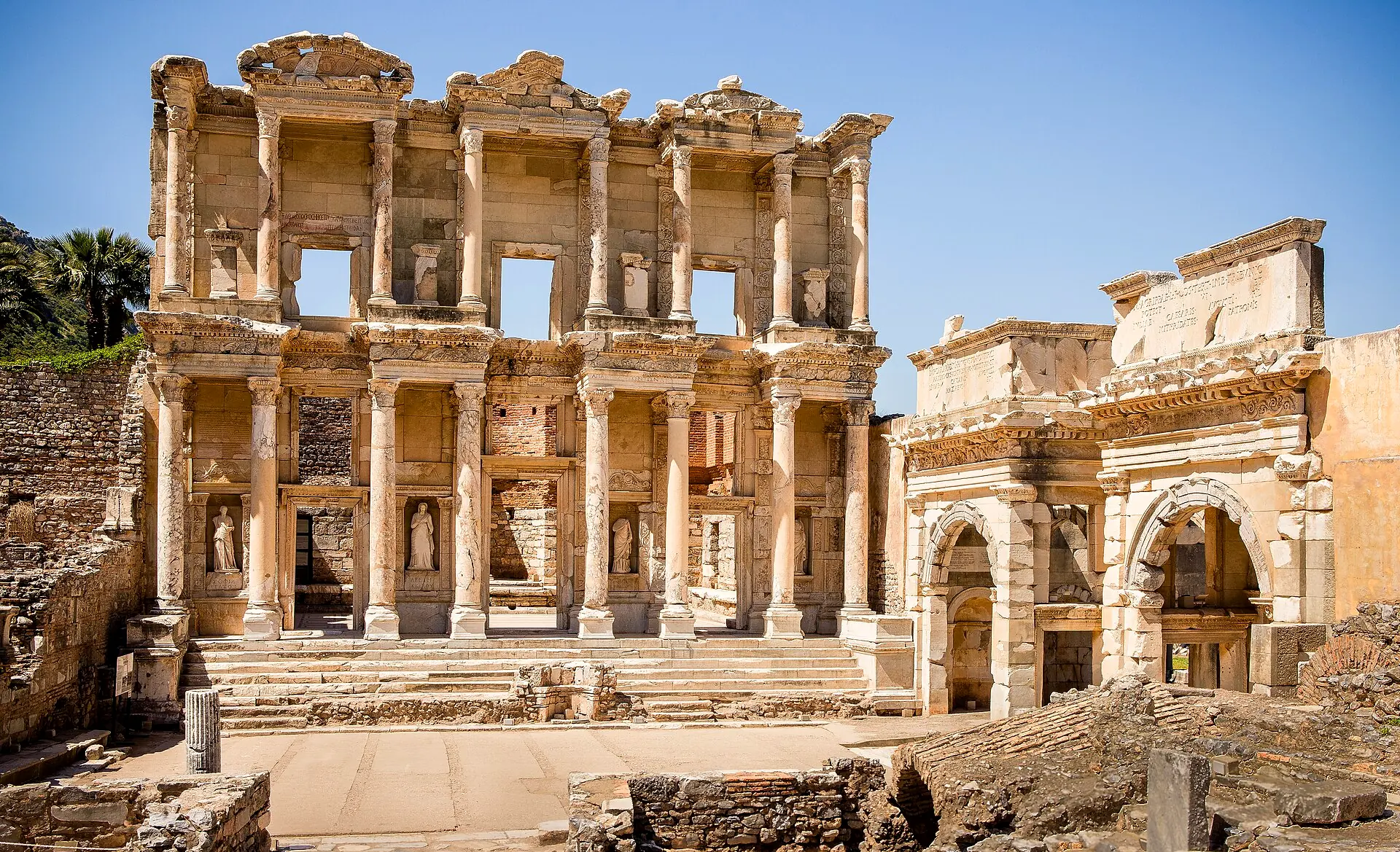
The Library of Celsus is a Roman library building in Ephesus, near the modern town of Selçuk in İzmir Province, western Türkiye. It was commissioned in the 110s CE as a funerary monument for the former proconsul Tiberius Julius Celsus Polemaeanus. Visitors come for its two-storey marble façade, which archaeologists re-erected between 1970 and 1978, and it is usually seen as part of an Ephesus day visit.
Key facts
- Location: Ephesus archaeological site, about 4 km west of Selçuk, İzmir Province
- Distance from airports and cities: About 55 km from İzmir Adnan Menderes Airport; about 19 km from Kuşadası
- Built: Commissioned in the 110s CE; completed under Emperor Hadrian
- Original function: Library and funerary monument for Celsus, who is buried in a crypt beneath it
- What survives: The façade, re-erected 1970-1978; the interior remains in ruin
- UNESCO status: Part of Ephesus, a UNESCO World Heritage Site
- Best season: Spring and autumn for milder weather; summers are hot and shadeless
- Typical visit time: 10-20 minutes at the library; 90 minutes to 2.5 hours for the whole site
- Entrance: See official page (ticket for the Ephesus site; check the current fee and hours)
What is the Library of Celsus and why visit?
The Library of Celsus is a Roman library and tomb in Ephesus, near Selçuk in İzmir Province. Its restored marble façade is the most photographed building on the site. Visitors come to see Roman architecture at close range and to understand how a wealthy family used a public building to honour a father.
Moreover, the library sits at the end of Curetes Street, the main boulevard of the ancient city, so it works as a natural landmark on any walking route. In contrast to many ruins that show only foundations, this building still presents a recognisable front with columns, niches and carved decoration.
What is the history of the Library of Celsus?
Tiberius Julius Aquila Polemaeanus commissioned the library in the 110s CE to honour his father, Tiberius Julius Celsus Polemaeanus, a former proconsul of the province of Asia. It was finished under Emperor Hadrian, after Aquila had died. A fire in 262 CE destroyed the interior, and an earthquake later toppled the façade.
Celsus had a military and political career, became consul in 92 CE and later served as proconsul, or governor, of Asia. He then retired to Ephesus, his home. After his death, his son paid for the library. However, the building was not completed until after the son’s own death.
The library worked as a public space from around 117-135 CE until 262 CE. In that year, a fire destroyed the interior and its contents. It is unclear whether an earthquake or a Gothic invasion caused it. The façade stood until an earthquake in the 10th or 11th century. The ruins then lay untouched for centuries.
Archaeologists re-erected the façade between 1970 and 1978. Wikipedia names the German archaeologist Volker Michael Strocka as the leader of this campaign and notes that only the façade was rebuilt, while the rest of the building remains in ruin. Consequently, what you see today is a careful reconstruction from ancient fragments, with some missing pieces replaced by copies.
The main dates at a glance:
- 92 CE: Celsus becomes consul.
- 110s CE: his son commissions the library.
- About 117-135 CE: the building is completed and in public use.
- 262 CE: fire destroys the interior.
- 10th or 11th century: earthquake topples the façade.
- 1970-1978: archaeologists re-erect the façade.
The table below sets out the building story in order.
| Period | Event | Why it matters |
|---|---|---|
| 92 CE | Celsus serves as consul | Marks the career that earned him a monument |
| 110s CE | Aquila commissions the library | Starts the project as a funerary monument |
| c. 117-135 CE | Building completed and used | Public reading space for Ephesus |
| 262 CE | Fire destroys interior | End of the library as a working space |
| 10th-11th c. | Earthquake topples façade | Ruins lie untouched for centuries |
| 1970-1978 | Façade re-erected | The view visitors see today |
What are the highlights of the Library of Celsus?
The main highlights are the east-facing marble façade, the statues of four female virtues, the nine-step platform and the crypt of Celsus. The façade uses carved plants, portrait statuary and a trick of false perspective to look larger and grander than the building really was.
Wikipedia explains that the façade has two storeys of columns, with four niches on the lower level that held statues of Sophia (wisdom), Episteme (knowledge), Ennoia (intelligence) and Arete (excellence). The statues now standing there are not the originals. Likewise, the sarcophagus of Celsus lay in a crypt beneath the apse, which was an unusual honour inside a Roman city.
Inside, the ruined hall measured 17 by 11 metres, according to Wikipedia, with niches along three walls for scroll cupboards. The niches had double walls, which may have helped protect the scrolls from heat and damp. Therefore the plan shows careful thought about how to store fragile papyrus.
Look for these features when you stand in front of the building:
- The nine broad steps leading up to three entrances.
- Four pairs of Composite columns on pedestals, with Corinthian columns above.
- Four niches with statues of the virtues Sophia, Episteme, Ennoia and Arete.
- Carved acanthus leaves, scrolls and fasces emblems, a sign of Celsus’s consular rank.
- The apse at the back, where a statue once stood and the crypt lay beneath.
The table gives a quick overview of what to look at and why.
| Feature | What to notice | Detail |
|---|---|---|
| Façade | Two storeys, carved decoration | Re-erected 1970-1978 |
| Niches with statues | Virtues Sophia, Episteme, Ennoia, Arete | Statues now in place are not originals |
| Steps and doors | Nine steps, three entrances | Platform raises the building above the street |
| Crypt | Sarcophagus of Celsus | Below the apse floor |
| Interior | Single hall about 17 x 11 m | Unrestored; niches for scroll cupboards |
How do you get to the Library of Celsus and get around?
The library is inside the ticketed Ephesus site, about 4 km west of Selçuk and about 19 km from Kuşadası. Most visitors arrive by dolmuş, taxi, organised tour or car, then walk. Selçuk is the nearest town and is linked to İzmir by suburban rail and by road.
Wikivoyage explains that dolmuşes run from the Selçuk bus station to the lower (northern) gate and also connect to Kuşadası, but there is no dolmuş to the upper (southern) gate. Taxis run from Selçuk to the upper gate. Many people enter at the upper gate, walk downhill along Curetes Street and leave by the lower gate. Check the current timetable and conditions before you travel.
From İzmir, Wikivoyage says Selçuk is the southern terminus of the İZBAN suburban line, and the trip from downtown takes about an hour. A regional TCDD train takes about 90 minutes. From Istanbul, intercity buses run via İzmir and take 8-9 hours according to Wikivoyage, so most travellers fly to İzmir instead.
Choose your transport with these points in mind:
- Dolmuş: cheapest option, serves the lower gate only.
- Taxi: flexible, can drop you at the upper gate and meet you at the lower gate.
- Train: İZBAN from İzmir and the airport to Selçuk, then a short taxi or dolmuş.
- Own car: parking is available at both gates; the site is near the D550 and D515 junction.
- Tour or private transfer: removes the gate logistics.
This table compares the usual routes with typical durations (check current timetables).
| From | Mode | Typical duration | Notes |
|---|---|---|---|
| İzmir city centre | İZBAN train to Selçuk | About 1 hour | Then taxi or dolmuş to a gate |
| İzmir airport | Train or taxi | Roughly 45-60 minutes by road | Airport is about 55 km from Selçuk |
| Kuşadası | Dolmuş or taxi | Short ride | About 19 km to the site |
| Selçuk town | Dolmuş, taxi or walk | Walk is about 4 km | Dolmuş serves the lower gate |
| Istanbul | Flight to İzmir, then rail or road | Same day | Bus takes 8-9 hours, per Wikivoyage |
When is the best time to visit the Library of Celsus?
Spring and autumn are the most comfortable seasons for Ephesus, because the site has little shade. Summer is hot and sunny, and winter is mild and wet. Early morning and late afternoon give softer light on the marble façade and thinner crowds, whatever the season.
Wikivoyage describes Ephesus as a year-round site with a Mediterranean climate. Summer noon temperatures push 36-37°C, and a lot of UV penetrates cloud, so a hat and sun protection matter even on cloudy days. In winter the main avenue is well paved, so rain is manageable.
Because coach groups converge on the site at similar hours, individual visitors can look for gaps between groups. As a result, arriving at opening time or late in the day often gives a calmer view of the façade. Check the official page for current opening hours.
The table summarises each season.
| Season | Weather | Crowds | Notes |
|---|---|---|---|
| Spring (Mar-May) | Mild, some rain early | Moderate, rising | Green surroundings; comfortable walking |
| Summer (Jun-Aug) | Hot and dry, noon around 36-37°C | Highest | Bring water, hat and sun protection |
| Autumn (Sep-Nov) | Warm then cooler | Moderate | Good light for photographs |
| Winter (Dec-Feb) | Mild and wet | Lowest | Paved avenue; check for closed areas |
How long should you stay at the Library of Celsus?
Plan about 10 to 20 minutes at the library itself, and 90 minutes to 2.5 hours for the whole Ephesus site, according to Wikivoyage. The Terrace Houses add around 30 minutes. A half day covers Ephesus alone; one to three days lets you add Selçuk, Şirince and the coast.
The grounds are seen entirely on foot, and pathways are clearly signed. However, excavation and stabilisation work means any single sight may be barricaded off, so keep your plan flexible. Moreover, the library is near the lower end of the main avenue, so it fits naturally as a midpoint or finale.
If you like detail, add the Ephesus Archaeological Museum in Selçuk, where many finds from the site are displayed.
Use these sample plans to match your time.
| Time available | Suggested plan | What you cover |
|---|---|---|
| Half day | Ephesus main avenue, Library of Celsus, Great Theatre | Core Roman city on foot |
| 1 day | Ephesus in the morning, Selçuk museum, St John Basilica area, lunch in town | Site plus Selçuk context |
| 2-3 days | Add Terrace Houses, Şirince village, Temple of Artemis column, beach time at the coast | Full Selçuk and Aegean sampler |
What practical tips should you know before visiting?
Wear comfortable shoes, carry water and cover your head, because the marble paving is slippery and shade is scarce. Buy tickets only through the official page or at the gate, and check current fees and hours there. The main avenue is suitable for wheelchairs and strollers, with some uneven stretches.
Photography of the façade works best from the street at a distance, so you can fit the full height into the frame. Early or late light reduces glare from the pale marble. In contrast, mid-day sun flattens the carving. Be patient, because tour groups pass in waves.
For safety, avoid very cheap or free tours that finish in a souvenir shop, a warning that Wikivoyage also gives. Keep your valuables close in crowded areas and stay on marked paths, because the ground is uneven and works are ongoing.
A quick checklist before you go:
- Check the official museum page for current fees, hours and any Museum Pass rules.
- Wear flat, grippy shoes and bring a hat and water.
- Do not climb on walls or columns; stay behind barriers.
- Ask permission before photographing other visitors or guides.
- Allow extra time for the Terrace Houses, which have a separate ticket.
Where should you stay and eat near the Library of Celsus?
Selçuk is the practical base, because it is about 4 km from the site and has the railway and bus stations. Kuşadası, about 19 km away, offers beach resort accommodation. For meals, the area west of Selçuk railway station has the main concentration of restaurants.
Wikivoyage lists Selçuk restaurants serving kebab, fish, meze and local dishes such as gözleme, with vegetarian options at several places. Moreover, Şirince, a hill village about 9 km east of Selçuk according to Wikivoyage, offers a quieter village setting. Try gözleme, mantı and other Aegean specialities when you can.
Therefore many travellers sleep in Selçuk for an early start, then spend the evening around the aqueduct and the old town. Check current reviews and availability for hotels, since conditions change.
What are the nearby places and day trips?
Nearby, you can see the rest of Ephesus, the Ephesus Archaeological Museum, the Temple of Artemis column, St John Basilica on Ayasuluk hill, Şirince village and the beaches around Kuşadası. İzmir, Pergamon and Çeşme are longer day trips from the area.
Selçuk itself holds the museum and the İsa Bey Mosque, built in 1374 according to Wikivoyage. The Temple of Artemis, once known as one of the Seven Wonders of the ancient world, survives as a single reconstructed column. In addition, Ayasuluk hill was the original site of Ephesus.
For a longer route, combine Ephesus with Pergamon to the north or with İzmir’s Kemeraltı Bazaar. As a result, one Aegean loop can cover Roman, Hellenistic and Ottoman layers in three or four days.
Related places on this site:
- Ephesus (UNESCO site page)
- Selçuk
- Şirince Village
- Kemeraltı Bazaar in İzmir
- Pergamon and its Multi-Layered Cultural Landscape
Plan this with TurkGT
TurkGT is an Istanbul-based travel company that offers guided trips, private transfers, local guides and interpreter support across Türkiye. Tell us your dates, group size and interests, and we will propose a route and confirm the details with you by WhatsApp. Prices, timings and availability are agreed directly with our team, so please message us before you book anything non-refundable.
Frequently asked questions
Who built the Library of Celsus?
Tiberius Julius Aquila Polemaeanus commissioned it in the 110s CE for his father, Tiberius Julius Celsus Polemaeanus. It was completed under Hadrian after Aquila’s death.
Where is the Library of Celsus?
In Ephesus, near the town of Selçuk in İzmir Province, western Türkiye. It is about 4 km west of Selçuk.
How many scrolls did it hold?
It is believed to have held around 12,000 scrolls, according to Wikipedia.
Is the Library of Celsus a UNESCO site?
It is part of Ephesus, which is a UNESCO World Heritage Site.
Can you go inside the Library of Celsus?
The façade was rebuilt but the interior remains in ruin. Check the official page and on-site signs for what is open.
How long do you need at Ephesus?
Wikivoyage gives 90 minutes to 2.5 hours for the grounds, plus about 30 minutes for the Terrace Houses.
What happened to the original library?
A fire in 262 CE destroyed the interior and contents, and an earthquake in the 10th or 11th century brought down the façade.
How much is the ticket?
Fees change, so see the official museum page for the current price and any Museum Pass options.
Related on TurkGT
- Part of İzmir
- Şirince Village
- İzmir Clock Tower
- Kemeraltı Bazaar
- Pergamon and its Multi-Layered Cultural Landscape
- Ephesus
- Çeşme
Sources
- Library of Celsus (Wikipedia)
- Ephesus (Wikivoyage)
- Selçuk (Wikivoyage)
- Ephesus (UNESCO World Heritage Centre)
- Celsus Kütüphanesi – Kültür Portalı
Last reviewed: 2026-11-17. Opening hours, ticket prices and other changeable details are not listed because they change; check the official source before you travel.