
The Basilica Cistern is the largest of several hundred ancient cisterns beneath Istanbul. Built in the sixth century under Justinian I, it lies about 150 m south-west of Hagia Sophia in Sultanahmet and is known for its 336 marble columns and Medusa heads.
Key facts
- Location: Sultanahmet, about 150 m south-west of Hagia Sophia
- Distance: Short walk from the Sultanahmet tram stop; see airport guides
- Built: 6th century, Justinian I
- Columns: 336, each 9 m high
- UNESCO: Not stated here; see our Historic Areas of Istanbul page
- Best season: Any season; useful in rain or heat
- Typical visit time: 30-60 minutes
- Entrance: See official page
What is the Basilica Cistern and why visit?
The Basilica Cistern, or Yerebatan Sarnıcı, is the largest of several hundred ancient cisterns beneath Istanbul. It was built in the sixth century under Emperor Justinian I and lies about 150 metres south-west of Hagia Sophia. Visitors come for its forest of marble columns and its Medusa heads.
Today it is kept with little water so that people can walk through it. Moreover, it is cool and atmospheric, which makes it a good contrast to the hot streets above. As a result, it pairs naturally with Hagia Sophia and the Blue Mosque in one Sultanahmet day.
What is the history of the Basilica Cistern?
A great basilica stood on the spot in the early Roman period, between the third and fourth centuries, and it served as a commercial, legal and artistic centre. The underground cistern was built in the sixth century under Justinian I. It was called Basilica because it lay under a large public square, the Stoa Basilica.
Its existence was eventually forgotten by all but locals who drew water from it, until the French traveller Petrus Gyllius left a record in 1565. He described being rowed between the columns and seeing fish swimming beneath the boat. Ancient texts also indicate that the cistern held gardens surrounded by a colonnade facing Hagia Sophia.
The first major modern restoration ran from 1985 to 1987, when more than 50,000 tons of silt were removed and raised walkways let the cistern open as a museum in 1987. A further restoration ran from 2020 to 2022. Stainless-steel rods replaced deteriorated iron tie-rods, and a new modular steel walkway was installed, physically separated from the historic structure. The work also revealed the original sixth-century brick floor.
Moreover, the 2020 to 2022 restoration also dismantled concrete walkways and a thick cement render added in the mid-twentieth century. Therefore today’s visit shows more of the original structure than earlier decades did.
The table sets the main dates in order.
| Date | Event | Result |
|---|---|---|
| 3rd-4th centuries | Great basilica on the site | Commercial, legal and artistic centre |
| 6th century | Cistern built under Justinian I | Underground water reservoir |
| 1565 | Petrus Gyllius records the cistern | Existence recorded outside local use |
| 1985-1987 | First major modern restoration | Opened as a museum in 1987 |
| 2020-2022 | Comprehensive restoration | Reopened to the public in 2022 |
What are the highlights of the Basilica Cistern?
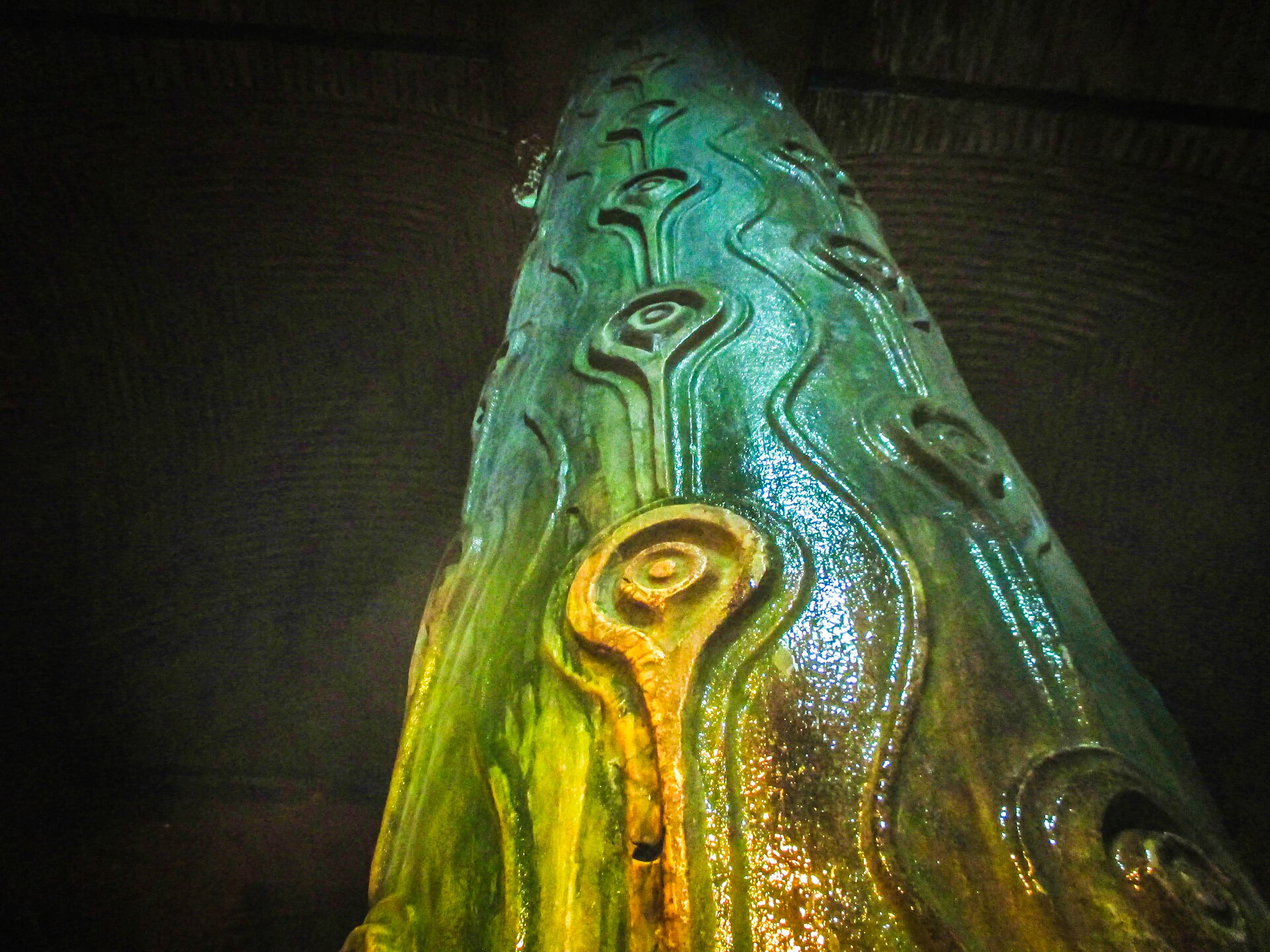
The highlights are the 336 marble columns and the two Medusa heads. The columns are 9 metres high and arranged in 12 rows of 28. The capitals are mainly Ionic and Corinthian, with a few Doric. Two columns in the north-west corner stand on blocks carved with the face of Medusa.
Look out for these features.
- The forest of 336 marble columns, each 9 metres high.
- The two Medusa-head column bases; their origin is unknown.
- The Ionic and Corinthian capitals.
- The cistern’s size: about 140 metres long and 70 metres wide, per the national culture portal.
- The original sixth-century brick floor revealed in the 2020-2022 restoration.
- The 1963 James Bond film From Russia with Love used the cistern as a location.
This at-a-glance table sums up the main facts.
| Feature | Detail | Note |
|---|---|---|
| Columns | 336, each 9 m high | 12 rows of 28 |
| Medusa heads | Two, in the north-west corner | Origin unknown |
| Size | About 140 m by 70 m | Rectangular area |
| Capacity | About 100,000 tons of water, per the culture portal | Figures may differ by source |
| Today | Little water, walkways for visitors | Museum since 1987 |
How do you get to the Basilica Cistern and get around?
The Basilica Cistern is in Sultanahmet, about 150 metres south-west of Hagia Sophia. Take the T1 tram to the Sultanahmet stop and walk a few minutes. Check the current timetable of the operator. Taxis and transfers drop off near the pedestrian zone.
This table compares ways to arrive.
| Option | How it works | Notes |
|---|---|---|
| T1 tram | Ride to Sultanahmet, then walk | Check the current timetable |
| From the airports | Shuttle, metro plus tram, or private transfer | See our airport guides |
| Ferry plus tram | Cross by ferry, then tram or walk | Useful from the Asian side |
| Taxi or transfer | Drop-off near Sultanahmet Square | Traffic varies |
| On foot | Walk from Hagia Sophia or the Blue Mosque | About 150 m from Hagia Sophia |
When is the best time to visit the Basilica Cistern?
The cistern is underground, so weather matters less than elsewhere in Sultanahmet. It is a useful choice on rainy or very hot days. Mornings and weekdays are quieter, and queues can build later in the day, so check the official page for opening hours.
The table shows what each season is generally like.
| Season | Weather above ground | Crowds | Notes |
|---|---|---|---|
| Spring (Mar-May) | Mild | Busy | Good before a walk outside |
| Summer (Jun-Aug) | Hot | Highest | Cool refuge; go early |
| Autumn (Sep-Nov) | Mild to cool | Moderate | Comfortable |
| Winter (Dec-Feb) | Cool and rainy | Lowest | Good rainy-day stop |
How long should you stay at the Basilica Cistern?
The Basilica Cistern is a short visit, but it fits well into a larger plan. Allow 30 to 45 minutes inside the cistern, or about an hour if you linger for photos. Combine it with Hagia Sophia and the Blue Mosque for a half day. Therefore it fits easily into a short Sultanahmet plan.
Moreover, you may want extra time for the walkways and photography. As a result, many visitors set aside an hour for the cistern and the queue.
This table gives three plans.
| Plan | What it covers | Pace |
|---|---|---|
| Half day | Basilica Cistern, Hagia Sophia, Blue Mosque | Relaxed |
| 1 day | Add Topkapı Palace | Full |
| 2-3 days | Add Dolmabahçe, the bazaars, Galata and a Bosphorus cruise | Easy pace |
What are the practical tips for visiting the Basilica Cistern?
Plan ahead for a low-light, damp space. Check the official page for tickets and opening hours, since we do not quote them. The walkways are narrow, and the light is low, so wear flat shoes. Move steadily to keep the flow of visitors going.
Moreover, check official sources for the current rules on photography, access and visitor flow. In contrast, the surrounding streets in Sultanahmet are open and easy to explore on foot.
These tips help.
- Tickets and fees: see the official page.
- MuseumPass Istanbul is a multi-day product; check whether it applies.
- Accessibility: the walkways and steps may be hard for some visitors; ask official sources.
- Photography: low light and crowds make tripods hard; check the current rules.
- Safety: watch your step on damp walkways.
- Etiquette: speak quietly and do not block the walkway.
Where should you stay and eat near the Basilica Cistern?
Choose a neighbourhood by mood rather than distance, since the area is compact and well linked by tram. Sultanahmet puts the cistern on your doorstep, with guesthouses and quiet nights. In contrast, Karaköy and Galata offer cafes across the Golden Horn. Fatih and Eminönü have local eateries.
Try lokantas, kebab houses and bakeries nearby, and compare menus before sitting down.
What is near the Basilica Cistern and what day trips work?
The main sights of the historic peninsula lie close together near the Basilica Cistern, so you can combine several in one day. The cistern is a few steps from the main sights, so a short walk links them. Use this list to plan.
Hagia Sophia is about 150 metres away, so the two sites pair easily. Beyond them, the Blue Mosque, the Hippodrome and Topkapı Palace complete a compact historic loop.
Nearby options include these.
- Hagia Sophia, about 150 m away.
- The Blue Mosque and Hippodrome area.
- Topkapı Palace.
- The Grand Bazaar and Spice Bazaar.
- Galata Tower across the Golden Horn.
- Bosphorus cruise or Princes’ Islands.
Plan this with TurkGT
TurkGT is an Istanbul-based travel company offering guided tours, private transfers, licensed guide and interpreter services, and tailored itineraries. Tell us your dates and interests, and we confirm the plan and availability by WhatsApp. For tickets and opening times, we point you to the official page first.
Our Basilica Cistern and Underground Istanbul Guided Tour and the Sultanahmet Walking Tour: Hippodrome, Hagia Sophia, Blue Mosque include the cistern.
Frequently asked questions
What is the Basilica Cistern?
It is the largest of several hundred ancient cisterns beneath Istanbul.
When was it built?
It was built in the sixth century under Justinian I.
What does Yerebatan mean?
Yerebatan Sarnıcı means Subterranean Cistern.
How many columns?
There are 336 marble columns, each 9 metres high.
Where are the Medusa heads?
In the north-west corner, as column bases. Their origin is unknown.
When did it reopen?
It reopened to the public in 2022 after restoration from 2020 to 2022.
What are the opening hours?
Check the official page; they are not stated here.
What is nearby?
Hagia Sophia is about 150 m away; the Blue Mosque and Topkapı Palace are close.
Related on TurkGT
Sources
- Wikipedia: Basilica Cistern
- Türkiye Kültür Portalı: Yerebatan Sarnıcı
- Ministry of Culture and Tourism: MuseumPass Istanbul
Last reviewed: 2026-11-17. Opening hours, ticket prices and other changeable details are not listed because they change; check the official source before you travel.