
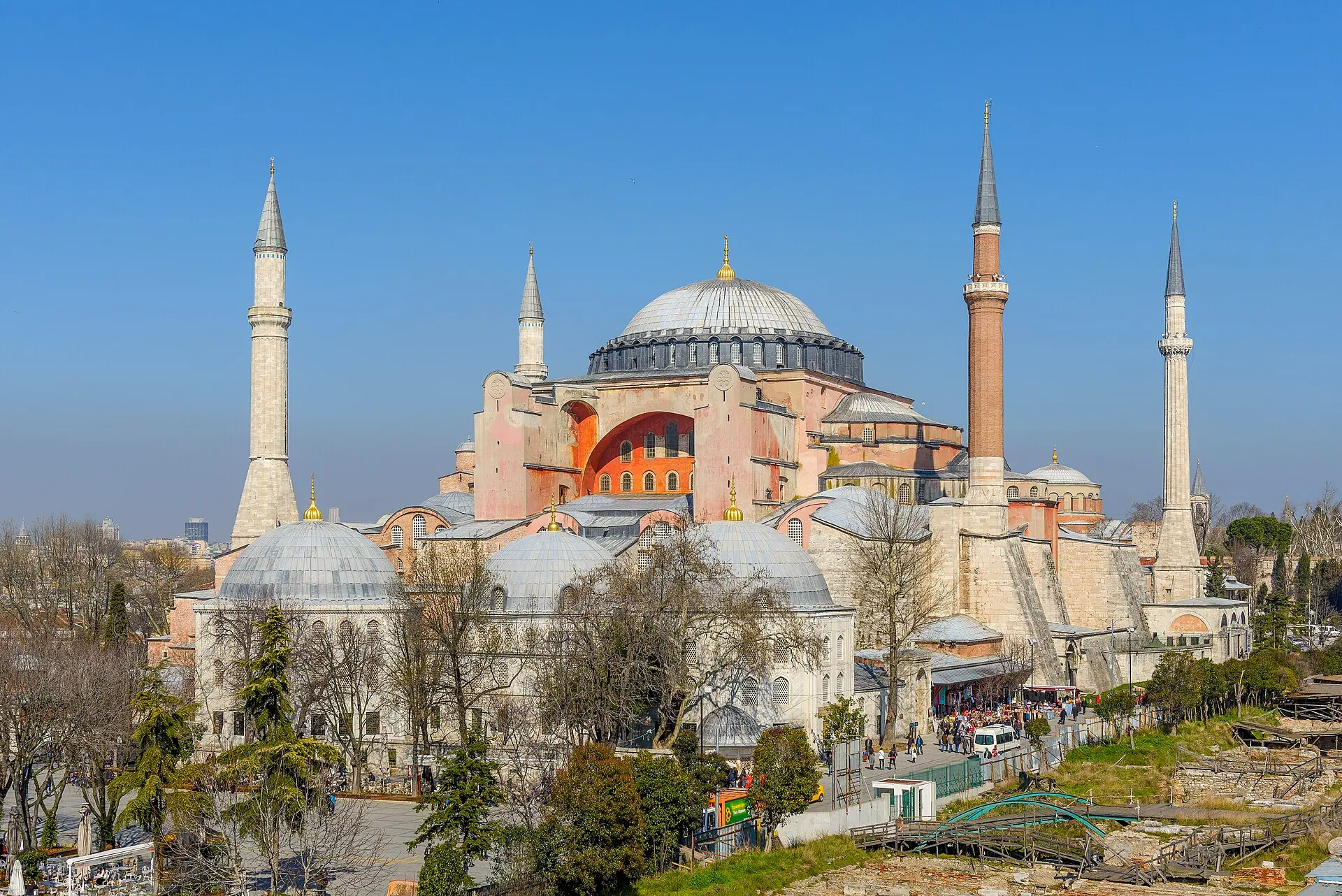
Hagia Sophia is a sixth-century Byzantine building in Istanbul’s Sultanahmet district, completed in AD 537 under Emperor Justinian I. It served as a church, a mosque and a museum, and has been a mosque again since 2020. It is part of the UNESCO-listed Historic Areas of Istanbul.
Key facts
- Location: Sultanahmet, Istanbul historic peninsula
- Distance: Short walk from the Sultanahmet tram stop; airports are on the city edges, see our airport guides
- Built: 532-537, Emperor Justinian I
- Current status: Mosque (redesignated 2020)
- UNESCO: Historic Areas of Istanbul, inscribed 1985
- Best season: Spring and autumn; early mornings
- Typical visit time: About 1 hour; half day with nearby sights
- Entrance: See official page
What is Hagia Sophia and why visit?
Hagia Sophia is a sixth-century Byzantine building in Istanbul’s Sultanahmet district, completed in AD 537 under Emperor Justinian I. Today it is officially the Hagia Sophia Grand Mosque. Visitors come for its vast dome, its layered Byzantine and Ottoman past, and its place in the UNESCO-listed Historic Areas of Istanbul.
The building has changed role several times. It was a church from 360 to 1453, a mosque after the Ottoman conquest, a museum from 1935 to 2020, and a mosque again from 2020. As a result, one visit touches architecture, religion and urban history together. Moreover, it stands a short walk from the Blue Mosque, the Basilica Cistern and Topkapı Palace, so most travellers combine these sites in one day.
What is the history of Hagia Sophia?
Hagia Sophia was built between 532 and 537 for Emperor Justinian I, after an earlier church of the same name burned down in the Nika riots. It became a mosque in 1453, a museum in 1935 and a mosque again in 2020. Each change shaped the building you see now.
The present structure was the last of three church buildings erected on the site by the Eastern Roman Empire. For nearly a thousand years it served as the cathedral of Constantinople. The only break came between 1204 and 1261, when Latin Crusaders installed their own hierarchy. In 1054 it was also the place where the excommunication of Patriarch Michael I Cerularius was delivered, an act often linked to the East-West Schism.
After the fall of Constantinople in 1453, Mehmed the Conqueror converted it to a mosque, and minarets were added soon afterwards. It became the principal mosque of Istanbul until the Sultan Ahmed Mosque was built. The complex stayed a mosque until 1931, when it closed to the public for four years. It reopened in 1935 as a museum under the secular Republic. In 2020 the Council of State annulled the 1934 decision that created the museum, and the building was reclassified as a mosque.
The table below places the main turning points in order.
| Date | Event | Result |
|---|---|---|
| 532-537 | Built for Justinian I after the Nika riots | Third church on the site |
| 1054 | Excommunication of Patriarch Michael I Cerularius delivered here | Linked to the East-West Schism |
| 1204-1261 | Latin Crusaders install their own hierarchy | Catholic cathedral under the Latin Empire |
| 1453 | Ottoman conquest of Constantinople | Converted to a mosque; minarets added |
| 1935 | Opened under the secular Republic | Museum |
| 2020 | Council of State annuls the 1934 decision | Reclassified as a mosque |
What are the highlights of Hagia Sophia?
The main highlight is the dome, which UNESCO describes as reflecting the architectural and decorative expertise of the sixth century. The building was the world’s largest interior space when completed and among the first to use a fully pendentive dome. In addition, its Ottoman minarets and surrounding complexes show how later eras reshaped the skyline.
These are the features most visitors look for inside and around the building.
- The central dome and its pendentives, an early fully pendentive design.
- The work of Isidore of Miletus and Anthemius of Tralles, the Greek geometers who designed it.
- Ottoman additions such as the minarets that followed the conquest of 1453.
- The setting among Sultanahmet landmarks, including the Hippodrome area and the Blue Mosque opposite.
- The sense of scale: it stayed the world’s largest church for more than five hundred years, until the abbey church at Cluny in the twelfth century.
This at-a-glance table summarises what to notice.
| Feature | What to notice | Era |
|---|---|---|
| Dome | Vast central dome carried on pendentives | 6th century |
| Designers | Isidore of Miletus and Anthemius of Tralles | 532-537 |
| Minarets | Added after the Ottoman conquest | After 1453 |
| Current role | Functioning mosque, Hagia Sophia Grand Mosque | Since 2020 |
| World Heritage | Part of the Historic Areas of Istanbul | Inscribed 1985 |
How do you get to Hagia Sophia and get around?
Hagia Sophia sits in Sultanahmet on Istanbul’s historic peninsula, and the easiest approach is the T1 tram to the Sultanahmet stop. From there it is a short walk. Taxis and private transfers also reach the area, although nearby streets are busy and partly pedestrianised, so check the drop-off point.
The airports are on the edges of the city, so allow generous time. Our guides to Istanbul Airport and Sabiha Gökçen Airport explain the transport options in detail. Once in Sultanahmet, most sights are within walking distance of each other.
The table compares the usual ways to reach the area.
| Option | How it works | Notes |
|---|---|---|
| T1 tram | Ride to the Sultanahmet stop, then walk | Check the current timetable and route |
| From the airports | Airport shuttle, metro and tram, or private transfer | See our airport guides; travel time depends on traffic |
| Ferry plus walk | Cross the Bosphorus or Golden Horn, then tram or walk uphill | Useful from the Asian side; check current timetable |
| Taxi or private transfer | Drop-off near the Sultanahmet pedestrian zone | Traffic varies by hour |
| On foot | Walk from the Blue Mosque, Hippodrome or Basilica Cistern | The sights are close together |
When is the best time to visit Hagia Sophia?
Early morning on a weekday is usually calmer, and spring or autumn gives mild weather for the walk around Sultanahmet. Summer is warm and busy, while winter is cooler, wetter and quieter. Because the building is a working mosque, prayer times affect access, so check the official page before you go.
The table summarises what each season is generally like.
| Season | Weather | Crowds | Notes |
|---|---|---|---|
| Spring (Mar-May) | Mild, occasional rain | Busy around holidays | Good for walking the old city |
| Summer (Jun-Aug) | Hot and humid | Highest | Go early; carry water |
| Autumn (Sep-Nov) | Mild to cool | Moderate | Comfortable for a full day out |
| Winter (Dec-Feb) | Cool and rainy | Lowest | Shorter days; dress in layers |
How long should you stay at Hagia Sophia?
Plan about an hour inside and around Hagia Sophia, and a half day if you add the Blue Mosque and the Basilica Cistern. A full day also fits Topkapı Palace. Therefore the right plan depends on how many Sultanahmet sights you want to see in one trip.
The table offers three simple plans.
| Plan | What it covers | Pace |
|---|---|---|
| Half day | Hagia Sophia, the Blue Mosque and the Hippodrome area | Relaxed |
| 1 day | Add the Basilica Cistern and Topkapı Palace | Full |
| 2-3 days | Add Dolmabahçe Palace, the bazaars, Galata and a Bosphorus cruise | Easy pace with time for meals |
What are the practical tips for visiting Hagia Sophia?
Treat Hagia Sophia as a working mosque. Dress modestly with covered shoulders and knees, expect to remove your shoes, and keep your voice low. Rules for tourist entry have changed since 2020, so check the official page for current arrangements and fees before you travel.
Keep these practical points in mind.
- Tickets and fees: see the Ministry of Culture and Tourism official page; we do not quote prices here.
- The Hagia Sophia History and Experience Museum is a separate exhibition with its own fee on the official page.
- MuseumPass Istanbul exists as a multi-day product; check whether it applies to your plans.
- Accessibility: expect steps, stone floors and crowds; ask the official page about current access routes.
- Photography: be discreet, avoid flash and do not photograph people at prayer.
- Safety: guard your phone and wallet in queues and be wary of unofficial guides at the gate.
- Etiquette: follow staff instructions, especially around prayer times.
Where should you stay and eat near Hagia Sophia?
Sultanahmet is the natural base because the main sights are on foot, although it can be touristy and quiet at night. In contrast, Karaköy and Galata offer more cafes and nightlife across the Golden Horn, a short tram or walk away. Eminönü and Fatih have local eateries popular with Istanbul residents.
For food, look for lokantas serving home-style dishes, kebab houses, and bakeries selling simit and baklava. Avoid restaurants that tout aggressively from the street, and compare menus before sitting down.
What is near Hagia Sophia and what day trips work?
The main sights of the historic peninsula lie close together near the Hagia Sophia, so you can combine several in one day. Several landmarks lie within walking distance, and longer trips branch out from there. Use the list below to plan your day.
The Hippodrome area, the Basilica Cistern and the Blue Mosque form the core cluster. In addition, the Golden Horn waterfront and Karaköy are a short tram ride away, and the Bosphorus shore with Dolmabahçe Palace is further along the tram line.
These places are close to Hagia Sophia.
- Blue Mosque, directly across the park.
- Basilica Cistern, about a short walk southwest.
- Topkapı Palace, behind the Sultanahmet area.
- Dolmabahçe Palace and the Bosphorus shore, reachable by tram and ferry.
- Galata Tower and Beyoğlu across the Golden Horn.
- Princes’ Islands and a Bosphorus cruise for a change of pace.
Plan this with TurkGT
TurkGT is an Istanbul-based travel company offering guided tours, private transfers, licensed guide and interpreter services, and tailored itineraries. Tell us your dates and interests, and we confirm the plan and availability by WhatsApp. For tickets and opening times, we point you to the official page first.
Our Sultanahmet Walking Tour: Hippodrome, Hagia Sophia, Blue Mosque and the Sunrise Hagia Sophia Photo Session in Sultanahmet are good starting points.
Frequently asked questions
Is Hagia Sophia a mosque or a museum?
Hagia Sophia is a mosque. It was a museum from 1935 to 2020 and was redesignated as a mosque in 2020.
Who built Hagia Sophia and when?
Emperor Justinian I had it built between 532 and 537. It was completed in AD 537, designed by Isidore of Miletus and Anthemius of Tralles.
Where is Hagia Sophia?
It is in Sultanahmet, on the historic peninsula of Istanbul, across from the Blue Mosque.
Is Hagia Sophia a UNESCO site?
Yes. It is part of the Historic Areas of Istanbul, inscribed in 1985.
How much does it cost to enter?
Rules and fees change, so check the official Ministry of Culture and Tourism page. We do not quote prices.
What should I wear?
Dress modestly with covered shoulders and knees, and expect to remove your shoes. Follow staff guidance on the day.
How long do I need?
Allow about an hour for the building itself, and a half day if you add the Blue Mosque and Basilica Cistern.
Which sights are nearby?
The Blue Mosque, Basilica Cistern, Topkapı Palace and the Hippodrome area are all close by.
Related on TurkGT
Sources
- Wikipedia: Historic Areas of Istanbul
- Wikipedia: Hagia Sophia
- UNESCO World Heritage Centre: Historic Areas of Istanbul
- Türkiye Kültür Portalı: Ayasofya-i Kebir Camii Şerifi
- Ministry of Culture and Tourism: MuseumPass Istanbul
Last reviewed: 2026-11-17. Opening hours, ticket prices and other changeable details are not listed because they change; check the official source before you travel.