
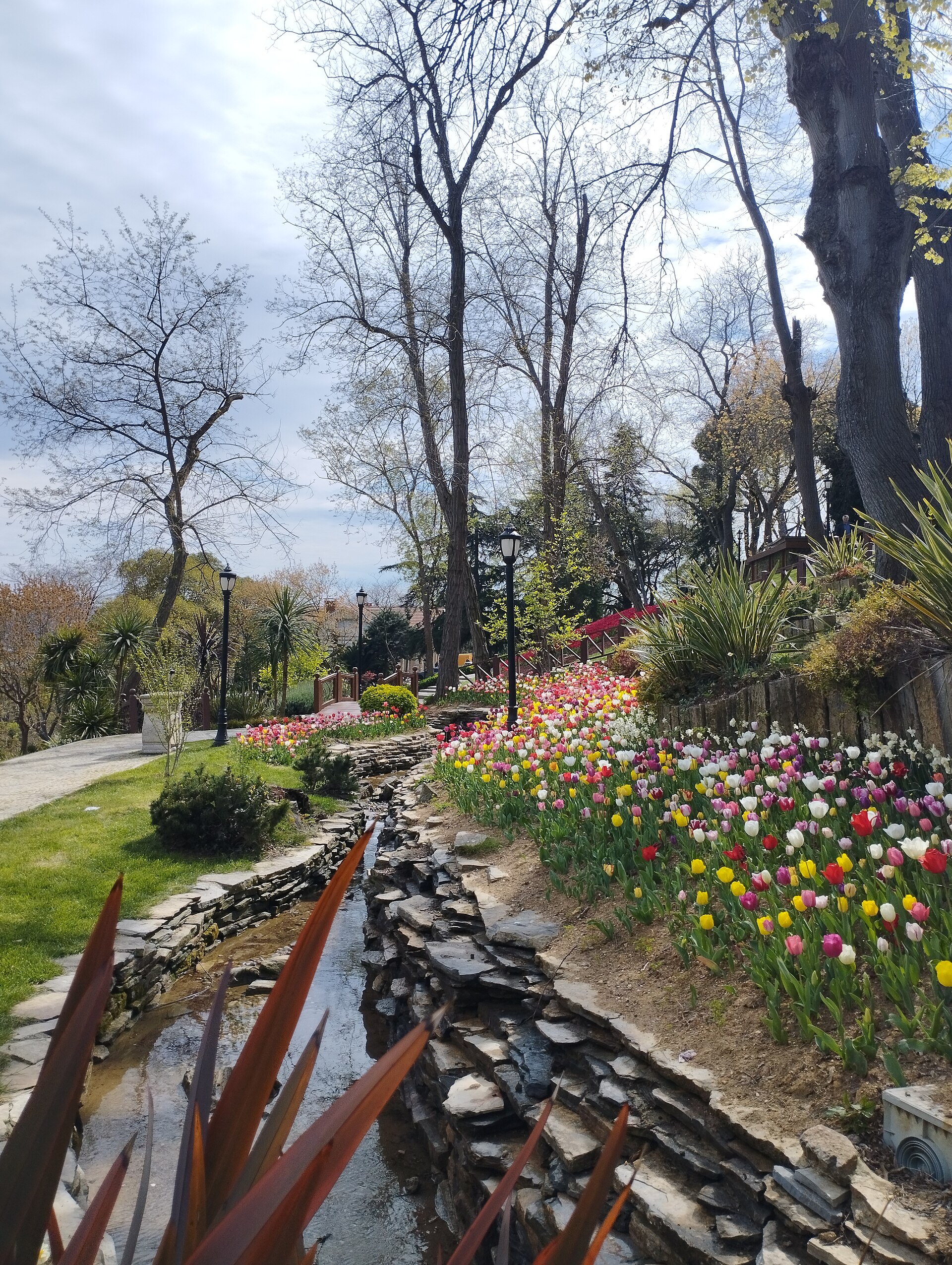
Emirgan Park is a large public park in the Emirgan neighbourhood of Sarıyer, on the European shore of the Bosphorus. It has three wooden pavilions built between 1871 and 1878, more than 120 plant species and two decorative ponds. It hosts the Istanbul Tulip Festival every April.
Key facts
- Location: Emirgan, Sarıyer district, European shore of the Bosphorus
- Area: 472 dunam (Istanbul Metropolitan Municipality); about 117 acres (Wikipedia)
- Owner / administrator: Istanbul Metropolitan Municipality
- Historic pavilions: Yellow, Pink and White, built 1871–1878
- Plant diversity: More than 120 species
- Annual event: Istanbul Tulip Festival, every April
- Distance from airports and centre: Road transfer from either airport; north of Beşiktaş along the Bosphorus road (check current routes)
- Best season: April for tulips; late spring and autumn for green and colour
- Typical visit time: About 1.5 to 3 hours; half a day in tulip season
- UNESCO status: Not a UNESCO site
- Entrance: See the Istanbul Metropolitan Municipality official page for access rules
What is Emirgan Park and why visit?
Emirgan Park is a historic landscaped park on the Bosphorus hills in Sarıyer. It is one of the largest public parks in Istanbul. Visitors come for the tulips in April, three wooden pavilions, mature trees, ponds and views of the strait. It suits families, walkers and photographers.
The Istanbul Metropolitan Municipality describes the wood as the favourite recreation area and excursion spot of Istanbul. As a result, it is busy on weekends and holidays, especially in tulip season.
In contrast to the dense old city, the park is green and open. Wikipedia notes many jogging tracks and picnic tables, which makes it popular with local people. Moreover, its mix of history and gardens gives a visit more depth than a simple stroll.
What is the history of Emirgan Park?
The land was cypress woodland in Byzantine times, then passed to Ottoman officials, a Safavid commander and later the Khedive of Egypt. Three wooden pavilions were built between 1871 and 1878. The estate went to the city in the 1940s, and the pavilions were restored in 1979–1983.
Byzantine and Ottoman names. The Municipality says the area was named Kiparodis (Kyparades), meaning cypresses, in the Byzantine era. Wikipedia says the uninhabited land was granted in the mid-16th century, and the Municipality names Feridun Bey. In the 17th century Murad IV gave the woods to Emir Güne Han, a Safavid commander who surrendered his castle without resistance. The name Emirgune became Emirgan in time.
The Khedive’s estate. By the end of the 1860s the park belonged to Ismail Pasha, Khedive of Egypt, who lived there in exile until his death. The three mansions were constructed between 1871 and 1878. In the 1940s the grounds, including the pavilions, were granted to the City of Istanbul.
Restoration and public use. The pavilions were restored between 1979 and 1983. Wikipedia says they opened to the public as a cafeteria and restaurant. A special tulip garden was established in the 1960s.
The key dates are easy to scan in this list.
- Byzantine era: cypress woodland called Kyparades.
- Mid-16th century: land granted to Feridun Bey.
- 17th century: Murad IV gives it to Emir Güne Han.
- 1871–1878: three pavilions built for Khedive Ismail Pasha.
- 1940s: grounds passed to the City of Istanbul.
- 1960s: tulip garden established; 1979–1983: pavilions restored.
What to see at Emirgan Park
The park offers three coloured pavilions, rare trees, two decorative ponds, tulip beds and Bosphorus views. Most visitors walk the main paths, stop at the pavilions and see the tulips. Wikipedia describes the park as enclosed by high walls, so enter through the gates.
The pavilions are named after their exterior colours: Yellow, Pink and White. Wikipedia describes one as a large wooden mansion in the form of a chalet. Another bears neo-classical architectural characteristics. Pavilion use can change, so check the official page.
These are the main things to look for.
- Yellow, Pink and White Pavilions.
- Tulip beds and the spring festival display.
- Notable rare trees, including the maidenhair tree and the coast redwood.
- Two decorative ponds.
- Jogging tracks, picnic tables and Bosphorus views.
This table summarises the highlights and what to know about each.
| Highlight | What you see | Planning note |
|---|---|---|
| Pavilions | Three wooden mansions of 1871–1878 | Use and access can change; check official pages |
| Tulip garden | Garden established in the 1960s | Best in April |
| Trees | More than 120 plant species | Look for labels and rare specimens |
| Ponds | Two decorative ponds | Good for a rest stop |
| Views | Bosphorus scenery | Clear days are best |
What is the Istanbul Tulip Festival?
The Istanbul Tulip Festival is an annual spring event held every April, with its main display in Emirgan Park. Sources date its start to 2005 or 2006. Dates and bloom timing vary each year, so check the official announcement before you travel.
Wikipedia says an annual international tulip festival has been organised there every April since 2005. The Municipality says since 2006. Therefore this page states both years. In addition, tulips are a famous symbol of Istanbul, and the park’s tulip garden dates to the 1960s.
How do I get to Emirgan Park?
Emirgan lies on the European shore of the Bosphorus in Sarıyer, north of Beşiktaş and Ortaköy. Most visitors arrive by bus, taxi or private transfer along the Bosphorus road. Traffic is heavy in tulip season, so allow extra time and check current routes.
Our public transport guide explains the Istanbulkart and main lines. From Sultanahmet, the simplest option is a private car or a guided trip.
This table compares the usual ways to reach the park.
| From | How | Notes |
|---|---|---|
| Beşiktaş / Ortaköy | Bus or taxi along the Bosphorus road | Check current routes |
| Taksim | Metro, then bus | Check current routes |
| Sultanahmet | Tram to Kabataş, then bus or taxi | Allow extra time |
| Airports | Taxi, shuttle or private transfer | See our airport guides |
| Bosphorus cruise | Boat passes the shore | The park is a land visit |
When is the best time to visit?
April is the main season because of the Tulip Festival. Late spring brings green growth, and autumn offers colour. Winter is quiet and often wet. Tulip dates change each year, so verify them with official announcements. Go early on weekends in April to avoid crowds.
Summer is hot, but the shade of mature trees helps.
This table shows what to expect each season.
| Season | Weather | Crowds | Notes |
|---|---|---|---|
| Spring (Mar–May) | Mild | Very high in April | Tulip Festival; arrive early |
| Summer (Jun–Aug) | Warm | Moderate | Shade under trees |
| Autumn (Sep–Nov) | Mild | Low to moderate | Autumn colour |
| Winter (Dec–Feb) | Cool, wet | Low | Quiet park |
How long should I stay?
Plan 1.5 to 3 hours for a relaxed walk and pavilion stop. A half day suits tulip season or a picnic. A full day links Emirgan with other Bosphorus villages. These are planning estimates, not official figures, and weather affects them.
Longer stays give time for a café break or photography at different light.
This table suggests plans for different time budgets.
| Time | Plan |
|---|---|
| Half day | Walk the park, pavilions and tea break |
| 1 day | Emirgan plus Bosphorus villages and a cruise |
| 2–3 days | Add Sultanahmet, Galata and the Asian side |
What practical tips should I know?
Check the official page for opening rules, parking and any fees. Wear comfortable shoes for sloping paths. Keep to marked paths in tulip beds and do not pick flowers. Weekends in April are crowded, so arrive early. Accessibility on slopes varies.
Photography is welcome. Keep valuables close in crowds.
These tips cover the common questions.
- Fees and rules: see the Istanbul Metropolitan Municipality official page.
- Dress: casual and comfortable; layers in spring.
- Etiquette: stay on paths and keep the park clean.
- Safety: watch children near the ponds and steps.
- Food: cafés in the pavilions can be busy; bring water.
- Accessibility: ask about step-free routes.
Where should I stay and eat?
Stay in Beşiktaş or Beyoğlu for Bosphorus transport, or Sultanahmet for old-city sights. Eat in the park, where the pavilions opened as a cafeteria and restaurant, or in Emirgan village and Ortaköy. Compare menus first. Details of the cafés change, so check before you go.
Bosphorus villages have fish restaurants and bakeries; ask locally for seasonal choices.
This table compares areas for a stay.
| Area | Why stay | Trade-off |
|---|---|---|
| Beşiktaş | Bosphorus access | Traffic |
| Beyoğlu | Nightlife and transport | Noisy |
| Sultanahmet | Old-city sights | Far from Emirgan |
What is nearby?
Ortaköy, Beşiktaş and Dolmabahçe Palace lie south along the shore. The Bosphorus villages continue north toward Sarıyer. Our linked pages cover Beşiktaş, Üsküdar and Galata. Bosphorus cruises show the whole shoreline from the water, which helps you understand how the villages connect.
Day trips from Istanbul reach Şile, Bursa and the Princes’ Islands.
Plan this with TurkGT
TurkGT is an Istanbul-based travel company. We offer guided tours, private transfers, licensed guides and interpreter support, including Bosphorus cruises and photography tours. Send your dates and group size by WhatsApp, and our team confirms the plan there before you travel.
Frequently asked questions
Where is Emirgan Park?
It is in the Emirgan neighbourhood of the Sarıyer district, on the European coast of the Bosphorus in Istanbul.
When is the Istanbul Tulip Festival?
It is held every April. Wikipedia dates it from 2005 and the Municipality from 2006. Exact bloom dates vary, so check official announcements.
How big is Emirgan Park?
The Municipality gives 472 dunam. Wikipedia converts this to 117 acres.
Who built the pavilions?
Wikipedia says Khedive Ismail Pasha built the three pavilions between 1871 and 1878. They are named Yellow, Pink and White.
Who owns the park?
It is owned and administered by the Istanbul Metropolitan Municipality.
How many plant species are there?
Wikipedia says the park has plants of more than 120 species.
Can I visit with a guide?
Yes. TurkGT can arrange a guide and transfers on request. Contact us on WhatsApp to confirm.
How long should I allow?
Allow 1.5 to 3 hours, or half a day in tulip season. This is a planning estimate.
Related on TurkGT
Sources
Last reviewed: 2026-11-18. Opening hours, ticket prices and other changeable details are not listed because they change; check the official source before you travel.