
Dolmabahçe Palace is a 19th-century imperial palace on the European shore of the Bosphorus in Istanbul. Sultan Abdülmecid I built it to replace Topkapı as a modern court residence, and Atatürk died there in 1938. Visit it to see Ottoman court life in a European-influenced setting, with crystal, gold and Bosphorus views.
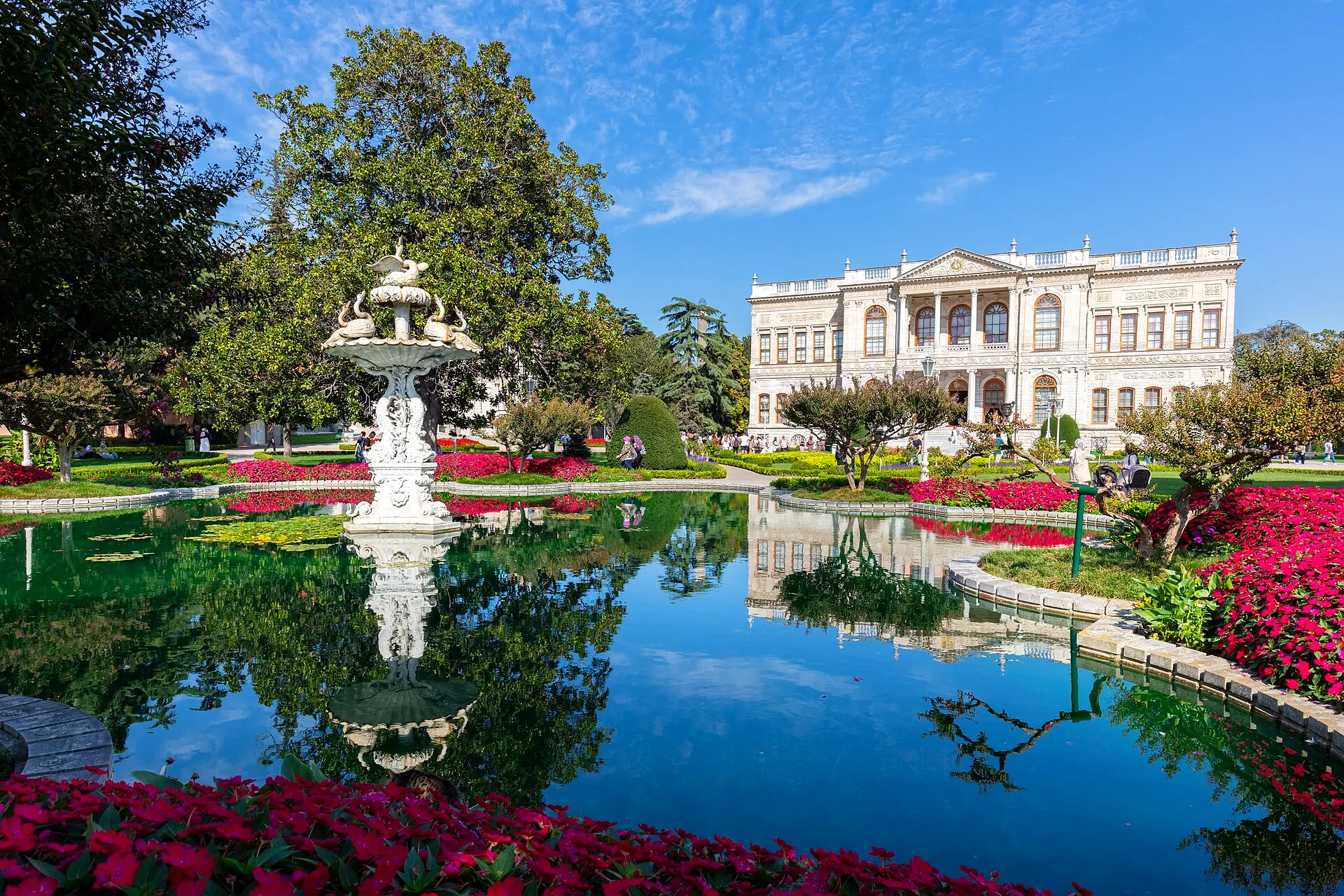
Key facts
- Location: Dolmabahçe Caddesi, Beşiktaş, European shore of the Bosphorus, Istanbul
- Nearest transport: Kabataş (T1 tram, F1 funicular, ferries) about 650 m away; Beşiktaş quay also nearby
- From the airports: Istanbul Airport (IST) is about 35 km north of the city; allow time for metro plus tram, or arrange a transfer
- Built: 1843-1853 for Sultan Abdülmecid I; inhabited from 1856 according to the official National Palaces page
- Style: Baroque, Rococo and Neoclassical elements blended with Ottoman design
- Best season: Late spring and early autumn; indoor visit, so it also works in rain
- Typical visit time: 2-3 hours including queues and gardens
- UNESCO status: Not a separate UNESCO listing
- Managed by: Directorate of National Palaces (Milli Saraylar)
- Entrance: See the official National Palaces page for current tickets, hours and closing days
What is Dolmabahçe Palace and why visit?
Dolmabahçe Palace is an imperial palace on the European shore of the Bosphorus in Istanbul. Sultan Abdülmecid I ordered it in the 19th century as a modern home for the court. It served as the Ottoman administrative centre, later hosted Atatürk, and now operates as a palace-museum open to visitors.
Wikipedia calls it the largest palace in Turkey, with 285 rooms, 46 halls, six hammams and 68 toilets. Moreover, the site covers 110,000 square metres between the strait and a steep slope. As a result, the garden space is small for a palace of this size.
Visitors come for three reasons. First, the interiors show how the late Ottoman court adopted European taste. Second, the palace is the place where Atatürk died. Third, the waterfront setting links easily with Beşiktaş, Ortaköy and the Bosphorus.
When and why was Dolmabahçe Palace built?
Sultan Abdülmecid I ordered Dolmabahçe Palace, and builders worked on it from 1843 to 1853. The court had lived at Topkapı, a medieval complex that lacked the comfort of European palaces. The sultan therefore chose a new waterfront site near the older Beşiktaş Sahil Palace, which was demolished.
The name explains the site. It began as a bay on the Bosphorus where the Ottoman fleet anchored. Over time the bay was filled in and became an imperial garden. The name Dolmabahçe means “filled garden”, from the Persian words for “filled” and “garden”.
Hacı Said Ağa oversaw construction, and members of the Balyan family of court architects designed it. In contrast to earlier palaces, the project was costly. Wikipedia gives a cost of five million Ottoman lira, or 35 tonnes of gold, and says the expense burdened state finances. Sources differ on dates, so the official National Palaces page records habitation from 1856.
The palace later became a republican site. A law of 3 March 1924 transferred ownership to the new Turkish Republic. Atatürk used it as a summer presidential residence and died there on 10 November 1938. The palace opened as a palace-museum with original furnishings in 1984.
What is there to see at Dolmabahçe Palace?
The main attractions are the state rooms, the harem apartments, the Ceremonial Hall and the Crystal Staircase. Together they show public life and private life under one roof. Wikipedia notes that gold and crystal dominate the décor, in contrast to the Iznik tiles of Topkapı.
The layout is the key to the visit. A selamlık wing held the reception rooms for officials and diplomats. A harem wing held the family apartments. The Ceremonial Hall (Muayede Salonu) sits between them under a 36 m dome.
The following highlights are worth planning around:
- Medhal Hall, the entrance hall, where guests waited before an official led them inside.
- The Ceremonial Hall, with a chandelier of 750 lamps that weighs 4.5 tonnes.
- The Crystal Staircase, a double horseshoe of Baccarat crystal, brass and mahogany.
- Atatürk’s room, where the clock still shows 9:05, the time of his death.
- The harem apartments, built as separate family quarters with their own bathrooms.
- The art collection of 202 oil paintings, including 23 by Ivan Aivazovsky.
- The waterfront gate, the clock tower and the nearby baroque mosque outside the palace walls.
This table summarises the main parts of the visit at a glance.
| Part of the visit | What you see | Why it matters |
|---|---|---|
| Selamlık (state wing) | Reception rooms, Medhal Hall, secretariat rooms | Shows how the state received officials and diplomats |
| Ceremonial Hall | 2,000 m2 hall, 36 m dome, 750-lamp chandelier | Centre point between public and private wings |
| Harem wing | Eight interconnected apartments, family quarters | Shows private court life |
| Atatürk’s room | Bedroom with the clock stopped at 9:05 | Key site of republican history |
| Painting collection | 202 oil paintings, including Aivazovsky | Links Ottoman court taste with European art |
| Waterfront and gate | Imperial Gate, clock tower, mosque | Good for photos from outside the museum |
How do you get to Dolmabahçe Palace and get around?
The simplest route is the T1 tram to Kabataş, then a walk of about 650 metres to the palace gate. Wikivoyage lists this distance. Ferries and buses also reach the Beşiktaş waterfront, so you can pick a route that fits your hotel.
T1 links Sultanahmet, Gülhane, Sirkeci and Eminönü across the Galata Bridge to Kabataş. The F1 funicular joins Kabataş with Taksim. Furthermore, ferries from Üsküdar and Kadıköy dock at Beşiktaş quay. Check the current timetable for every service, because schedules change by season.
Istanbul Airport (IST) lies about 35 km north of the city, and the M11 metro runs from it to Gayrettepe. From there, plan a metro or taxi connection to Beşiktaş. Our guides on Istanbul public transport and on airport transfers explain the options in more detail.
This table compares the main ways to reach the palace.
| Starting point | Route | Typical effort |
|---|---|---|
| Sultanahmet / Old City | T1 tram to Kabataş, then walk | Tram ride plus about 650 m walk; check current timetable |
| Taksim | F1 funicular to Kabataş, then walk | Short ride plus about 650 m walk |
| Asian side (Üsküdar, Kadıköy) | Ferry to Beşiktaş or Kabataş | Crossing time varies; check current timetable |
| Beşiktaş centre | Walk along the shore | Short walk; palace is in the Beşiktaş area |
| Istanbul Airport (IST) | M11 metro plus city metro or tram, or a private transfer | IST is about 35 km north; allow extra time |
When is the best time to visit Dolmabahçe Palace?
Late spring and early autumn suit the palace and its waterfront. Wikivoyage describes late May to early June and late September to early October as pleasant in Istanbul. The interiors are indoors, so rain does not cancel a visit, but queues can still form at the gate.
Summer is warm and humid, and winter is chilly and damp. Moreover, the garden and the shore are more comfortable in mild weather. Arrive early in the day, and check the official page for closing days.
This table shows how the seasons affect a visit.
| Season | Weather | Crowds | Notes |
|---|---|---|---|
| Spring (Apr-Jun) | Mild, mixed sun and rain | Moderate to high | Late May and early June are pleasant for the garden and shore |
| Summer (Jul-Aug) | About 26 °C by day, humid | High | Go early; carry water |
| Autumn (Sep-Nov) | Mild, more rain from November | Moderate | Late September to early October is pleasant |
| Winter (Dec-Mar) | About 8 °C by day, damp | Lower | Indoor visit works well; dress warmly for the queue |
How long should you stay at Dolmabahçe Palace?
Plan two to three hours for the palace, since Wikivoyage suggests allowing about three hours to see everything. Time depends on queues, the tour format and how long you spend in each hall. A guide can keep the visit focused and explain the symbols and rooms.
You can combine the palace with Beşiktaş or Ortaköy. Therefore a half day works well for most visitors, and a full day suits those who add the Bosphorus.
This table gives sample plans for different time budgets.
| Plan | What to include | Notes |
|---|---|---|
| Half day | Palace visit, then a walk to the waterfront and Beşiktaş | Start early to avoid queues |
| 1 day | Palace, Akaretler Street, Ortaköy and a Bosphorus cruise | Check ferry and cruise timetables |
| 2-3 days | Palace plus Sultanahmet, Topkapı and Hagia Sophia on other days | Group sites by district to save transit time |
What practical tips help at Dolmabahçe Palace?
Check the official National Palaces page for tickets, hours, closing days and tour rules before you go. Fees and rules change, so we do not quote them here. Wikivoyage reports that the museum card is not accepted, but confirm this on the official page.
Wikivoyage also reports no photography inside, no backpacks and a cloakroom for bags. Therefore travel light and follow staff instructions on the day.
These points help you plan the day:
- Dress: wear comfortable shoes, because the route covers many halls and stairs.
- Photography: expect limits inside the halls; check the official page and signs.
- Bags: leave large bags at the hotel or use the cloakroom if offered.
- Audio guide: Wikivoyage reports a free multilingual audio guide near the ticket office.
- Accessibility: ask the palace about step-free routes before you travel.
- Safety: Wikivoyage warns of pickpockets on crowded buses and trams, so keep valuables close.
- Etiquette: stay behind rope lines and avoid touching furniture and textiles.
Where should you stay and eat near Dolmabahçe Palace?
For a stay close to the palace, look at Beşiktaş, Akaretler and Taksim. Beşiktaş has a lively waterfront and ferry links. Sultanahmet is the choice if the Old City is your main focus, and the T1 tram links it with the palace.
For food, Akaretler Street has restaurants and cafés in restored Ottoman rowhouses, and Ortaköy is known for its baked potatoes called kumpir. Choose places by reading current reviews and avoid touts.
What is near Dolmabahçe Palace, and which day trips combine well?
Nearby places include Ortaköy Mosque, the Beşiktaş waterfront and Galata Tower across the Golden Horn. In the other direction, Sultanahmet holds Hagia Sophia, the Blue Mosque and Topkapı Palace. A Bosphorus cruise links these stops from the water, so you can combine several sights in one day.
Moreover, the Maiden’s Tower and the Asian shore are easy to reach by ferry. Use the related pages below to build a route.
Plan this with TurkGT
TurkGT is an Istanbul-based travel company. We offer a guided Dolmabahçe Palace tour from Beşiktaş with a guide, as well as private transfers, private guides and interpreters. Related options include the Istanbul museum pass sightseeing plan and a Bosphorus cruise, which you can add to the same day.
Message us on WhatsApp with your dates and group size, and we confirm the details with you directly.
Frequently asked questions
Where is Dolmabahçe Palace?
It stands on the European shore of the Bosphorus in the Beşiktaş area of Istanbul. Kabataş, the T1 tram and F1 funicular stop, is about 650 m away.
Who built Dolmabahçe Palace?
Sultan Abdülmecid I ordered it. Court architects of the Balyan family designed it, and Hacı Said Ağa oversaw construction.
When was Dolmabahçe Palace built?
Wikipedia gives 1843 to 1853. The official National Palaces page says the palace was inhabited from 1856, so dates vary by source.
Why is Dolmabahçe Palace famous?
It is the largest palace in Turkey, it holds a 750-lamp chandelier and a Crystal Staircase, and Atatürk died there on 10 November 1938.
How do I get to Dolmabahçe Palace from Sultanahmet?
Take the T1 tram to Kabataş and walk about 650 m. Check the current timetable and the entrance location on the official page.
How long does a visit take?
Plan about two to three hours. Wikivoyage suggests allowing three hours to see everything.
Can I use a museum card at Dolmabahçe Palace?
Wikivoyage reports that the museum card is not accepted. Check the official National Palaces page for current ticket rules.
Can I take photos inside Dolmabahçe Palace?
Wikivoyage reports no photography inside. Check the official page and follow signs and staff instructions.
Related on TurkGT
Sources
- Wikipedia: Dolmabahçe Palace
- Milli Saraylar (National Palaces): Dolmabahçe Palace
- Türkiye Kültür Portalı: Dolmabahçe Sarayı
- Wikivoyage: Istanbul/Historical Peninsula
- Wikivoyage: Istanbul/European Bosphorus
- Wikivoyage: Istanbul
Last reviewed: 2026-11-17. Opening hours, ticket prices and other changeable details are not listed because they change; check the official source before you travel.