
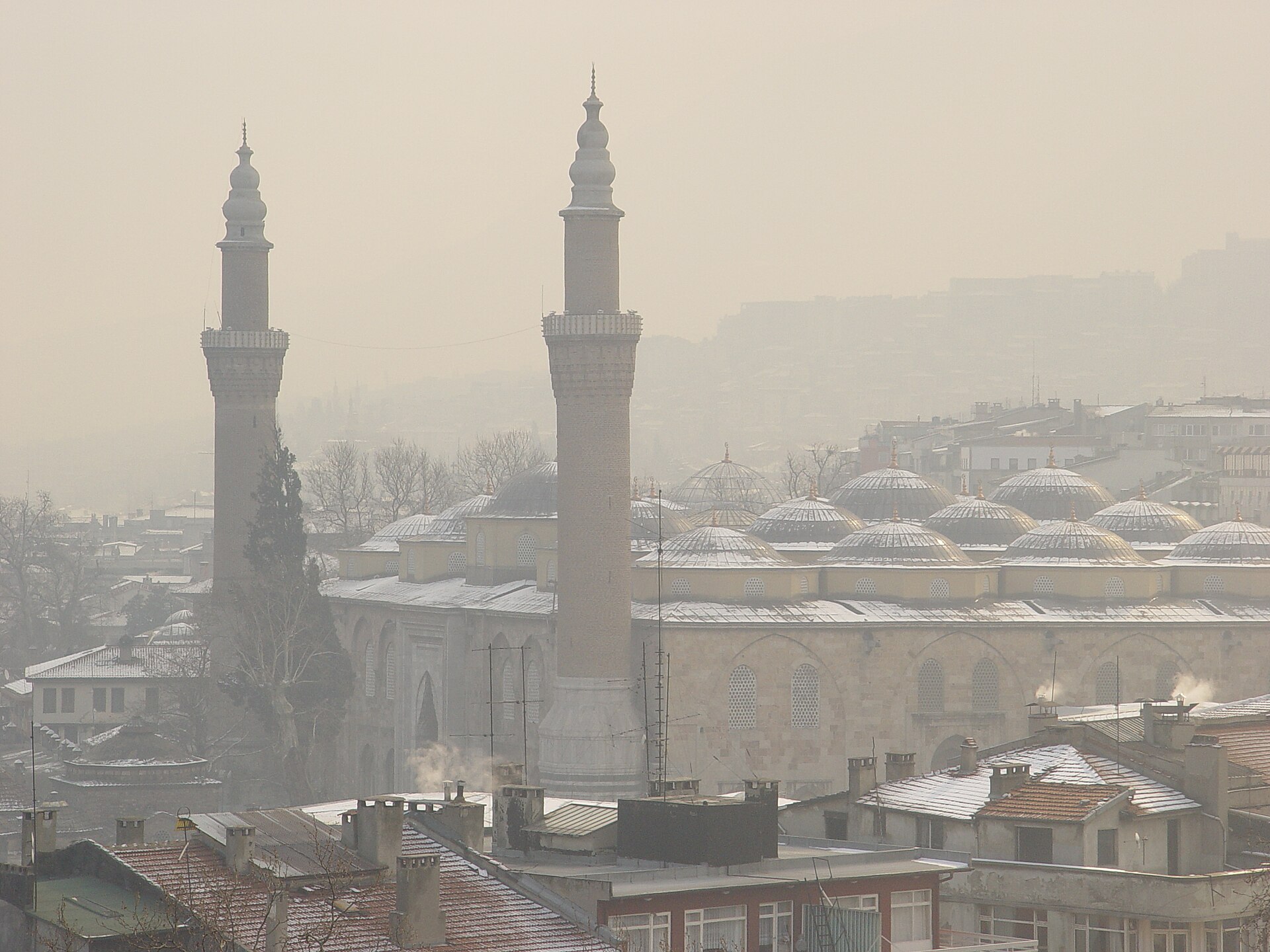
The Grand Mosque of Bursa (Ulu Cami) is a working mosque in the old city of Bursa, north-western Türkiye. Sultan Bayezid I commissioned it after the Battle of Nicopolis, and it was built between 1396 and 1399. Visitors come for its twenty domes, its central fountain and its calligraphy.
Key facts
- Location: Old city centre of Bursa, Marmara Region
- Built: 1396-1399, for Sultan Bayezid I
- Architect: Ali Neccar
- From Istanbul: About 2 hr 10 min by direct bus; check current timetables
- From airports: Istanbul airports are the usual gateway; Bursa has no railway
- Best season: Spring and autumn; summers are hot
- Typical visit: 45-90 minutes, longer with the nearby bazaar
- UNESCO: Within the area of the Bursa and Cumalıkızık World Heritage listing (see our WHS page)
- Entrance: See official page; it is an active mosque
What is the Grand Mosque of Bursa and why visit?
The Grand Mosque of Bursa, called Ulu Cami in Turkish, is the largest mosque in the first Ottoman capital. It was commissioned by Sultan Bayezid I and finished in 1399. People visit it for early Ottoman architecture, a multi-domed interior and an atmosphere of everyday worship.
Moreover, the mosque sits next to the covered bazaar, the Koza Han and the Orhan Gazi Mosque. Therefore many visitors combine it with a walk through the old market district.
What is the history of the Grand Mosque?
Bayezid I ordered the mosque to commemorate his victory at the Battle of Nicopolis, and the architect Ali Neccar designed and built it between 1396 and 1399. A popular tradition says the sultan promised twenty mosques and built one with twenty domes instead.
Tradition also says Timur burned the mosque in 1402. The first recorded repairs date from 1493. In contrast, the best documented damage came in 1855, when an earthquake caused the roof to collapse; the mosque stayed closed for several years and repairs finished in 1889.
Key dates in the mosque’s story:
- 1396-1399: construction under Bayezid I.
- 1402: traditional date of the fire attributed to Timur.
- 1493: first recorded repairs.
- 1572: date of the mihrab.
- 1855: earthquake and roof collapse.
- 1889: repairs completed.
What are the highlights of the Grand Mosque?
The main highlights are the twenty domes, the central fountain and the wall calligraphy. The domes rest on twelve columns in four rows of five. As a result, the interior feels like a forest of columns under shallow domes.
The wooden minbar uses the Anatolian Seljuk style and the kundekari joinery technique, in which pieces interlock without nails. The interior holds about 5,000 people.
Look for these features inside and outside:
- The central şadırvan (ablution fountain) over an eighteen-cornered basin, under a glazed opening in the dome.
- Calligraphic panels on walls and columns.
- The kundekari wooden minbar beside the mihrab.
- Two minarets, the eastern one detached.
- Three entrances, to the north, west and east.
The table below summarises the mosque at a glance.
| Feature | Detail |
|---|---|
| Plan | Rectangle, 55 by 69 metres |
| Domes | Twenty, in four rows of five |
| Supports | Twelve columns |
| Capacity | About 5,000 people |
| Minarets | Two |
| Entrances | Three (north, west, east) |
How do I get to the Grand Mosque and get around Bursa?
Most visitors reach Bursa from Istanbul by direct bus or by ferry. Direct buses from Istanbul take about two hours ten minutes non-stop, according to Wikivoyage, and ferries sail several times a day. Bursa has no railway, so trains are not an option today.
In the city, Bursaray is the metro and city buses serve the centre. The mosque is in the old city, close to the bazaar, so most visitors finish the last stretch on foot.
The table below compares the usual ways to arrive.
| Route | Typical duration | Notes |
|---|---|---|
| Direct bus, Istanbul to Bursa | About 2 hr 10 min non-stop | Check the current timetable and terminal |
| Ferry from Istanbul plus onward bus | Varies | Several sailings a day; check current timetable |
| Private transfer | Depends on traffic | Door to door; arrange in advance |
| Bursaray metro and city bus | Short hops | Then walk or take a taxi |
When is the best time to visit the Grand Mosque?
Spring and autumn are the most comfortable seasons for walking the old city. Summers are hot and can be sticky, with occasional thundery downpours. The mosque is open for prayer, so plan around prayer times and check the official page for current visiting rules.
Friday midday brings a large congregation. Therefore, tourists usually choose another day or a morning slot.
This table gives a seasonal overview.
| Season | Weather | Crowds | Notes |
|---|---|---|---|
| Spring | Mild, some rain | Moderate | Good for old-city walks |
| Summer | Hot and humid | Higher at weekends | Go early in the day |
| Autumn | Mild | Moderate | Comfortable for combined sightseeing |
| Winter | Cool to cold | Lower | Snow possible on nearby Uludağ |
How long should I stay?
Allow about an hour for the mosque itself and half a day if you add the bazaar district. A full day lets you include the Green Tomb and a lunch stop. Two to three days cover Bursa‘s other sights and Mount Uludağ.
These sample plans fit different schedules.
| Time | Suggested plan |
|---|---|
| Half day | Grand Mosque, Koza Han and the covered bazaar |
| 1 day | Add the Yeşil complex and Green Tomb, then a traditional lunch |
| 2-3 days | Add Cumalıkızık, İznik or Mount Uludağ |
What practical tips should I know?
The Grand Mosque is a place of worship, so dress modestly and behave quietly. Check the official page or ask on arrival about visiting hours and any limits during prayer. Entrance arrangements can change, so we do not quote fees.
Practical points for the visit:
- Cover shoulders and knees; women usually cover their hair with a scarf.
- Remove shoes at the entrance and carry them in a bag.
- Photograph respectfully and do not photograph worshippers.
- Avoid prayer times and Friday midday.
- Stay aware of pickpockets in crowded bazaar lanes.
- Accessibility: older mosques may have steps; ask staff about access.
Where should I stay and eat?
Stay in the old city near Heykel and Ulu Cami for walking access, or in the Çekirge district for thermal spas. Wikivoyage notes that visitors should not leave Bursa without trying its signature dish, and boxed sweets are sold from stores around the city.
Local specialities are worth looking for in the market streets. Eat at busy local restaurants and check the menu before you sit.
What is nearby and what day trips work from here?
Bursa is a base for the Koza Han, the Green Tomb, Cumalıkızık village, İznik and Mount Uludağ. Moreover, Mudanya‘s coast is a short ride away. Each place suits a different interest, as the list below shows.
Nearby places to combine:
- Koza Han: silk caravanserai a few minutes’ walk away.
- Green Tomb: mausoleum of Mehmed I on a hill in the Yeşil neighbourhood.
- Cumalıkızık: Ottoman village in the UNESCO listing.
- İznik: city of Byzantine walls and tile history.
- Uludağ: forests and ski slopes.
Plan this with TurkGT
TurkGT is an Istanbul-based travel company. We offer guided trips, private transfers, and licensed guide and interpreter services for Bursa. Moreover, we can combine the visit with other stops on your route.
Send us your dates, group size and interests on WhatsApp. As a result, you receive a tailored plan, and everything is confirmed by WhatsApp before you travel.
Frequently asked questions
Who built the Grand Mosque of Bursa?
Sultan Bayezid I commissioned it, and the architect Ali Neccar designed and built it between 1396 and 1399.
Why does it have twenty domes?
A popular tradition says Bayezid I promised twenty mosques after Nicopolis and built one mosque with twenty domes instead.
How many people can it hold?
About 5,000 people, according to Wikipedia.
Can tourists enter the mosque?
Visitors are generally welcome outside prayer times if they dress modestly. Check the official page for current rules.
How far is Bursa from Istanbul?
Direct buses take about two hours ten minutes non-stop. Check current timetables, and consider a ferry or private transfer.
Is there a train to Bursa?
No. Wikivoyage states that Bursa has no railway.
What else is near the mosque?
The Koza Han, the covered bazaar, the Orhan Gazi Mosque and the Green Tomb lie within the old city.
Is there an entrance fee?
Check the official page. Visiting rules can change.
Related on TurkGT
Sources
Last reviewed: 2026-11-18. Opening hours, ticket prices and other changeable details are not listed because they change; check the official source before you travel.