
Çeşme is a port and resort town at the westernmost tip of İzmir Province, about 85 km west of İzmir. Visit for its 1508 castle, thermal springs at Ilıca, Aegean beaches and a short ferry to the Greek island of Chios. It also works as a base for Alaçatı and the ancient site of Erythrae.
Key facts
- Location: Tip of the Çeşme Peninsula, İzmir Province, Aegean coast
- Distance: About 85 km west of İzmir; roughly 30 minutes by bus on the O-32 motorway (check current timetable)
- Nearest airport: İzmir Adnan Menderes (ADB), with Havaş airport buses
- Population: 48,924 (2022)
- Landmark: Çeşme Castle (1508), on UNESCO’s Tentative List since 2020
- Best season: Late spring and early autumn for sea and sightseeing; summer for beach life
- Typical visit time: 2-3 days, or a long day trip from İzmir
- UNESCO status: Castle on the Tentative List only; no inscribed site in the town
- Ferry: Seasonal links to Chios and, per Wikipedia, Italy
- Entrance: See official page for the castle and museum
What is Çeşme and why visit it?
Çeşme is a municipality and district at the western end of İzmir Province, on a promontory at the tip of the Çeşme Peninsula. It lies 85 km west of İzmir. People visit for the castle, the sea, the thermal coast of Ilıca and an easy crossing to Chios.
The name means spring or fountain. According to Wikipedia, it possibly refers to the many Ottoman fountains in town. Moreover, the district counts about 48,900 residents, and most of them live in the town itself. As a result, Çeşme feels like a real working port rather than a pure resort strip.
Wikivoyage adds that much tourism here is domestic, because many international visitors head to Marmaris and Bodrum instead. Therefore the town can feel Turkish in character, with local families, weekend crowds from İzmir and a lively waterfront. In contrast, nearby Alaçatı is more boutique and more windsurf-oriented.
What is the history of Çeşme?
Çeşme grew from the ancient Ionian world into an Ottoman port. In antiquity the main city of the area was Erythrae, today’s Ildırı. Boutheia, probably at Çeşme itself, paid tribute to Athens in the 5th century BC. Later the town took its Turkish name.
The Ottoman period brought the castle and the sea-trade story. Venice attacked the town in 1472 and 1501, and Sultan Bayezid II ordered the castle in 1508. Chios joined the empire in 1566 after Piyale Pasha simply anchored at Çeşme. After that, trade shifted gradually to İzmir.
In 1770 the bay saw the naval Battle of Chesma between Russian and Ottoman fleets. Afterwards, the 19th century brought grape and mastic exports, and tourism took off in the 1970s. Finally, archaeologists announced in 2021 the ruins of a 2,500-year-old temple of Aphrodite, which shows that excavation is still adding to the story.
Key dates for Çeşme:
- 5th century BC: Boutheia pays tribute to Athens as part of the Delian League.
- 1472 and 1501: Venetian attacks on the town.
- 1508: Çeşme Castle is built under Bayezid II.
- 1566: Chios joins the Ottoman Empire.
- 1770: Battle of Chesma in the bay.
- 2020: castle added to the UNESCO Tentative List.
What are the main things to see in Çeşme?
The main sights are Çeşme Castle and its small museum, the old town around it, the church of Ayios Haralambos, the 1528 caravanserai and the Ilıca thermal strip. The coast adds beaches and coves. Most central sights are walkable within an hour.
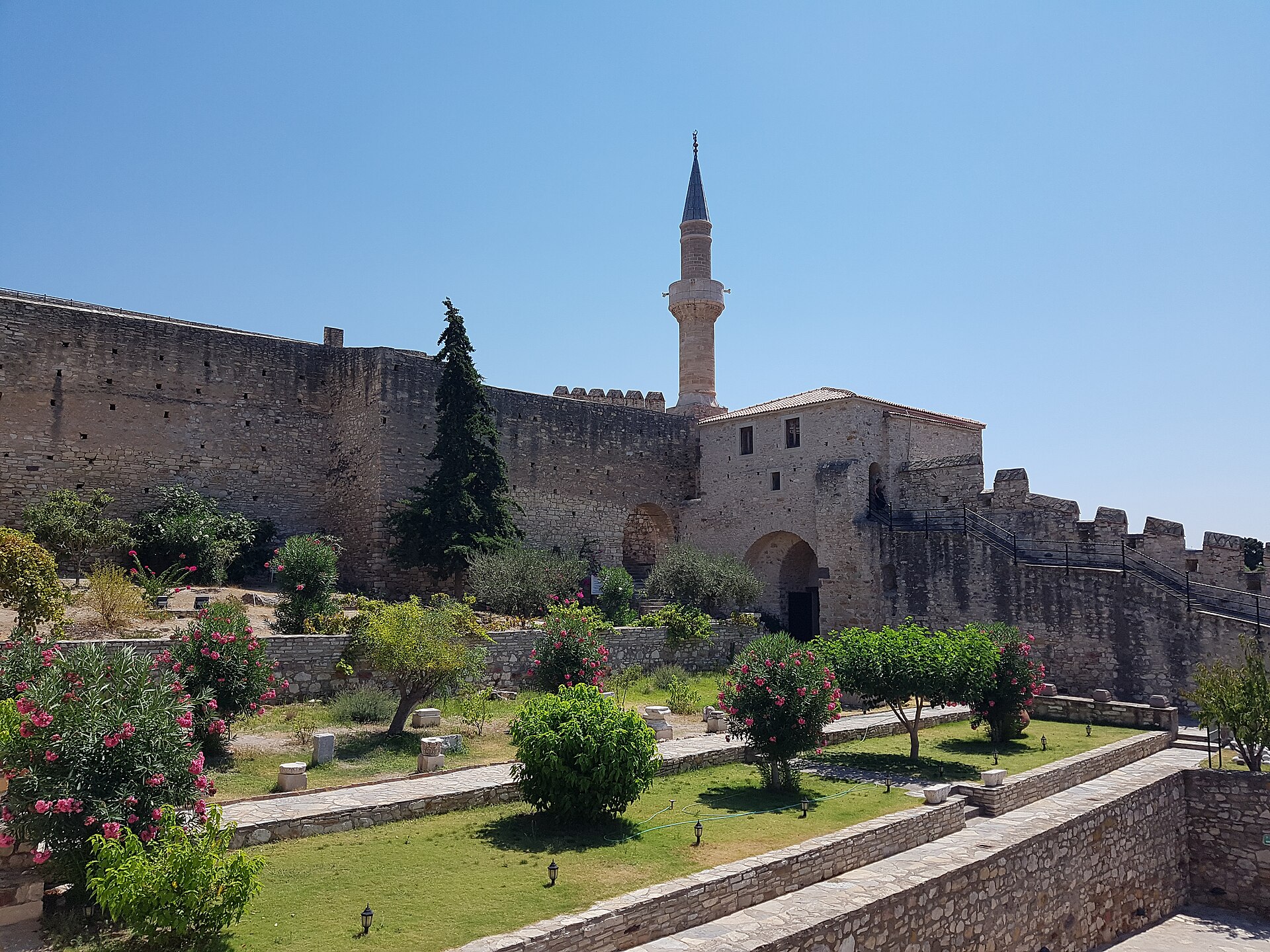
The castle dominates the waterfront. Wikipedia describes a rectangular fortress with moats on three sides and bastions, used today as a festival centre. In front of it stands the monument to Cezayirli Gazi Hasan Pasha, the Ottoman naval commander of 1770, who is shown with his lion.
Highlights, in a sensible walking order:
- Çeşme Castle and its museum, with views over the harbour and the square.
- The Hasan Pasha monument in front of the castle.
- The old town streets with 19th-century Ottoman houses and alleys.
- Ayios Haralambos church, used for temporary exhibitions.
- The caravanserai south of the castle, dated to 1528.
- Ilıca, 5 km east, for thermal water and a long beach.
The table below gives Çeşme’s main sights at a glance.
| Sight | What it is | Typical time |
|---|---|---|
| Çeşme Castle | 1508 Ottoman fortress and small museum | 45-90 minutes |
| Old town and waterfront | Ottoman-era houses, alleys, harbour promenade | 1-2 hours |
| Ayios Haralambos | Former Greek Orthodox church, now an exhibition space | 20 minutes |
| Ilıca | Thermal springs, spa hotels and beach | Half day |
| Ildırı (Erythrae) | Ancient Ionian city site on the north coast | Half day |
| Beaches and coves | Sandy and rocky bays along a 90 km coastline | Half day or more |
How do I get to Çeşme and get around?
Most visitors fly to İzmir, then travel 85 km west by road. A Havaş bus connects the airport and Çeşme, and buses or dolmuşes from İzmir take about 30 minutes on the O-32 motorway. From Istanbul, flights to İzmir are the usual choice.
Ferries add a second route. According to Wikivoyage, boats from Chios take 20 minutes by catamaran or 45 minutes by standard ferry, with more sailings in summer. Wikipedia also notes larger ferries to Italy. However, always check the current timetable, because services change by season and weather.
The table lists the main ways to reach Çeşme, with typical durations.
| From | Mode | Typical duration |
|---|---|---|
| İzmir airport | Havaş airport bus | Check current timetable |
| İzmir city | Intercity bus or dolmuş on O-32 | About 30 minutes (Wikivoyage) |
| İzmir city | Car on Otoyol 32 | Check route and tolls; traffic builds at summer weekends |
| Chios, Greece | Fast catamaran | About 20 minutes |
| Chios, Greece | Standard ferry | About 45 minutes |
| Alaçatı and Ilıca | Local dolmuş | Short hops; check current timetable |
When is the best time to visit Çeşme?
Late spring and early autumn give the best balance of warm sea and manageable crowds. Summer is hot and humid, and it is the busiest period. Winter is mild and rainy, and many seasonal businesses reduce service. Çeşme has a Mediterranean climate with low summer rainfall.
Therefore choose the season by purpose. Beach visitors want July to early September. Sightseers and walkers do better in May, June and October. Ferry users should check the Chios schedule, because winter sailings are fewer.
Use this table to match the season to your plans.
| Season | Weather | Crowds | Notes |
|---|---|---|---|
| Spring (Mar-May) | Mild, some rain | Low to medium | Good for walking and the old town; sea still cool |
| Summer (Jun-Aug) | Hot, muggy, very dry | High | Peak beach season; book ahead; weekends are busiest |
| Autumn (Sep-Nov) | Warm, then cooler | Medium to low | Pleasant sea early in the season; fewer ferries later |
| Winter (Dec-Feb) | Mild and rainy | Low | Quiet town; some seasonal venues closed |
How long should I stay in Çeşme?
Plan two to three days if you want the castle, the beaches and one excursion. A single day from İzmir covers the castle, the waterfront and a swim. A half day works only if you pair Çeşme with Alaçatı by car or dolmuş.
In short, the length depends on your goal. Beach holidaymakers often stay longer. Culture-focused travellers can finish the town in a morning.
The table suggests three plans by available time.
| Time | Suggested plan |
|---|---|
| Half day | Castle and museum, old town walk, lunch on the harbour |
| 1 day | Castle, old town, Ilıca thermal coast and a beach stop |
| 2-3 days | Add Alaçatı, Ildırı (Erythrae) and a Chios ferry day, with a slow beach day in between |
What practical tips should I know before visiting Çeşme?
Carry sun protection, water and light layers, and check official pages for ticket prices and hours. The castle and museum are managed through official channels, so see the official page for current fees and opening times rather than relying on older blogs.
Moreover, the town is compact and flat enough for easy walking. In summer, traffic on the İzmir road builds up at weekends, so leave early.
Practical points:
- Dress: swimwear is for beaches and pools only; cover shoulders and knees if you enter a mosque.
- Tickets and fees: see the official page for the castle and museum.
- Accessibility: the castle has steps and uneven stone; expect limited step-free access.
- Safety: the town is a busy resort, so watch bags in crowds and use sun protection.
- Photography: the harbour and castle are open for photos; ask before photographing people.
- Etiquette: greet shop owners, bargain gently, and tip in restaurants as is customary.
- Food: try kumru, local fish and mastic-flavoured sweets and ice cream.
Where should I stay and eat in Çeşme?
Stay near the harbour and castle for walking, or on the Ilıca strip for spa hotels and beaches. Alaçatı offers boutique stone houses a short ride away. Eat along the main avenue and the waterfront, and order the local fish.
Wikivoyage describes the main eating strips as Atatürk Boulevard and the north waterfront, plus the marina area. Local specialities include kumru and mastic-flavoured desserts. Furthermore, the Ottoman caravanserai near the castle now works as a hotel, which suits travellers who want a historic setting.
Neighbourhood guide:
- Town centre and harbour: best for walkers, ferries and restaurants.
- Ilıca: thermal hotels, wellness and a long beach.
- Çiftlikköy and the coves: quieter, beach-focused stays.
- Alaçatı: boutique stone houses; evenings are lively.
What are the nearby places and day trips from Çeşme?
Alaçatı, Ildırı with ancient Erythrae, İzmir, Bergama and Selçuk make the best excursions. Alaçatı is the shortest hop. The ancient sites need a longer day, and Ephesus and Pergamon are best planned as separate trips.
The table gives rough directions and reasons for each.
The table shows the main day-trip options.
| Destination | Why go | Notes |
|---|---|---|
| Alaçatı | Stone houses, windmills, windsurfing | Short dolmuş or car ride |
| Ildırı (Erythrae) | Ancient Ionian city on the north coast | Allow half a day |
| İzmir | Clock Tower, bazaar, museums | About 30 minutes by bus each way |
| Bergama | Pergamon, a UNESCO World Heritage cultural landscape | Full-day trip by car or tour |
| Selçuk | Ephesus-area sights | Full-day trip by car or tour |
| Chios, Greece | Short ferry crossing | Check passport and visa rules |
Plan this with TurkGT
TurkGT is an Istanbul-based travel company. We offer guided trips, private transfers, local guides and interpreter support across Türkiye, including the Aegean. Tell us your dates and group size, and we confirm the plan and details by WhatsApp.
Frequently asked questions
Where is Çeşme?
Çeşme is a port town and district at the western tip of İzmir Province on the Aegean coast, about 85 km west of the city of İzmir.
How do I get from İzmir to Çeşme?
Buses and dolmuşes run along the O-32 motorway and take about 30 minutes according to Wikivoyage. A Havaş airport bus also serves Çeşme. Check the current timetable.
What does Çeşme mean?
The name means spring or fountain, and may refer to the Ottoman fountains in the town.
What is Çeşme Castle?
It is an Ottoman castle built in 1508 under Sultan Bayezid II. It houses a small museum and was added to UNESCO’s Tentative List in 2020.
Can I take a ferry from Çeşme to Chios?
Yes. Wikivoyage says fast boats take 20 minutes and standard ferries 45 minutes. Sailings are seasonal, so check the current timetable and passport requirements.
Is Çeşme the same as Alaçatı?
No. Alaçatı is a separate neighbourhood of the Çeşme district, known for stone houses and windsurfing, a short ride from Çeşme town.
What is Ilıca known for?
Ilıca lies 5 km east of Çeşme and is famed for thermal springs, spa hotels and a beach strip.
How many days do I need in Çeşme?
Two to three days suit most visitors. A day trip from İzmir covers the castle, harbour and a swim.
Related on TurkGT
- Part of İzmir
- Library of Celsus
- Şirince Village
- İzmir Clock Tower
- Kemeraltı Bazaar
- Pergamon and its Multi-Layered Cultural Landscape
- Ephesus
Sources
Last reviewed: 2026-11-18. Opening hours, ticket prices and other changeable details are not listed because they change; check the official source before you travel.