
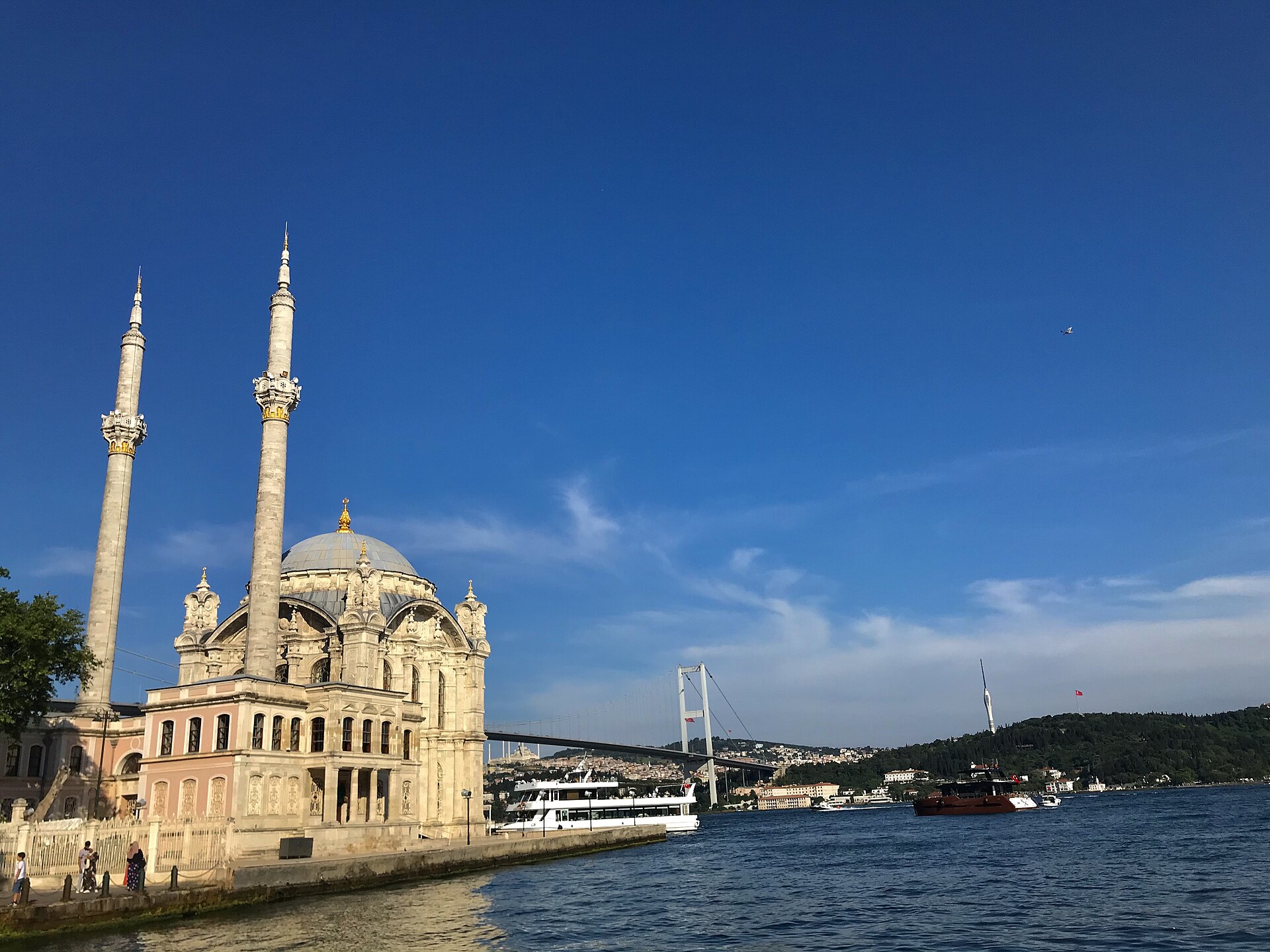
Ortaköy Mosque, formally the Büyük Mecidiye Camii, is a waterside mosque in Istanbul’s Beşiktaş district, beside the Ortaköy pier square on the Bosphorus. Sultan Abdülmecid I commissioned it, and it was finished around 1854 or 1856. The Balyan family designed it, and it is known for ornate stone carving and a view of the Bosphorus Bridge.
Key facts
- Formal name: Büyük Mecidiye Camii
- Location: Ortaköy pier square, Beşiktaş, European shore of the Bosphorus
- Commissioned by: Sultan Abdülmecid I
- Completed: Around 1854 or 1856 (sources differ)
- Architects: Garabet Balyan and Nikoğos Balyan
- Latest restoration: Three-year project completed 2014; reopened 6 June 2014
- Distance from airports and centre: Road transfer from either airport; a short ride from Beşiktaş and Kabataş (check current routes)
- Best season: Spring and autumn; late afternoon light all year
- Typical visit time: About 30 to 60 minutes inside and outside; longer with the waterfront
- UNESCO status: Not part of the Historic Areas of Istanbul
- Entrance: Active mosque; see the official Directorate of Religious Affairs and foundation pages for visiting rules
What is Ortaköy Mosque and why visit?
Ortaköy Mosque is a nineteenth-century Ottoman mosque on the Bosphorus shore, set in the lively Ortaköy square. Visitors come for its carved stone, its position beside the water and its view of the Bosphorus Bridge. It is an active place of worship, so visits follow prayer times and etiquette.
Wikipedia describes it as situated at the waterside of the Ortaköy pier square, one of the most popular locations on the Bosphorus. As a result, the mosque pairs well with a ferry ride, a waterfront walk and a stop at the district’s small streets and cafés.
The same article notes that the structure is symbolic of the district of Ortaköy and is often photographed. In contrast to the great imperial mosques of the old city, it is small and intimate, so a short visit is enough.
What is the history of Ortaköy Mosque?
A small mosque of 1720 first stood here and was ruined in the Patrona Halil Uprising of 1731. Sultan Abdülmecid I commissioned the present building, finished around 1854 or 1856. The Balyan family designed it. Earthquake, fire and repairs then shaped its later history, ending with a restoration in 2014.
Why do the dates differ? Wikipedia says its construction was completed around 1854 or 1856. Therefore this page gives both years rather than choosing one.
Who designed it? Wikipedia credits the Armenian father and son Garabet Balyan and Nikoğos Balyan, who also designed the nearby Dolmabahçe Palace and the Dolmabahçe Mosque.
Damage and repair. The mosque was damaged in the 1894 Istanbul earthquake and had a minor fire in 1984. After the quake the Ministry of Foundations repaired it in 1909, and the original fluted minarets were replaced with more austere masonry. The dome developed cracks and was rebuilt in concrete, and the mosque reopened in 1969. A three-year restoration by the General Directorate of Foundations was completed in 2014, and the mosque reopened on 6 June 2014.
This list gives the key dates at a glance.
- 1720: small mosque built on the site.
- 1731: that mosque ruined during the Patrona Halil Uprising.
- c. 1854 or 1856: Büyük Mecidiye Camii completed.
- 1894: earthquake damage; 1909 repairs.
- 1969: reopened after dome reconstruction.
- 1984: minor fire.
- 2014: restoration completed; reopened 6 June 2014.
What to see at Ortaköy Mosque
Visitors see an ornate stone facade, two slender minarets, tall windows and a single-domed prayer hall. Inside, painted dome decoration and calligraphy panels stand out. Outside, the waterfront view includes the Bosphorus Bridge. Check visiting rules before entering because prayer times restrict access.
The mosque combines Neoclassical trends with Ottoman Baroque elements, according to Wikipedia. Its particularly ornate stone-carved decoration sets it apart from other mosques of its period. The plan has two parts: a square prayer hall under one dome and a two-storey imperial apartment with a U-shaped plan.
These are the main features to look for.
- Carved stone facade and window surrounds.
- Two stone minarets with balconies resembling Corinthian capitals.
- Wide, tall windows that refract the mosque’s reflection in water.
- Trompe-l’œil frescoes inside the dome.
- Calligraphy panels executed by Abdülmecid I himself.
- Marble and porphyry in the mihrab and minbar.
This table summarises the architecture and what each feature shows.
| Feature | What to notice | Source note |
|---|---|---|
| Prayer hall | Square plan, single dome | Wikipedia |
| Imperial apartment | Two storeys, U-shaped plan | Wikipedia |
| Minarets | Slender stone shafts, Corinthian-style balconies | Wikipedia |
| Dome interior | Trompe-l’œil frescoes | Wikipedia |
| Waterfront | View of the Bosphorus and its bridge | Wikipedia |
How do I get to Ortaköy Mosque?
Ortaköy lies on the European shore of the Bosphorus, between Beşiktaş and the Bosphorus Bridge. Buses and taxis run from Beşiktaş and Kabataş, and cruise boats call at the district. Routes and timetables change, so check an up-to-date journey planner. Our public transport guide covers cards and basics.
For the Asian side, ferries and Marmaray cross the strait, but a bus or taxi along the shore finishes the trip. As a result, most visitors combine Ortaköy with Beşiktaş and Dolmabahçe Palace.
This table compares the usual ways to reach the mosque.
| From | How | Notes |
|---|---|---|
| Beşiktaş | Bus, taxi or a waterfront walk | Check current routes |
| Kabataş / Taksim | Tram, funicular and metro to Kabataş, then bus or taxi | Check current routes |
| Sultanahmet | Tram to Kabataş, then bus or taxi | Allow extra time in traffic |
| Bosphorus cruise | Boat stops at the Ortaköy waterfront | See our cruise trips |
| Airports | Taxi, shuttle or private transfer | See our airport guides |
When is the best time to visit?
Spring and autumn offer mild weather for the waterfront. Weekday mornings are calmer, while weekends and evenings fill with local visitors. The mosque is active, so avoid prayer times, especially Friday midday. Late afternoon gives warm light on the stone.
Summer is hot and busy, and winter is cooler and wetter, so adjust your plans.
This table shows what to expect each season.
| Season | Weather | Crowds | Notes |
|---|---|---|---|
| Spring (Mar–May) | Mild | Moderate to high | Pleasant for walking |
| Summer (Jun–Aug) | Hot | High | Visit early; evenings are lively |
| Autumn (Sep–Nov) | Mild | Moderate | Clear views of the bridge |
| Winter (Dec–Feb) | Cool, wet | Lower | Wind on the waterfront |
How long should I stay?
The mosque needs 30 to 60 minutes. A half day adds Ortaköy’s streets and waterfront and a nearby palace. A full day links Ortaköy with Beşiktaş and a Bosphorus cruise. These are estimates, not official figures, and prayer times or queues can change them.
Plan more time if you want to photograph the mosque at different light.
This table suggests plans for different time budgets.
| Time | Plan |
|---|---|
| Half day | Mosque, waterfront walk and snack stop |
| 1 day | Ortaköy plus Dolmabahçe Palace and a Bosphorus cruise |
| 2–3 days | Add Sultanahmet, Galata and the Asian side |
What practical tips should I know?
Ortaköy Mosque is a working mosque, so dress modestly, remove shoes and keep quiet. Women should cover their hair and shoulders and knees; men should cover knees. Visiting rules and hours are set by the mosque authorities, so check official pages or ask on site. We do not list times or fees here.
Photography is common outdoors. Ask before photographing worshippers. Accessibility varies, with steps at entrances. Keep an eye on bags in the crowded square.
These tips cover the common questions.
- Dress: modest; head covering for women, covered knees and shoulders for all.
- Shoes: removed at the entrance.
- Prayer times: access may pause, especially Friday midday.
- Tickets: normally no ticket for a mosque; check the official page.
- Safety: watch your belongings in the busy square.
- Etiquette: speak quietly and do not walk in front of worshippers.
Where should I stay and eat?
Stay in Beşiktaş for Bosphorus access, Sultanahmet for old-city sights or Beyoğlu for nightlife. Eat at the Ortaköy square, where small stalls and cafés sell baked potatoes and snacks. Compare menus and prices before ordering. Walk a few streets back for quieter spots.
Beşiktaş also has a lively market area with simple restaurants.
This table compares areas for a stay.
| Area | Why stay | Trade-off |
|---|---|---|
| Beşiktaş | Bosphorus buses and ferries | Busy traffic |
| Beyoğlu | Nightlife, transport | Noisy |
| Sultanahmet | Old-city sights | Further from Ortaköy |
What is nearby?
Dolmabahçe Palace and the Dolmabahçe Mosque are close, as are Beşiktaş, Kabataş and the Bosphorus Bridge. The Balyan family also designed the palace and the nearby mosque, so the architecture links these sites into one walk. Our linked pages cover Beşiktaş, Galata and Üsküdar.
A Bosphorus cruise lets you see the mosque from the water. Day trips to the Princes’ Islands and Bursa are also available.
Plan this with TurkGT
TurkGT is an Istanbul-based travel company. We offer guided tours, private transfers, licensed guides and interpreter support, including Dolmabahçe Palace tours and Bosphorus cruises. Send us your dates and group size on WhatsApp, and our team confirms the plan there before you travel.
Frequently asked questions
What is the formal name of Ortaköy Mosque?
Its formal name is the Büyük Mecidiye Camii, after Sultan Abdülmecid I, who commissioned it.
Where is Ortaköy Mosque?
It stands at the waterside of Ortaköy pier square in Istanbul’s Beşiktaş district, on the European shore of the Bosphorus.
Who designed Ortaköy Mosque?
Garabet Balyan and his son Nikoğos Balyan, who also designed the nearby Dolmabahçe Palace and Dolmabahçe Mosque.
When was it built?
Construction was completed around 1854 or 1856; sources differ on the exact date.
When was the last restoration?
A three-year restoration by the General Directorate of Foundations was completed in 2014. The mosque reopened on 6 June 2014.
Can tourists enter the mosque?
Visitors normally enter outside prayer times and with modest dress. Check the official page or ask on site for current rules.
How long should I allow?
Allow 30 to 60 minutes for the mosque and square. This is a planning estimate, not an official figure.
Can I visit with a guide?
Yes. TurkGT can arrange a guide and transfers on request. Contact us on WhatsApp to confirm.
Related on TurkGT
Sources
Last reviewed: 2026-11-18. Opening hours, ticket prices and other changeable details are not listed because they change; check the official source before you travel.