
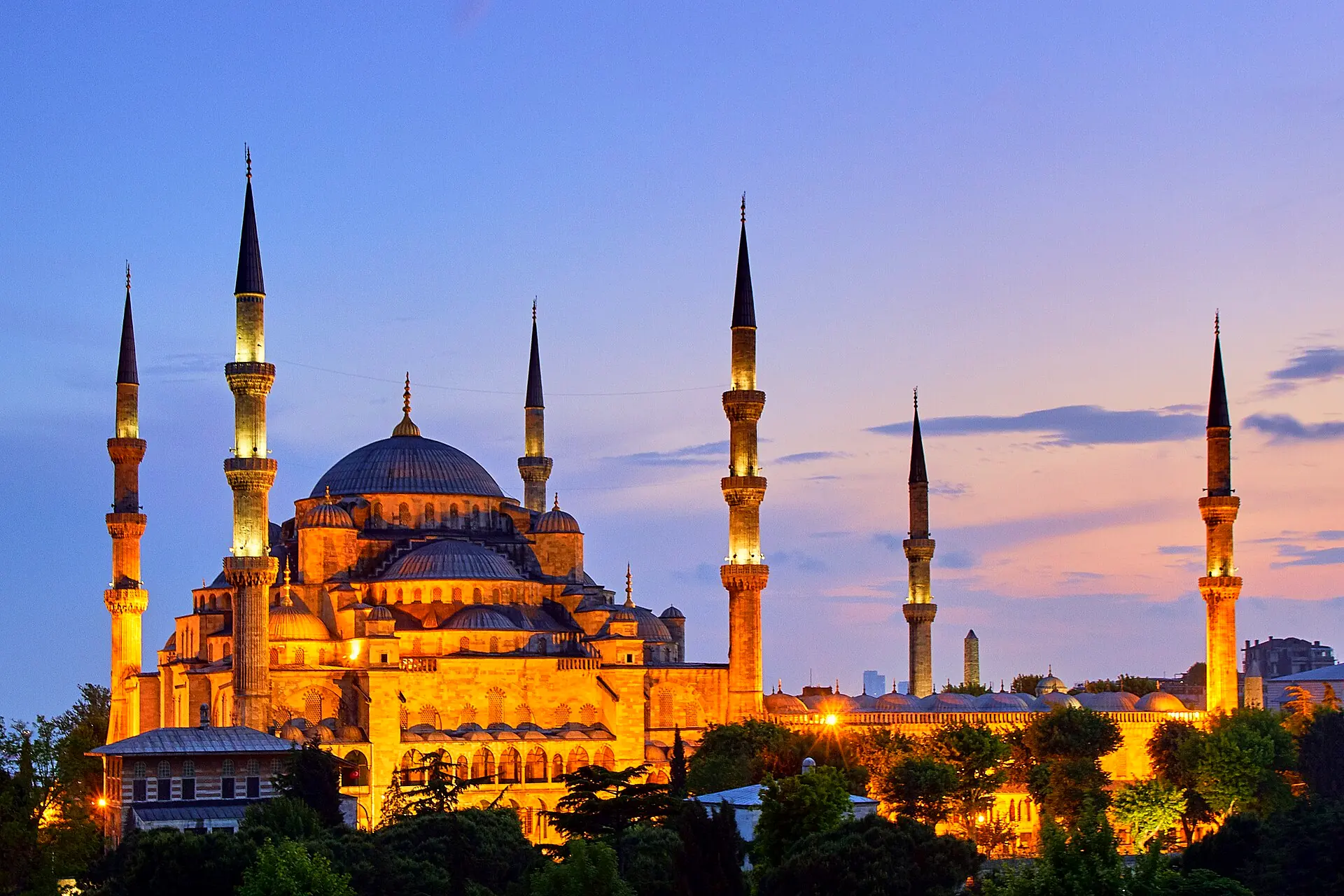
The Sultan Ahmed Mosque, popularly called the Blue Mosque, is an imperial Ottoman mosque in Istanbul’s Sultanahmet district. It was built between 1609 and 1617 under Sultan Ahmed I, has six minarets, and takes its nickname from the thousands of predominantly blue Iznik tiles inside.
Key facts
- Location: Sultanahmet, beside the former Hippodrome, across from Hagia Sophia
- Distance: Short walk from the Sultanahmet tram stop; see airport guides for transfers
- Built: 1609-1617, Sultan Ahmed I
- Minarets: Six
- UNESCO: Historic Areas of Istanbul, 1985
- Best season: Spring and autumn; mornings outside prayer times
- Typical visit time: 30-60 minutes; half day with Hagia Sophia
- Entrance: See official page
What is the Blue Mosque and why visit?
The Blue Mosque, officially the Sultan Ahmed Mosque, is an Ottoman imperial mosque in Istanbul’s Sultanahmet district, built between 1609 and 1617. It has six minarets and is decorated with thousands of Iznik tiles in mainly blue tones. It is part of the UNESCO-listed Historic Areas of Istanbul.
Visitors come to see a classical Ottoman design at full scale: a central dome, four semi-domes and a large courtyard. Moreover, the mosque is still in daily use, so you see living worship as well as architecture. It faces Hagia Sophia across a park, which makes it easy to visit both in one morning.
What is the history of the Sultan Ahmed Mosque?
Sultan Ahmed I commissioned the mosque, and it was built from 1609 to 1617 beside the old Hippodrome. After the Peace of Zsitvatorok, seen as a blow to Ottoman prestige, he decided to build a large mosque in Istanbul. He was the first sultan to build an imperial mosque since Selim II, who died in 1574.
The site was on the south-east side of the old Byzantine Hippodrome, near Hagia Sophia. It had been occupied by the palaces of several viziers, including Sokollu Mehmet Pasha and Güzel Ahmet Pasha, so expropriation was costly. Ahmed I had won no major victories, therefore he had to divert funds from the treasury.
The opening ceremony took place in 1617, although some inscriptions mention 1616. The architect, Sedefkar Mehmed Agha, synthesised the ideas of his master Sinan, aiming for overwhelming size and splendour. Wikipedia describes it as the last great mosque of the classical period, and it gave its name to the Sultanahmet neighbourhood.
The table below lists the key dates and people.
| Item | Detail |
|---|---|
| Commissioned by | Sultan Ahmed I |
| Construction | 1609 to 1617 (some inscriptions say 1616) |
| Architect | Sedefkar Mehmed Agha, pupil of Sinan |
| Site | South-east side of the old Hippodrome |
| Main dome height | 43 metres |
| UNESCO | Historic Areas of Istanbul, 1985 |
What are the highlights of the Blue Mosque?
The highlights are the six minarets, the cascade of domes and the blue Iznik tile interior. The plan is a central dome surrounded by four semi-domes, which gives a sense of height and light. The wider complex, or külliye, includes the tomb of Ahmed I and a madrasa.
Look out for these features during your visit.
- Six minarets; with the site and size, they suggest Ahmed meant to rival Hagia Sophia.
- Thousands of Iznik tiles and painted floral motifs in predominantly blue colours.
- The main dome, which reaches 43 metres.
- The tomb of Ahmed I and the madrasa within the külliye.
- The view across the park toward Hagia Sophia and the Hippodrome.
This at-a-glance table sums up the structure.
| Feature | Detail | Why it matters |
|---|---|---|
| Minarets | Six | Signals imperial status and rivalry with Hagia Sophia |
| Domes | Central dome plus four semi-domes | Classical Ottoman plan |
| Tiles | Thousands of Iznik tiles, mainly blue | Source of the popular name |
| Complex | Tomb of Ahmed I, madrasa | Part of the külliye |
| Setting | Beside the former Hippodrome | Heart of Sultanahmet |
How do you get to the Blue Mosque and get around?
Take the T1 tram to the Sultanahmet stop, which is a short walk from the mosque. The mosque stands across from Hagia Sophia, so signs and crowds lead the way. Taxis and transfers drop you near the pedestrian zone. For schedules, check the current timetable of the operator.
This table compares the main ways to arrive.
| Option | How it works | Notes |
|---|---|---|
| T1 tram | Ride to the Sultanahmet stop and walk | Check the current timetable |
| From the airports | Shuttle, metro plus tram, or private transfer | See our airport guides |
| Ferry plus tram | Cross by ferry, then tram or walk uphill | Useful from the Asian side |
| Taxi or transfer | Drop-off near the pedestrian zone | Traffic varies |
| On foot | Walk from Hagia Sophia, the Hippodrome or the Basilica Cistern | All close together |
When is the best time to visit the Blue Mosque?
Visit in the morning outside prayer times, and in spring or autumn for mild weather. Because the mosque is a place of worship, it restricts visiting around the five daily prayers, so plan around them and check the official page. Summer is hot and busy, while winter is quieter but wet.
The table shows what each season is generally like.
| Season | Weather | Crowds | Notes |
|---|---|---|---|
| Spring (Mar-May) | Mild | Busy around holidays | Good light for the courtyard |
| Summer (Jun-Aug) | Hot and humid | Highest | Go early; shade in the courtyard is limited |
| Autumn (Sep-Nov) | Mild to cool | Moderate | Comfortable walking weather |
| Winter (Dec-Feb) | Cool and rainy | Lowest | Bring a rain layer |
How long should you stay at the Blue Mosque?
Allow 30 to 60 minutes for the mosque and its courtyard, and a half day if you add Hagia Sophia and the Hippodrome. A full day fits the Basilica Cistern and Topkapı Palace as well. As a result, many visitors build their first Istanbul day around Sultanahmet.
This table gives three simple plans.
| Plan | What it covers | Pace |
|---|---|---|
| Half day | Blue Mosque, Hagia Sophia, Hippodrome | Relaxed |
| 1 day | Add the Basilica Cistern and Topkapı Palace | Full |
| 2-3 days | Add Dolmabahçe, the bazaars, Galata and a Bosphorus cruise | Easy pace |
What are the practical tips for visiting the Blue Mosque?
Dress modestly and be ready to remove your shoes. Covered shoulders and knees are expected for everyone, and many visitors carry a scarf. Entry rules and any fees can change, so check the official page for current information. Treat the mosque as a place of worship first.
Moreover, a guide can explain the architecture, the tilework and the history of the külliye in context. In contrast, visiting alone is fine if you prefer your own pace; just plan around prayer times and check the official page for the latest visitor arrangements.
These tips make the visit smoother.
- Tickets and rules: see the official page; the mosque is a working place of worship.
- Prayer times: expect closures to visitors around the five daily prayers; check before you go.
- Dress code: covered shoulders and knees; carry a light scarf.
- Shoes: remove them at the entrance; carry them in a bag if offered.
- Photography: be discreet, avoid flash and keep people in prayer out of frame.
- Accessibility: the approach has steps and stone paving; ask official sources about current routes.
- Safety: watch for unofficial guides and carpet touts in the Sultanahmet area.
Where should you stay and eat near the Blue Mosque?
Choose a neighbourhood by mood rather than distance, since the area is compact and well linked by tram. Sultanahmet puts you beside the mosque, with quiet evenings and plenty of guesthouses. Alternatively, Karaköy and Galata across the Golden Horn have more cafes and nightlife. Fatih and Eminönü offer local neighbourhood eateries.
For food, try lokantas with home-style dishes, kebab houses, and bakeries with simit and baklava. Compare menus and avoid aggressive street touts.
What is near the Blue Mosque and what day trips work?
The main sights of the historic peninsula lie close together near the Blue Mosque, so you can combine several in one day. The mosque sits among the main sights of the historic peninsula. Use this list to plan the rest of your day.
The Blue Mosque, Hagia Sophia and the Hippodrome form a compact trio. As a result, a first-time visitor can see the mosque, then cross to the Basilica Cistern and finish at Topkapı Palace without needing transport.
These places are close by.
- Hagia Sophia, directly across the park.
- The Hippodrome area beside the mosque.
- The Basilica Cistern, a short walk away.
- Topkapı Palace, behind Sultanahmet.
- Galata Tower and Beyoğlu across the Golden Horn.
- A Bosphorus cruise or Princes’ Islands trip for a change of pace.
Plan this with TurkGT
TurkGT is an Istanbul-based travel company offering guided tours, private transfers, licensed guide and interpreter services, and tailored itineraries. Tell us your dates and interests, and we confirm the plan and availability by WhatsApp. For tickets and opening times, we point you to the official page first.
Our Sultanahmet Walking Tour: Hippodrome, Hagia Sophia, Blue Mosque and the Ottoman Istanbul Mosques Tour: Suleymaniye and Rustem Pasha cover this area with a guide.
Frequently asked questions
Why is it called the Blue Mosque?
The interior is decorated with thousands of Iznik tiles in predominantly blue colours, which give the mosque its popular name.
When was the Blue Mosque built?
It was built between 1609 and 1617 during the rule of Sultan Ahmed I.
How many minarets does it have?
It has six minarets.
Who was the architect?
Sedefkar Mehmed Agha, a student of Sinan, designed it.
Is it a UNESCO site?
It is part of the Historic Areas of Istanbul, inscribed in 1985.
Can tourists visit during prayer?
Visiting is restricted around prayer times. Check the official page for current arrangements.
What should I wear?
Dress modestly with covered shoulders and knees, and be ready to remove your shoes.
What is near the Blue Mosque?
Hagia Sophia, the Hippodrome, the Basilica Cistern and Topkapı Palace are all within walking distance.
Related on TurkGT
Sources
- Wikipedia: Historic Areas of Istanbul
- Wikipedia: Sultan Ahmed Mosque
- Türkiye Kültür Portalı: Sultan Ahmed Camii
Last reviewed: 2026-11-17. Opening hours, ticket prices and other changeable details are not listed because they change; check the official source before you travel.