
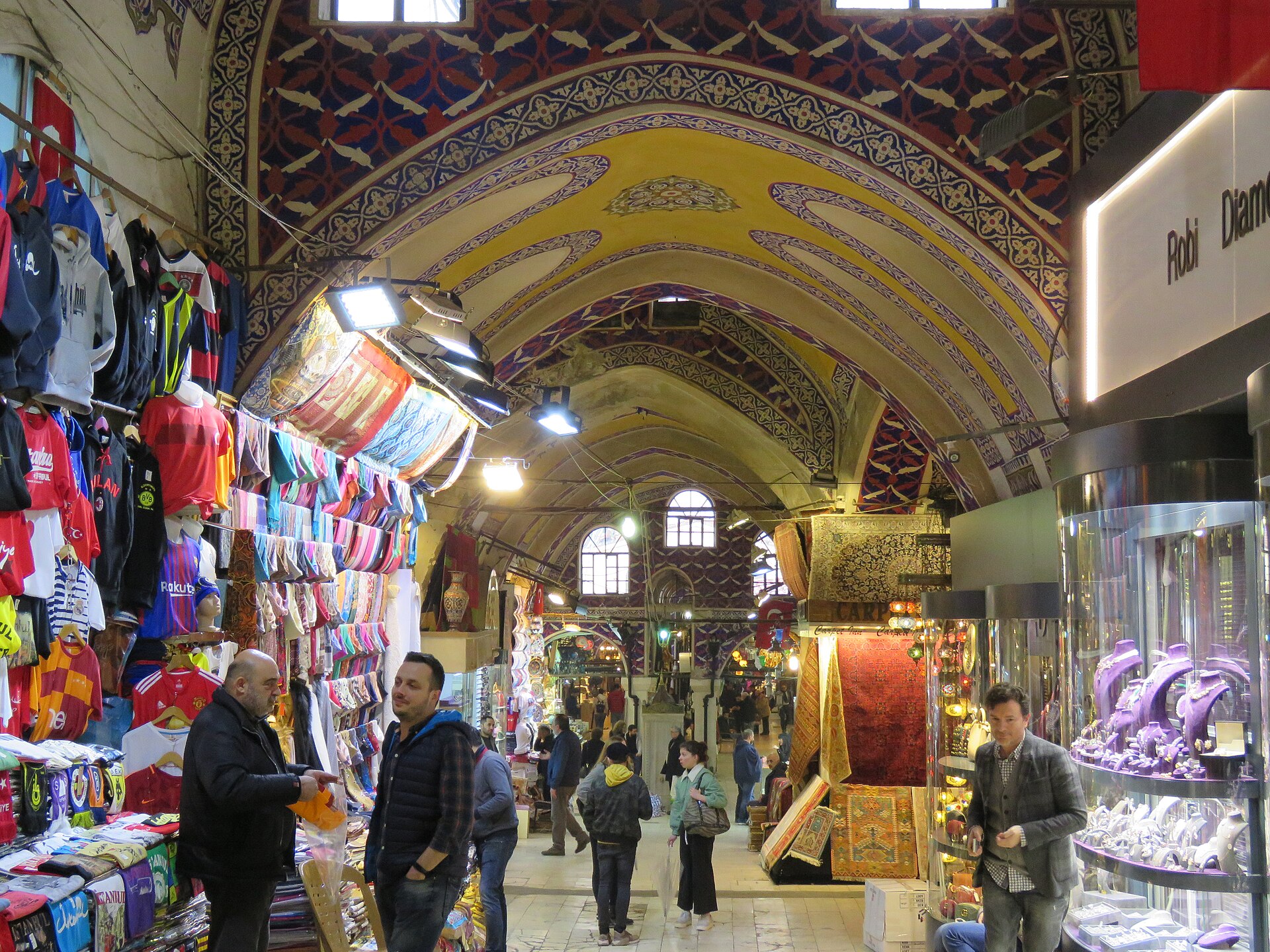
The Grand Bazaar, or Kapalıçarşı (“Covered Market”), is a historic covered market in the Fatih district of Istanbul, inside the walled old city. Its core was begun in the winter of 1455/56 under Mehmed II. Visit it for its domed bedesten halls, its maze of 61 covered streets and its trades in jewellery, textiles, carpets and leather.
Key facts
- Turkish name: Kapalıçarşı (“Covered Market”); also Büyük Çarşı
- Location: Fatih district, inside the walled old city, between Beyazıt and Nuruosmaniye mosques
- Nearest transport: T1 tram, Beyazıt-Kapalıçarşı stop; Sultanahmet and Sirkeci are on the same line
- Airports: Istanbul Airport (IST) lies about 35 km north; metro M11 and city connections lead to the old city
- Core begun: Winter 1455/56, shortly after the Ottoman conquest; core hall finished 1460/61
- Scale (reported): 61 covered streets and over 4,000 shops on about 30,700 m2
- Best season: Late spring and early autumn; the market is covered, so rain is manageable
- Typical visit time: 1.5-3 hours for browsing and a break
- UNESCO status: Not individually listed; stands in the old city area covered by Istanbul’s World Heritage listing, see our Historic Areas page
- Entrance: No ticket is normally needed for the market itself; see the official page for opening days and hours
What is the Grand Bazaar and why visit?
The Grand Bazaar is a historic covered market in Istanbul’s walled old city, in the Fatih district. Wikipedia counts 61 covered streets and over 4,000 shops. Visitors come to see Ottoman commercial architecture, compare crafts such as jewellery, carpets and leather, and understand how Istanbul traded.
The Turkish name, Kapalıçarşı, means “Covered Market”. The bazaar stretches roughly from west to east between the Beyazıt and Nuruosmaniye mosques. As a result, it is easy to combine with Sultanahmet, the Spice Bazaar and the Süleymaniye area.
Wikipedia also says the bazaar is often regarded as one of the first shopping malls in the world. However, reported figures for shops and visitors vary by source and year. Treat all counts as approximate.
What is the history of the Grand Bazaar?
Construction of the future Grand Bazaar began in the winter of 1455/56, soon after the Ottoman conquest of Constantinople. Sultan Mehmed II had a hall built for the trade in textiles and jewels. It was named the Cevâhir Bedestan, or “Bedesten of Gems”, and finished in the winter of 1460/61.
The building was endowed to the waqf of the Hagia Sophia Mosque. Likewise, Turkish sources say the bazaar was built to bring income to Hagia Sophia. The word bedesten comes from the Persian bezestan, derived from bez, “cloth”. Brickwork shows that most of the structure dates from the second half of the 15th century, although a Byzantine eagle relief on the East Gate leads some scholars to propose an older origin.
A second domed hall, the Sandal Bedesten, was added later; one source dates it to 1545. Textile trade then moved to it, and the older hall kept luxury goods. Shops opened between and around the two halls, and a whole commercial quarter formed. By the early 17th century the bazaar had reached its final shape.
Disasters shaped the complex. The first recorded fire was in 1515, and many more followed. The 1894 earthquake caused the last major damage, and repairs ran until 1898. The Sahaflar Çarşısı, the old book market, moved to its present place near the Beyazıt Mosque only after that quake. A restoration took place in 1980.
Social life was part of the story too. Customers once sat with dealers and drank tea or Turkish coffee. Guilds controlled trades, and the gates were closed at night. Wikipedia says the concentration of trades gave security against theft, fire and uprising.
What can you see and do in the Grand Bazaar?
The main experiences are the two bedesten halls, the specialist streets and the old hans around the market. Shops are grouped by trade, as in Ottoman times. The bazaar is a place to look, compare and learn, so you do not have to buy anything.
Wikipedia lists today’s clusters of trade. For example, jewellers gather along Kalpakçılar Caddesi, and furniture shops along Divrikli Caddesi. In contrast, leather goods gather along Perdahçılar Caddesi.
These are the stops that give a visit structure:
- The Iç (Cevahir) Bedesten, the old core with domed bays and four gates.
- The Sandal Bedesten, the second domed hall, later used as an auction house for carpets.
- Kalpakçılar Caddesi, where jewellers cluster.
- Perdahçılar Caddesi, for leather goods.
- Sahaflar Çarşısı, the old book market near the Beyazıt Mosque, outside the bazaar walls.
- The Çorlulu Ali Paşa Medrese courtyard near the Beyazıt gate, a quiet tea stop.
- The surrounding hans, the old caravanserais where merchants once stored goods.
This table summarises what to browse at a glance.
| Area or street | Trade or feature | Tip |
|---|---|---|
| Iç Bedesten | Old core hall with domed bays | Look up at the domes and gates |
| Sandal Bedesten | Second hall, later an auction house | Notice the 12 stone piers and domes |
| Kalpakçılar Caddesi | Jewellery | Compare several shops before you decide |
| Divrikli Caddesi | Furniture | Mainly for decorative pieces |
| Perdahçılar Caddesi | Leather goods | Check stitching and lining |
| Sahaflar area | Books and prints | Just outside the bazaar, near Beyazıt Mosque |
How do you get to the Grand Bazaar and get around?
Take the T1 tram to the Beyazıt-Kapalıçarşı stop. Wikipedia says the bazaar can be reached easily from Sultanahmet and Sirkeci by tram. Wikivoyage calls T1 the most useful route in the Old City, and it also stops at Laleli-Üniversite, linked to metro M2.
Metro M2 stops at Vezneciler, which connects with T1 and is within walking distance of the market area. Moreover, old city streets are traffic-restricted, so expect to walk. Check the current timetable and stop names before you travel.
From Istanbul Airport (IST), the M11 metro connects to central Istanbul, and the airport is about 35 km north of the city. A private transfer avoids changing lines with luggage.
This table lists the main routes to the bazaar.
| From | Route | Typical effort |
|---|---|---|
| Sultanahmet | T1 tram to Beyazıt-Kapalıçarşı, or walk along Divan Yolu | Short tram ride; walking is possible but uphill in parts |
| Sirkeci / Eminönü | T1 tram | Short ride; check current timetable |
| Taksim / Galata | M2 metro to Vezneciler, then walk | Metro plus a walk of several minutes |
| Kabataş | T1 tram | One line; can be crowded at rush hours |
| Istanbul Airport (IST) | M11 metro and city lines, or private transfer | IST is about 35 km north; allow extra time |
When is the best time to visit the Grand Bazaar?
Late spring and early autumn are the most comfortable times for the walk to and from the bazaar. Wikivoyage describes late May to early June and late September to early October as pleasant in Istanbul. The market is covered, so a rainy day works, but check the official opening days.
Public transport is crowded at rush hours, so travel outside peak times. Furthermore, the market tends to be calmer earlier in the day. Confirm holidays and closing days on the official page.
This table shows how seasons affect a visit.
| Season | Weather | Crowds | Notes |
|---|---|---|---|
| Spring (Apr-Jun) | Mild, some rain | Moderate to high | Late May and early June are pleasant for the walk between sights |
| Summer (Jul-Aug) | About 26 °C by day, humid | High | The covered streets give shade; drink water |
| Autumn (Sep-Nov) | Mild, more rain later | Moderate | Late September to early October is pleasant |
| Winter (Dec-Mar) | About 8 °C by day, damp | Lower | A covered market is a good rainy-day plan |
How long should you stay at the Grand Bazaar?
Plan about two hours for a first visit, or more if you plan to shop. This is our planning estimate, not an official figure. The maze of lanes makes it easy to lose time, so set a meeting point and a time limit.
You can extend the day with the Spice Bazaar and the Süleymaniye area. As a result, a full day covers several markets and hans.
This table gives sample plans for different time budgets.
| Plan | What to include | Notes |
|---|---|---|
| Half day | Bazaar, tea break in a han courtyard, walk to Beyazıt and the book market | Start early |
| 1 day | Bazaar plus Spice Bazaar, Süleymaniye and a Golden Horn walk | Use T1 between districts |
| 2-3 days | Bazaar on one day, Sultanahmet sights on another, Galata and Beyoğlu on a third | Group sights by district |
What practical tips help at the Grand Bazaar?
Check the official sources for opening days and any entry rules, because hours differ between sources. Wikipedia and Wikivoyage give different opening days, so we do not quote them. Prices are negotiable in many shops, so compare before you buy.
Wikivoyage warns that crowded public transport attracts pickpockets. Therefore carry bags in front and keep phones and wallets secure inside the market.
These habits make the visit easier:
- Dress: modest, comfortable clothes and flat shoes for stone floors.
- Money: carry small notes and check card fees before you pay.
- Bargaining: ask for a price, compare two or three shops and stay polite.
- Photography: ask before photographing shop owners or goods.
- Accessibility: lanes are narrow and crowded, so a wheelchair or pushchair is difficult at busy times.
- Safety: keep valuables in front, and watch for crowds near the entrances.
- Tea: accept a tea if you like, but you are not obliged to buy.
Where should you stay and eat near the Grand Bazaar?
Sultanahmet, Beyazıt and Laleli are the nearest areas for a stay, and all are on the T1 tram line. Sultanahmet is close to the major monuments, while Beyazıt places you beside the bazaar and the university quarter. Choose by what you want to be near.
For food, the bazaar has small cafés, and Beyazıt and Vezneciler have everyday restaurants. Wikivoyage advises avoiding restaurants with touts outside and warns that places along the tram line near the Blue Mosque are touristy. Walk a few blocks away and read current reviews.
What is near the Grand Bazaar, and which day trips combine well?
Nearby places include the Spice Bazaar, Hagia Sophia, the Blue Mosque, Topkapı Palace and the Basilica Cistern. Beyazıt Mosque and the Süleymaniye complex are close, and Galata is across the Golden Horn. A day could pair the bazaar with the Spice Bazaar and a ferry.
Use the related pages below to plan your route.
Plan this with TurkGT
TurkGT is an Istanbul-based travel company. We offer a guided Grand Bazaar and Spice Bazaar shopping tour with a guide, plus a market day with the Spice Bazaar and Kadıköy. We can also arrange private transfers, private guides and interpreters.
Message us on WhatsApp with your dates and interests, and we confirm the plan with you directly.
Frequently asked questions
Where is the Grand Bazaar?
It is in the Fatih district of Istanbul, inside the walled old city, between the Beyazıt and Nuruosmaniye mosques.
What does Kapalıçarşı mean?
It means “Covered Market”. The bazaar is also called Büyük Çarşı, or “Grand Market”.
When was the Grand Bazaar built?
Construction of its core began in the winter of 1455/56 under Sultan Mehmed II. The core hall was finished in the winter of 1460/61.
How many shops are in the Grand Bazaar?
Wikipedia reports 61 covered streets and over 4,000 shops. Counts vary by source and year, so treat them as approximate.
How do I get to the Grand Bazaar from Sultanahmet?
Take the T1 tram to the Beyazıt-Kapalıçarşı stop. Check the current timetable on the day.
How long should I spend in the Grand Bazaar?
About two hours for a first visit is a reasonable plan. Add time if you intend to shop or visit nearby hans.
Do I need a ticket for the Grand Bazaar?
Check the official page for current rules on entry, opening days and hours.
Is the Grand Bazaar safe?
It is a busy tourist area. Wikivoyage warns of pickpockets in crowds on public transport, so keep valuables secure and carry bags in front.
Related on TurkGT
Sources
- Wikipedia: Grand Bazaar, Istanbul
- Türkiye Kültür Portalı: Kapalıçarşı
- Wikivoyage: Istanbul/Historical Peninsula
- Wikivoyage: Istanbul Airport
- Wikivoyage: Istanbul
Last reviewed: 2026-11-17. Opening hours, ticket prices and other changeable details are not listed because they change; check the official source before you travel.