
Pamukkale, meaning “cotton castle”, is a natural site in Denizli Province in southwestern Türkiye, known for white travertine terraces formed by thermal spring water. The ancient city of Hierapolis stands above them, and the combined site has been on the UNESCO World Heritage List since 1988. Visit it for the terraces, the Roman ruins and the thermal pool.
Key facts
- Location: Denizli Province, Inner Aegean region, River Menderes valley; Denizli city is about 20 km south
- Nearest transport: Denizli bus station, then a local bus to Pamukkale; Denizli Çardak Airport is 65 km east of Denizli
- Larger airport: İzmir Adnan Menderes Airport, about 260 km west of Denizli
- Terrace formation: About 2,700 m long and 600 m wide, made of travertine
- Hot springs: 17 springs with temperatures from 35 °C to 100 °C
- Ancient city: Hierapolis, built on top of the travertine formation
- UNESCO status: Inscribed in 1988 together with Hierapolis
- Best season: Late spring and early summer; summers are hot and winters are cold underfoot
- Typical visit time: 3-5 hours for terraces, ruins and museum; longer with a swim
- Entrance: See the official page; Hierapolis-Pamukkale is one ticketed area with three gates
What is Pamukkale and why visit?
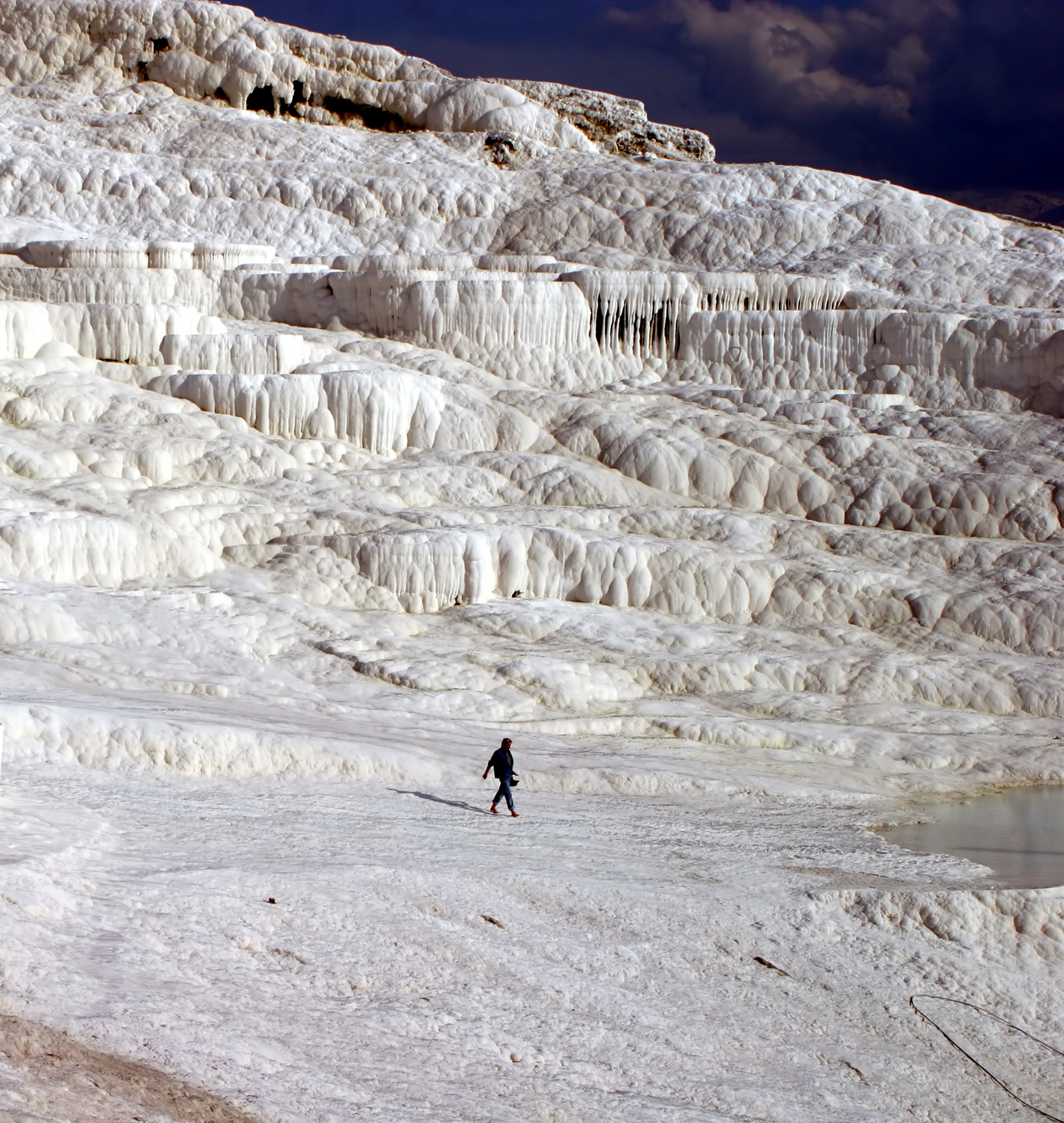
Pamukkale is a natural site in Denizli Province, Türkiye, famous for white terraces of travertine. Thermal spring water built them over thousands of years. Above them stands Hierapolis, a Greco-Roman city. UNESCO lists the two together, so one visit covers geology, archaeology and a warm-water swim.
The Turkish name means “cotton castle”. Wikipedia says the name refers to the shimmering, snow-white limestone shaped by calcite-rich springs. UNESCO describes an unreal landscape of mineral forests, petrified waterfalls and terraced basins.
Moreover, the site pairs nature with history. Visitors walk from the pools to the museum, the theatre and the necropolis. As a result, many people plan it as a stop between the Aegean coast and Cappadocia.
How did the Pamukkale terraces form?
The terraces are travertine, a sedimentary rock deposited by mineral water. Hot springs carry the water about 320 metres to the head of the terraces. At the surface, carbon dioxide escapes and calcium carbonate is deposited as a soft gel. The gel eventually crystallises into travertine.
The area has 17 hot springs with temperatures from 35 °C to 100 °C. Wikipedia gives the formation as about 2,700 m long, 600 m wide and 160 m high. Other sources may give different dimensions, so treat these figures as approximate.
The terraces are fragile. Wikivoyage says visitors were few until 1980, and then mass tourism damaged the site. Protection tightened in 1988, most terraces were closed to walkers, and the hotels on the plateau were removed.
What is the history of Hierapolis above the terraces?
Hierapolis was a thermal spa city founded in the early 2nd century BC within the Seleucid sphere. Doctors used the springs to treat patients. Earlier, the Phrygians probably built a temple in the first half of the 7th century BC. Few facts are known about the origin of the city.
In 133 BC Attalus III bequeathed his kingdom to Rome, and Hierapolis joined the Roman province of Asia. A major earthquake destroyed the city in AD 17, and rebuilding followed. The Christian Apostle Philip spent his last years there. Later, Justinian raised the local bishop to metropolitan rank in 531.
The Roman baths became a Christian basilica. Wikivoyage says repeated earthquakes hit the town and that it was abandoned after the quake of 1334. The kulturportali.gov.tr page says Hierapolis lies about 17 km north of Denizli and has been preserved in a good state.
UNESCO adds that a system of canals brought the thermal water to nearby villages and fields. It calls the combination of formations and canals exceptional.
What can you see at Pamukkale and Hierapolis?
The main sights are the travertine pools, the Archaeology Museum, the Roman theatre and amphitheatre, the Martyrium and the necropolis. All lie within one ticketed area with three gates. Most terraces are off-limits to protect them, so you walk on a marked route.
The pools along the access route are shin deep, and shoes are not allowed on the travertine. As a result, you carry your shoes and wear swim shorts or a swimming costume if you plan to wade.
These stops form a useful route:
- The travertine terraces, accessed by a barefoot route from Town Gate.
- The Archaeology Museum, inside the Roman bath house, with finds including ornate sarcophagi.
- The Roman amphitheatre, well restored, with 12,000 seats, built in 129 AD.
- The Ploutonion, a shrine to Pluto or Hades, where carbon dioxide gas rises; follow warning signs.
- The Martyrium, the church and tomb of St Philip the Apostle.
- The necropolis, which extends 2 km towards North Gate.
- Cleopatra Pool, a naturally hot swimming pool inside the site.
- The Sunset Spot, a look-out over the terraces.
This table summarises the main stops at a glance.
| Stop | What it is | Notes |
|---|---|---|
| Travertine terraces | White calcium carbonate terraces and pools | Barefoot route; most terraces are closed |
| Archaeology Museum | Finds from Hierapolis and nearby cities | Housed in the Roman bath |
| Roman amphitheatre | Theatre from 129 AD, 12,000 seats | Well restored |
| Ploutonion | Shrine to Pluto or Hades | Carbon dioxide gas; obey warnings |
| Martyrium | Church and tomb of St Philip | Within the necropolis |
| Cleopatra Pool | Naturally hot pool | Check the official page for fees |
How do you get to Pamukkale and get around?
Most travellers go through Denizli, which has frequent buses from Istanbul, Ankara and İzmir. A local bus then runs from Denizli bus station to Pamukkale about every 20 minutes and takes about 20 minutes, according to Wikivoyage. Check the current timetable before you go.
Denizli Çardak Airport has flights from Istanbul, but it lies 65 km east of Denizli and needs onward transport. İzmir Adnan Menderes Airport is about 260 km away, a four-hour drive. Moreover, by car Pamukkale is a 10-minute drive from a motorway junction.
Inside the village the main sights are within 15 minutes of the bus stop on foot. Three gates serve the site, and Town Gate, South Gate and North Gate suit different plans.
This table compares the main ways to reach Pamukkale.
| From | Route | Typical duration |
|---|---|---|
| Denizli bus station | Local bus to Pamukkale | About 20 min, every 20 min; check current timetable |
| Denizli city | Taxi or car | About 20 km; short drive |
| Istanbul, Ankara, İzmir | Intercity bus to Denizli, then local bus | Check current timetable |
| Denizli Çardak Airport | Private transfer or taxi | Airport is 65 km east of Denizli |
| İzmir airport (ADB) | Car or bus via Denizli | About 4 hours by road to Denizli |
When is the best time to visit Pamukkale?
Late spring and early summer are the usual recommendation. Wikivoyage says summers can be fiercely hot, with no shade and dazzling light from the white terraces. It also says pools can be dry in late summer, and that climbing the cold cascades barefoot in winter is unpleasant.
Go early or late in the day if you visit in summer. Therefore bring sun protection, water and a hat. Check the official page for current opening hours.
This table shows how the seasons affect a visit.
| Season | Conditions | Crowds | Notes |
|---|---|---|---|
| Spring | Mild; good for walking | Moderate | Late spring is a good choice |
| Summer | Hot, no shade, bright light | High | Pools may be dry in late summer |
| Autumn | Mild to cool | Moderate | Check pool water levels |
| Winter | Cold; barefoot ascent is uncomfortable | Lower | Dress warmly; carry a towel |
How long should you stay at Pamukkale?
Plan three to five hours inside the site, which is our planning estimate rather than an official figure. That allows time for the terraces, the museum, the amphitheatre and a break. A longer stay suits visitors who swim in the thermal pool or walk the long necropolis route.
Because the site works as a stop between coast and Cappadocia, many travellers stay one night in the village. Therefore an evening visit and a sunrise visit can both fit.
This table gives sample plans for different time budgets.
| Plan | What to include | Notes |
|---|---|---|
| Half day | Terraces from Town Gate, museum, theatre, then exit | Wear footwear you can carry |
| 1 day | Terraces, Hierapolis ruins, necropolis walk, Cleopatra Pool, Sunset Spot | Start early in summer |
| 2-3 days | Add Laodicea, Karahayıt and Denizli | Use Denizli as a hub |
What practical tips help at Pamukkale?
Check the official page for tickets, hours and gate rules before you go. The site is one ticketed area, and you can enter or exit at any of the three gates. Wikivoyage warns that euro prices may be charged in lira by card, so check the amount before you pay.
Wikivoyage also reports that headphones are added to the ticket price automatically. Confirm what is included on the official page.
These tips make the visit easier:
- Footwear: you carry your shoes on the travertine route; bring a bag.
- Swimwear: the pools are shin deep, so wear a swimming costume or shorts.
- Sun: bring a hat, sunglasses and sunscreen for the white light.
- Accessibility: South Gate is the main entrance for motorists and may suit restricted mobility.
- Safety: obey signs near the Ploutonion, where carbon dioxide gas rises.
- Etiquette: stay on open routes, because most terraces are closed to protect them.
- Photography: sunrise and sunset light the terraces well; the Sunset Spot is a look-out.
Where should you stay and eat near Pamukkale?
Stay in Pamukkale village or in Karahayıt, which are both close to the site gates. Wikivoyage says both have plenty of accommodation. Denizli suits travellers who need bus connections, a larger choice of restaurants or an easier arrival by intercity bus.
For food, try Denizli-style lamb kebab and baked fish with grated cheese in Denizli. In the village, pick small family restaurants and read current reviews.
What is near Pamukkale, and which day trips combine well?
Laodicea, another ancient city, lies near Denizli, and Karahayıt is known for red thermal water and spa hotels. Aphrodisias and Ephesus are further afield and fit longer itineraries. Check distances and timetables before you commit to a day trip, because road times vary.
Moreover, the Aegean region links Pamukkale with İzmir, Selçuk and Şirince. Use the related pages below to plan your route.
Plan this with TurkGT
TurkGT is an Istanbul-based travel company. We arrange guided tours, private transfers, private guides and interpreters, including for Aegean routes such as Pamukkale, Ephesus and Denizli connections. We can also help you build a flight-and-transfer plan from Istanbul, and we confirm every detail with you before the trip.
Message us on WhatsApp with your dates and group size, and we confirm the route with you directly.
Frequently asked questions
Where is Pamukkale?
It is in Denizli Province in southwestern Türkiye, in the Inner Aegean region. Denizli city is about 20 km south.
Why is Pamukkale white?
The terraces are travertine. Thermal water supersaturated with calcium carbonate reaches the surface, carbon dioxide escapes and calcium carbonate is deposited as a soft gel that crystallises.
Is Pamukkale a UNESCO World Heritage Site?
Yes. It was inscribed in 1988 together with Hierapolis.
How do I get from Denizli to Pamukkale?
Take the local bus from Denizli bus station. Wikivoyage reports a service every 20 minutes taking about 20 minutes; check the current timetable.
Can you walk on the terraces?
Only on the marked route. Most terraces are off-limits to protect them, shoes are not allowed on the travertine, and you carry your shoes.
How long do you need at Pamukkale?
A visit with terraces, the museum and the amphitheatre takes about three to five hours, our planning estimate. Add time for a swim.
Are Pamukkale and Hierapolis one ticket?
Wikivoyage says the travertines and Hierapolis share one ticketed area with three gates. Check the official page for current tickets.
When is the best time to visit Pamukkale?
Wikivoyage points to late spring and early summer. Summers are hot, late-summer pools may be dry, and winter is cold underfoot.
Related on TurkGT
Sources
- Pamukkale (Wikipedia)
- Hierapolis-Pamukkale (UNESCO World Heritage Centre)
- Pamukkale Hierapolis Antik Kenti – Kültür Portalı
- Wikivoyage: Pamukkale
- Wikipedia: Hierapolis
- Wikipedia: Denizli
- Wikivoyage: Denizli
Last reviewed: 2026-11-17. Opening hours, ticket prices and other changeable details are not listed because they change; check the official source before you travel.