
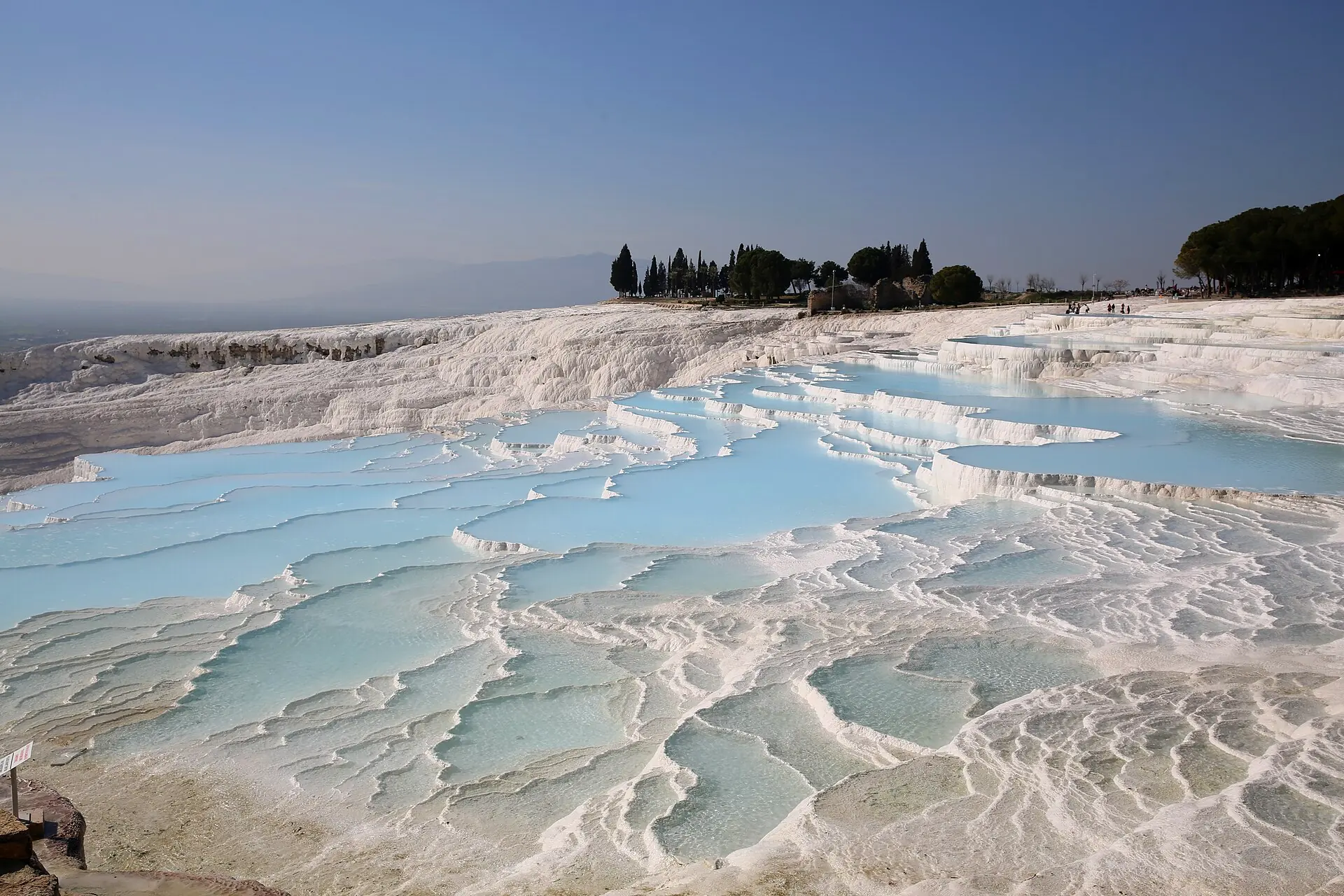
Hierapolis-Pamukkale is a UNESCO mixed World Heritage Site in Denizli Province, Türkiye. White travertine terraces and the ruins of the spa city Hierapolis share one plateau, about 20 km from Denizli. It was inscribed in 1988 and suits half-day stops and longer history-focused visits.
Key facts
- Location: Denizli Province, south-west Türkiye; about 20 km from Denizli
- From airports and cities: Reached via Denizli; check current flights, buses and transfers
- UNESCO status: Mixed site, inscribed 1988, criteria (iii), (iv), (vii)
- Natural feature: Travertine terraces on a cliff almost 200 m high
- Ancient city: Hierapolis, a Hellenistic and Roman spa town
- Best season: Late spring and early summer; hot summers, little shade
- Typical visit time: Half a day to one full day
- Entrance: See official page
What is Hierapolis-Pamukkale and why visit?
Hierapolis-Pamukkale is a World Heritage Site in Denizli Province, south-western Turkey. It joins two attractions in one place: white travertine terraces filled with warm mineral water, and the ruins of the ancient spa city of Hierapolis on the plateau above them.
The terraces are the reason most people come. However, the ruins add depth to the visit. The theatre, the necropolis and the early Christian monuments show how a Greco-Roman spa town grew beside the springs, and why people travelled here for centuries.
Moreover, the site mixes natural and cultural heritage. UNESCO lists it as a mixed property, so one ticket-controlled area covers geology, archaeology and a lively spa tradition. Therefore it suits first-time visitors, photographers and history readers alike.
Reasons travellers give for including the site in a Turkey itinerary:
- White calcite terraces and pools on a cliff almost 200 metres high
- A Hellenistic and Roman spa city with a theatre, baths and a long necropolis
- Early Christian remains linked to the apostle Philip
- A thermal pool with submerged ancient marble columns (the Cleopatra’s Pool area)
- Easy pairing with Laodicea and Aphrodisias in the Lycus and Menderes valleys
What is the history of Hierapolis and the travertines?
Hierapolis was founded as a thermal spa in the early 2nd century BC. UNESCO credits the Attalid kings of Pergamon, while Wikipedia places it within the Seleucid sphere, so sources differ on the founder. The town passed to Rome in 133 BC and flourished in the 2nd and 3rd centuries AD.
Earthquakes shaped the city repeatedly. Wikipedia records a major quake in AD 17 under Tiberius and a more severe one in AD 60 under Nero. UNESCO also notes destruction in 60 AD and a rebuilding. As a result, much of the standing Roman architecture dates from the later reconstruction.
The Christian period followed. After Constantinople became the new Rome in 330 AD, Hierapolis became a bishopric, and Justinian raised its bishop to metropolitan rank in 531. In the early 7th century, Persian armies and another earthquake devastated the town. Excavation began with the German archaeologist Carl Humann in 1887, and an Italian mission has worked there since 1957.
Key dates for the ancient city, as given by the sources:
- Early 2nd century BC: founding of the spa town
- 133 BC: city passes to Rome
- AD 17 and AD 60: major earthquakes
- 330 AD: Constantinople becomes the new Rome; Hierapolis becomes a bishopric
- 531: bishop raised to metropolitan rank
- Early 7th century: Persian attacks and a further earthquake
The table below places the main periods side by side.
| Period | What happened | Visible today |
|---|---|---|
| Hellenistic (2nd c. BC) | Spa town founded around thermal springs | Early street grid, temple traditions |
| Roman (133 BC onwards) | Peak of importance in 2nd-3rd c. AD | Theatre, baths, monumental arch, necropolis |
| Early Christian (4th-6th c.) | Bishopric; Martyrium of St Philip | Cathedral, baptistery, churches, Martyrium |
| Late antique decline | Persian raids and earthquake, early 7th c. | Collapsed walls and ruined quarters |
What are the highlights of Hierapolis-Pamukkale?
The main highlights are the travertine terraces, the ancient theatre, the necropolis and the thermal pool. UNESCO describes mineral forests, petrified waterfalls and terraced basins, some less than a metre high and others about six metres.
The geology is simple to explain. Water supersaturated with calcium carbonate reaches the surface, carbon dioxide degasses, and the calcium carbonate settles as a soft gel that crystallises into travertine. Fresh deposits give the terraces their dazzling white coating.
On the plateau, the theatre has been the object of important restorations between 2004 and 2014. Its auditorium had stacked seating for about 15,000 according to Wikipedia, while Wikivoyage gives 12,000, so treat the figure as approximate. In contrast, the necropolis, which extends over 2 kilometres, is one of the best preserved in Turkey. Furthermore, the Martyrium of St Philip stands on a hill outside the north-eastern city walls.
Sights to look for on a typical route:
- The travertine cascades and pools, entered by shoe-free paths
- The Roman theatre and its restored stage building
- The Frontinus Gate and the broad main street (plateia, 14 m wide)
- The Plutonium, a small fenced cave linked to ancient cult practice
- The necropolis with tombs spread along the roads
- The Martyrium of St Philip on its hilltop
- The archaeology museum, where finds include ornate sarcophagi
- The Sunset Spot lookout over the terraces
This at-a-glance table summarises what each sight offers.
| Sight | Type | Why it matters |
|---|---|---|
| Travertine terraces | Natural | Calcite pools and petrified waterfalls on a cliff face |
| Theatre | Roman | Restored seating bowl; strong views |
| Necropolis | Funerary | Over 2 km of tombs, well preserved |
| Cleopatra’s Pool area | Thermal | Warm water with submerged marble columns |
| Martyrium of St Philip | Early Christian | Pilgrimage site on the hill |
| Museum | Archaeology | Sarcophagi and excavation finds |
How do you get to Pamukkale and get around?
Most travellers reach Pamukkale through Denizli, about 20 km away. Denizli has frequent buses from Istanbul, Ankara and Izmir, and local services run from Denizli to Pamukkale village. Always check the current timetable before you travel.
Wikivoyage describes a local bus to Pamukkale running every 20 minutes and taking about 20 minutes, with a stated 2023 fare. Timetables and prices change, so treat that as indicative. By car, Pamukkale is about 10 minutes from a motorway junction.
Inside the site, there are three entry options. The South Gate is the main entrance for drivers and suits visitors with reduced mobility. The North Gate has its own car and bus park. The Town Gate leads into a 15-minute climb through the travertine pools. In addition, Selçuk, Izmir and the Aegean coast make a logical route for a combined Ephesus and Pamukkale trip.
Practical routing notes:
- Intercity buses usually stop in Denizli, not in Pamukkale itself
- Pick your gate to match your plan: south for easy access, north for a downhill finish
- Hotels in Pamukkale village are within walking distance of the Town Gate
- Taxis and tour operators connect the village with the two car parks
The table lists common ways to reach the site, with indicative timing only.
| From | Main option | Notes |
|---|---|---|
| Denizli | Local bus or taxi | About 20 km; around 20 minutes by bus per Wikivoyage |
| Istanbul | Overnight or day bus via Denizli, or a domestic flight | Check current timetables and airport options |
| Izmir / Selçuk | Bus or private transfer via Denizli | Common Ephesus plus Pamukkale route |
| Antalya / Fethiye | Bus via Denizli or private transfer | Check current routes |
| Self-drive | Motorway junction close to village | About 10 minutes from the junction |
When is the best time to visit Pamukkale?
Late spring and early summer are the best time to visit Pamukkale, according to Wikivoyage. Temperatures are pleasant, the pools hold water and the light is good for photographs. Moreover, you can still walk the plateau without extreme heat.
Summers can be fiercely hot with no shade. In late summer, some pools may be dry, and in winter climbing the cold cascades barefoot is unpleasant. Opening times vary by season and by gate, so check the official page before you go.
As a result, early morning or late afternoon works well in July and August. Sunset offers softer colours, although you should plan your return route in advance.
This season guide compares weather, crowds and practical notes.
| Season | Weather | Crowds | Notes |
|---|---|---|---|
| Spring (Apr-Jun) | Mild to warm | Moderate to high | Best balance; pools usually full |
| Summer (Jul-Aug) | Very hot, little shade | High midday | Go early or late; bring water and sun protection |
| Autumn (Sep-Oct) | Warm, easing | Moderate | Some pools may be dry in late summer |
| Winter (Nov-Mar) | Cool, wet at times | Low | Cold wet travertine; warm clothes needed |
How long should you stay?
Most visitors need half a day for the terraces and ruins. A full day lets you add the museum, the thermal pool and the theatre at a slower pace. Two to three days make sense if you also visit Laodicea, Aphrodisias or Karahayıt.
Short stays work if you arrive early. However, rushing the plateau means you miss the necropolis, which is long and rewards unhurried walking.
Use this table to match your time to a simple plan.
| Time | Suggested plan | Good for |
|---|---|---|
| Half day | Terraces by the South or Town Gate, then the theatre | Tour groups, stopovers |
| 1 day | Terraces, Hierapolis ruins, museum, thermal pool, sunset | Most first-time visitors |
| 2-3 days | Add Laodicea, Aphrodisias and village evenings | History readers, photographers |
What practical tips should you know before visiting?
Practical rules matter at Pamukkale because the terraces are fragile. You cannot wear shoes on the travertine, so carry sandals or go barefoot where permitted. Check the official page for current tickets, fees and access rules, because sections of the terraces are periodically closed to regulate water flow.
Wear a swimming costume or shorts if you plan to use the terrace pools or the thermal pool. In addition, watch for signs marked ‘Tehlikeli zehirli gaz’, which means dangerous poisonous gas. Keep to marked paths.
Wikivoyage also warns that the price on some tickets or services may be stated in euros but charged in lira if you pay by card. Therefore ask which currency applies before you pay, and keep receipts.
Checklist for the day:
- Sun hat, sunglasses and water; there is little shade
- Footwear that is easy to remove, plus a bag for shoes
- Swimwear and a towel if you want to bathe
- Photography is welcome; avoid blocking narrow wet paths
- Follow marked routes and signs about gas vents
- Accessibility: the South Gate is the better choice for reduced mobility
- Tickets and fees: see the official page
Where should you stay and eat?
Most visitors stay in Pamukkale village at the foot of the plateau, or in Denizli. The plateau hotels were removed, so accommodation sits in the valley. Wikivoyage mentions a simple hotel near the bus stop with a pool and rooftop restaurant, and an open-air restaurant at the foot of town with traditional Turkish food and valley views.
Karahayıt is another nearby area some visitors choose for spa-style stays. Eating options include family restaurants in the village. In contrast, Denizli offers a wider choice of city restaurants.
Choose by plan. Stay in the village if you want sunrise or sunset on the terraces. Stay in Denizli if you arrive late by bus.
Neighbourhood picks by priority:
- Pamukkale village: walking distance to the Town Gate
- Karahayıt: thermal hotels and quieter evenings
- Denizli: transport links and more restaurants
What can you visit nearby?
Several worthwhile places lie within day-trip range. Laodicea on the Lycus is a nearby ancient city, and Aphrodisias is a separate World Heritage Site in the region. Ephesus and Selçuk are further west and often combined with Pamukkale on a two-day route.
Related pages on TurkGT cover Pamukkale Travertines, Laodicea, Aphrodisias, Ephesus and the Aegean region. Consequently you can build a route from one page to the next.
Plan this with TurkGT
TurkGT is an Istanbul-based travel company. We offer guided trips, private transfers, and guide or interpreter services for visits like this one. Message us on WhatsApp with your dates and group size, and we will confirm availability and options with you directly.
Frequently asked questions
Where is Pamukkale?
Pamukkale is in Denizli Province, south-western Turkey. Wikipedia says it can be seen from the hills near Denizli, 20 km away.
When was Hierapolis-Pamukkale inscribed by UNESCO?
UNESCO inscribed it in 1988. Wikipedia and the Turkish culture ministry list the criteria as (iii), (iv) and (vii), as a mixed site.
Can you walk on the travertines in shoes?
No. Wikivoyage says you are not allowed to wear shoes while on the travertine. Check the official page for current access rules.
What does Pamukkale mean?
UNESCO gives the name as Cotton Palace, a reference to the white terraced basins formed by calcite-laden water.
How far is Pamukkale from Denizli?
About 20 km. Wikivoyage describes a local bus of about 20 minutes. Check the current timetable.
When is the best time to go?
Wikivoyage says late spring and early summer. Summers are hot with little shade, and some pools may be dry in late summer.
How long do you need?
Half a day covers the terraces and main ruins. A full day adds the museum and thermal pool. Two or three days suit visits to Laodicea and Aphrodisias.
What can you see at Hierapolis?
UNESCO lists baths, temple ruins, a monumental arch, a nymphaeum, a necropolis and a theatre, plus Christian monuments such as a cathedral, baptistery and churches.
Related on TurkGT
Sources
- UNESCO World Heritage Centre: Hierapolis-Pamukkale
- Wikipedia: Pamukkale
- Go Türkiye: Denizli – See
- Wikipedia: Hierapolis
- Wikivoyage: Pamukkale
- Turkish Ministry of Culture and Tourism: Türkiye on the World Heritage List
Last reviewed: 2026-11-17. Opening hours, ticket prices and other changeable details are not listed because they change; check the official source before you travel.