
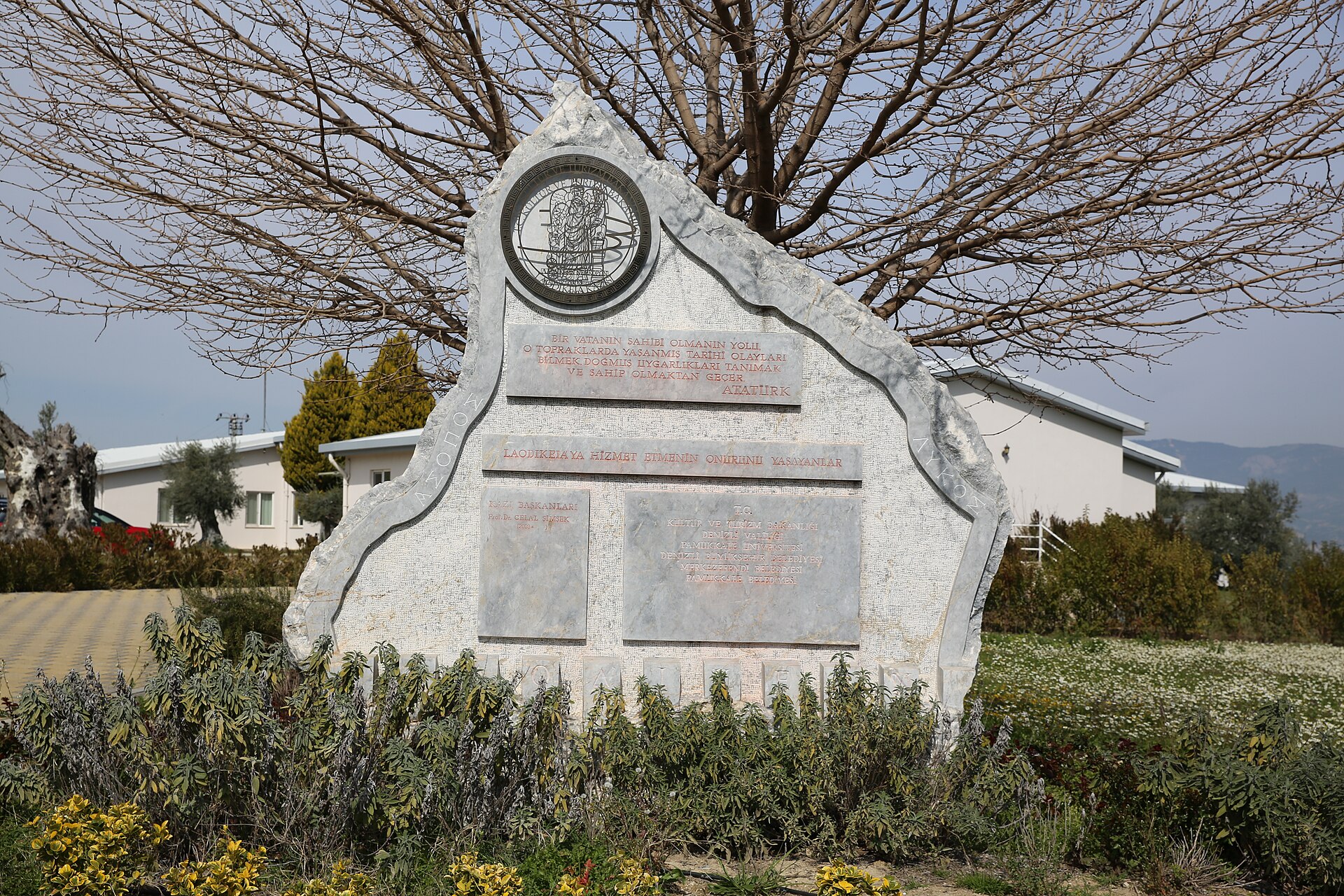
Laodicea on the Lycus (Laodikeia) was a rich ancient Greek city on the river Lycus (Çürüksu). Its ruins lie near Denizli, 6 km north of the city and about 10 km south of Hierapolis. Founded by Antiochus II Theos in the 3rd century BC, it contained one of the Seven Churches of Asia in the Book of Revelation.
Key facts
- Location: Near Denizli, 6 km north of the city; 10 km south of Hierapolis
- Also known as: Laodikeia; earlier names Diospolis and Rhoas
- Founded: 261-253 BC by Antiochus II Theos, for his wife Laodice
- Distance to Ephesus: 160 km east of Ephesus (Wikipedia)
- From Denizli Çardak Airport: Airport is 65 km east of Denizli; arrange onward transport
- From Pamukkale: Pamukkale is about 20 km north of Denizli; Laodicea is 1.5 km walk from the Pamukkale road
- Best season: Spring and autumn
- Typical visit time: 1.5 to 3 hours
- UNESCO status: Tentative List since 2013; not inscribed. Nearby Hierapolis-Pamukkale is inscribed
- Entrance: See official page
What is Laodicea on the Lycus and why visit?
Laodicea on the Lycus is an archaeological site near Denizli in Türkiye’s Aegean interior. It was a rich Hellenistic and Roman trading city, and the Book of Revelation counts its church among the Seven Churches of Asia. Visit it for a well-preserved stadium, theatres, colonnaded streets and ongoing excavation, and as a quiet complement to Pamukkale.
Wikipedia says it was a rich ancient Greek city on the river Lycus (Çürüksu). Moreover, it lies only about 10 km south of Hierapolis, so the two sites combine easily.
Main reasons to go:
- A major Seleucid and Roman city with visible monumental remains
- A site linked to the Seven Churches of Asia and to the Epistle to the Colossians
- Active excavation and restoration since 2002
- Fewer crowds than the nearby travertine terraces
- A natural pair with Hierapolis and Pamukkale
What is the history of Laodicea?
Antiochus II Theos, king of the Seleucid Empire, founded Laodicea between 261 and 253 BC in honour of his wife Laodice. Wikipedia notes that several cities of the same name were founded together with it, and that Pliny the Elder says it was first called Diospolis, ‘City of Zeus’, and afterwards Rhoas.
The city lay on a major trade route and soon became wealthy. Under the first Roman emperors it was one of the most flourishing commercial cities of Asia Minor, with large money transactions and an extensive trade in black wool. Cicero records holding assizes there around 50 BC.
However, disaster struck in the reign of Nero. Wikipedia reports that a great earthquake in 60 AD destroyed the town, and that the inhabitants declined imperial assistance and rebuilt by their own means. Later, the Epistle to the Colossians mentions Laodicea as a community of concern for Paul the Apostle, and sixty canons of a Council of Laodicea survive in Greek.
In the medieval period the city declined. Wikipedia says the Seljuks sacked it in 1161 and enslaved much of its population, and that it was destroyed during the Turkish and Mongol invasions. Regionally, the city belonged at different times to Caria, Lydia and the Roman province of Phrygia Pacatiana, so ancient authors place it in different territories.
The table gives a dated timeline from the sources.
| Date | Event |
|---|---|
| 261-253 BC | Founded by Antiochus II Theos, named for Laodice |
| c. 50 BC | Cicero holds assizes in the city |
| 1st century AD | Flourishing commercial city; trade in black wool |
| 60 AD | Earthquake in Nero’s reign; residents rebuild without imperial aid |
| 1161 | Sacked by the Seljuks |
| 2002 | Pamukkale University begins excavations |
| 2010 | Laodikeia Church uncovered in excavations |
| 2013 | Placed on Türkiye’s Tentative List |
What can you see at Laodicea?
The site is large and partly unrestored, so you see a mix of reconstructed monuments and open ruins. Wikipedia singles out the stadium near the southern edge as well preserved and the West theatre, built in the Hellenistic period for about 8,000 spectators and used until the 7th century. Moreover, colonnaded streets cross the town, lined with pedestals.
The Culture Portal says the Laodikeia Church came to light in excavations in 2010. Wikipedia also points to the remains of an aqueduct that begins several kilometres away at the Başpınar spring in Denizli. Pamukkale University has run excavations since 2002, followed by intensive restoration, so new areas may open over time.
Look out for these features:
- The stadium near the southern end of the site
- The West theatre, built in the Hellenistic era
- Colonnaded streets and pedestals
- The Laodikeia Church uncovered in 2010
- The remains of the aqueduct from the Başpınar spring
- Ongoing excavation areas, which may be fenced
The table lists what to see at a glance; check on site for current access.
| Feature | What it is | Why it matters |
|---|---|---|
| Stadium | Hippodrome near the south edge | Well preserved per Wikipedia |
| West theatre | Hellenistic, about 8,000 seats | Used until the 7th century |
| Colonnaded streets | Main routes through the city | Show the layout of a trade city |
| Laodikeia Church | Uncovered in 2010 | Link to the Seven Churches |
| Aqueduct remains | Water supply from Başpınar | Engineering feat |
How do you get to Laodicea?
Laodicea is about 6 km north of Denizli, on the road to Pamukkale. Wikivoyage says any bus or dolmuş heading toward Pamukkale will drop you at the approach road, and then you walk 1.5 km west. A taxi or private transfer is easier, particularly with luggage.
Denizli’s airport is 65 km east of the city according to Wikivoyage, so arrange onward transport in advance. Moreover, buses from Istanbul take 10 to 11 hours, and a daily Pamukkale Ekspresi train runs from Eskişehir in about 8 hours 20 minutes. Always check current timetables.
The table compares routes and typical durations (check current timetables).
| From | Option | Typical duration or note |
|---|---|---|
| Denizli city | Bus or dolmuş toward Pamukkale, then walk | Walk about 1.5 km (Wikivoyage) |
| Denizli city | Taxi or private transfer | Short drive; agree on return |
| Pamukkale | Taxi or guided trip | About 20 km between Denizli and Pamukkale area |
| Istanbul | Intercity bus | 10-11 hours (Wikivoyage) |
| Eskişehir | Pamukkale Ekspresi train | About 8 h 20 min; check timetable |
| Denizli Çardak Airport | Transfer | Airport is 65 km east of Denizli |
When is the best time to visit?
Spring and autumn are the most comfortable seasons, because the site has little shade. Wikivoyage reports average summer highs of 35°C and winter days around 5 to 10°C, with rain concentrated in winter and spring.
Therefore plan early-morning visits in summer and bring sun protection, a hat and water.
This table shows what to expect by season.
| Season | Weather | Crowds | Notes |
|---|---|---|---|
| Spring | Mild, some rain | Moderate | Comfortable for walking |
| Summer | Highs around 35°C | Higher near Pamukkale | Go early; limited shade |
| Autumn | Warm to mild | Moderate | Good light for photography |
| Winter | Days around 5-10°C | Low | Wet ground; dress warmly |
How long should you stay?
Allow 1.5 to 3 hours at Laodicea for a thorough walk. Add half a day for Hierapolis and the travertines. A longer stay lets you visit Aphrodisias and Ephesus as separate excursions.
Therefore Denizli works well as a two-night base.
Choose from the plans below.
| Time | Plan |
|---|---|
| Half day | Laodicea on its own: stadium, theatre, church area |
| 1 day | Laodicea in the morning, Hierapolis and Pamukkale in the afternoon |
| 2-3 days | Add Aphrodisias, Denizli town and a trip toward Ephesus (160 km west) |
What practical tips should you know?
Wear sturdy shoes, because paths are uneven and partly unrestored. Bring a hat, sun cream and water, since shade is limited. Check the official page for opening hours and tickets; we do not state fees. Keep to marked paths and never climb on fragile stones.
For photography, early or late light flatters the stone. Ask staff about drone rules, and note that accessibility on rough ground is limited.
Practical checklist:
- Tickets and hours: see the official page or the museum directorate
- Comfortable shoes and sun protection
- Carry water; services on site may be limited
- Respect fences around excavation areas
- Allow time for the walk from the road if you use public transport
Where should you stay and eat?
Denizli is the practical base, and Pamukkale and Karahayıt to the north have plenty of accommodation. Wikivoyage notes that the bus station area has many budget hotels, and that Pamukkale and Karahayıt sit on the international tourist circuit.
For food, Wikivoyage lists Denizli-style lamb kebab, baked trout with cheese (Kaşarlı Alabalık) and kokoreç. Try them in the city centre rather than at the site.
Where to stay:
- Denizli centre for buses and local restaurants
- Pamukkale village for a short walk to the travertines
- Karahayıt for hot-spring hotels
- Near the bus station for budget stays
What else is nearby?
Hierapolis and the Pamukkale travertines are the obvious pair, about 10 km north. Aphrodisias is a UNESCO site within a longer day trip, and Ephesus lies 160 km west.
As a result, Laodicea fits into a Roman Asia Minor itinerary through the Aegean region.
Related pages on our site are listed here.
| Place | Why go |
|---|---|
| Hierapolis-Pamukkale | UNESCO site with thermal terraces and ruins |
| Pamukkale Travertines | White terraces and pools |
| Aphrodisias | UNESCO ancient city of marble |
| Ephesus | Major Roman port city |
| Denizli | Provincial base |
Plan this with TurkGT
TurkGT offers guided tours, private transfers, licensed guides and interpreter support across Türkiye. Tell us your dates and group size, and we will suggest a plan and confirm the details with you by WhatsApp. Check our Trabzon and Black Sea pages for related trips.
Frequently asked questions
Where is Laodicea on the Lycus?
Its ruins lie near Denizli, about 6 km north of the city and about 10 km south of Hierapolis.
Who founded Laodicea?
Antiochus II Theos, king of the Seleucid Empire, between 261 and 253 BC in honour of his wife Laodice.
Is Laodicea a UNESCO World Heritage Site?
Not yet. It has been on Türkiye’s Tentative List since 2013. Nearby Hierapolis-Pamukkale is the inscribed property.
Why is Laodicea in the Bible?
It contained one of the Seven Churches of Asia in the Book of Revelation, and Colossians mentions it.
What happened in 60 AD?
Wikipedia reports an earthquake in Nero’s reign destroyed the town; residents rebuilt without imperial help.
What can I see there today?
A stadium, the West theatre, colonnaded streets, the aqueduct remains and the Laodikeia Church uncovered in 2010.
How far is Laodicea from Pamukkale?
Laodicea is near the Pamukkale road north of Denizli; Hierapolis is about 10 km north of Laodicea.
How much does it cost to enter?
See the official page for current fees and hours.
Related on TurkGT
Sources
- Laodicea on the Lycus (Wikipedia)
- Denizli Province (Wikipedia)
- Laodikeia Antik Kenti – Kültür Portalı
- Denizli – Wikivoyage
Last reviewed: 2026-11-18. Opening hours, ticket prices and other changeable details are not listed because they change; check the official source before you travel.