
Byzantine heritage in Türkiye centres on Istanbul, the Eastern Roman capital, and reaches İznik and the Black Sea mountains at Sümela. Akdamar and Ani are medieval Armenian sites that sit beside this story rather than inside it.
Key facts
- Capital: Istanbul was capital of the Eastern Roman and Ottoman empires (UNESCO)
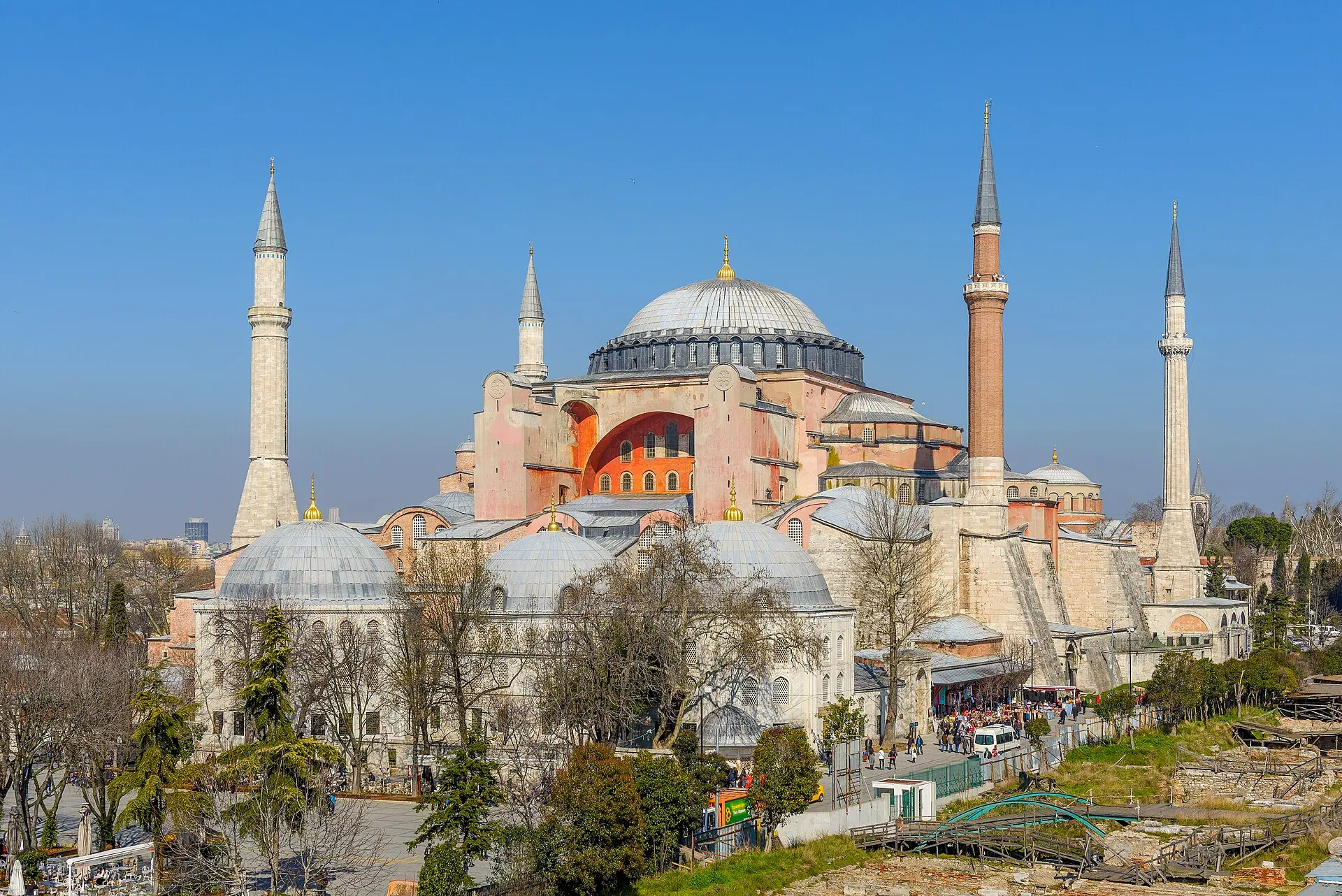
- Hagia Sophia: Built by Justinian between 532 and 537
- Basilica Cistern: 6th century, under Justinian I
- İznik: Ancient Nicaea; 1st and 7th Ecumenical Councils (325, 787)
- Sümela: Komnenos of Trabzon linked to the monastery (Alexios III)
- Akdamar: Armenian palace church, built 915-921
Constantinople: the capital
UNESCO states that Istanbul was successively the capital of the Eastern Roman and Ottoman empires.
The wall of Theodosius II, 6,650 m long, was created in 447, according to UNESCO.
A hippodrome was first built on the site of today’s Sultanahmet Square in AD 203 under Septimius Severus, and Constantine renovated it.
Hagia Sophia and the Basilica Cistern
The Culture Portal says Hagia Sophia was the largest church built by the Eastern Roman Empire in Istanbul and was built three times on the same site. It was first called Megale Ekklesia (Great Church).
The present building was commissioned by Justinian from Anthemios of Tralles and Isidoros of Miletus and built between 532 and 537.
The Basilica Cistern dates from the 6th century under Justinian I. The Culture Portal gives it as 140 m long and 70 m wide, with 336 columns.
İznik: ancient Nicaea
The modern town of İznik stands on the site of ancient Nicaea, a Hellenistic city founded by Antigonus in 316 BC.
GoTürkiye says the 1st and 7th Ecumenical Councils, in 325 and 787, were held there.
Wikipedia says Orhan captured the city from the Byzantines in 1331.
Trabzon and Sümela
After the Latins took Constantinople in 1204, the Komnenos set up an independent state at Trabzon, according to the provincial governorship. It ended on 26 October 1461 with the Ottoman conquest.
The Ministry of Culture and Tourism names Alexios III (1349-1390) of the Komnenos of Trabzon as the main figure behind the Sümela Monastery in its present form, as shown by its frescoes.
The monastery was evacuated in 1923 after the Turkey-Greece population exchange.
Neighbouring Armenian sites
These two sites are not Byzantine. They are included because they belong to the same medieval Christian landscape in Anatolia.
The Akdamar church, on Akdamar Island in Lake Van, was commissioned by King Gagik I of Vaspurakan and built by the architect Monk Manuel in 915-921, according to the Ministry. Its plan is a four-leaf clover of the Hripsime type.
Ani was founded at the Silk Road entry point from the Caucasus to Anatolia, says the Culture Portal. Wikipedia says it was a capital between 961 and 1045.
Frequently asked questions
What is the most famous Byzantine site in Türkiye?
Hagia Sophia in Istanbul, built between 532 and 537 under Justinian, is the best known.
Is Sümela Byzantine?
Tradition and the Ministry link it to the Komnenos of Trabzon, a state founded after the Latin capture of Constantinople in 1204.
Are Akdamar and Ani Byzantine?
No. The Ministry describes Akdamar as built for the kingdom of Vaspurakan, and the Culture Portal describes Ani as a Silk Road city.
Where was the 787 council held?
In İznik, ancient Nicaea, according to GoTürkiye.
Related on TurkGT
- Hagia Sophia
- Basilica Cistern
- Historic Areas of Istanbul
- Sultanahmet
- Sümela Monastery
- Akdamar Church (Holy Cross)
- Archaeological Site of Ani
- İznik
- Ani
- Türkiye’s UNESCO Intangible Heritage: 32 Living Traditions
- Neolithic Anatolia: Göbekli Tepe, Çatalhöyük and Arslantepe
- Ottoman Mosques and Complexes to Know in Türkiye
- Underground Cities and Rock-Cut Churches of Cappadocia
- Ancient Roman and Greek Cities in Türkiye: Ephesus to Aspendos
Sources
- UNESCO World Heritage Centre (356)
- Türkiye Culture Portal (ayasofya-muzesi)
- Wikipedia (Hagia_Sophia)
- Wikipedia (Basilica_Cistern)
- Türkiye Culture Portal (yerebatan-sarnici-)
- Wikipedia (Hippodrome_of_Constantinople)
- Wikipedia (%C4%B0znik)
- GoTürkiye (see)
- Ministry of Culture and Tourism museums (muze-detay?DistId=MRK&SectionId=SML01)
- Trabzon Governorship (tarihce-cografya)
- Türkiye Culture Portal (genelbilgiler)
- Ministry of Culture and Tourism museums (muze-detay?DistId=MRK&SectionId=VAN01)
- Türkiye Culture Portal (an-oren-yer)
- Wikipedia (Ani)
Last reviewed: 2026-11-16. Opening hours, ticket prices and other changeable visitor details are not listed here because we have not verified them; check the official source before you travel.