
Türkiye holds many ancient Greek, Hellenistic and Roman-era cities, from Ephesus and Pergamon in the west to Perge and Aspendos on the south coast. Seven of the sites on this page are UNESCO World Heritage sites, and the table lists their inscription years.
Key facts
- Ephesus: UNESCO inscribed 2015
- Pergamon: UNESCO inscribed 2014
- Aphrodisias: UNESCO inscribed 2017
- Hierapolis-Pamukkale: UNESCO inscribed 1988
- Xanthos-Letoon: UNESCO inscribed 1988
- Troy: UNESCO inscribed 1998
- Sardis and Bin Tepe: UNESCO inscribed 2025
What this page covers
This is a selection, not a complete list. It brings together ancient cities in western and southern Türkiye that have Greek, Hellenistic or Roman-era remains. Each section gives dated facts from UNESCO or the Ministry of Culture and Tourism’s Culture Portal, with Wikipedia as support only.
Ephesus and the Library of Celsus
Ephesus is at Selçuk in İzmir Province. UNESCO traces continuous settlement from the seventh millennium BCE to Selçuk today, and says the Sanctuary of the Ephesian Artemis was founded by the 2nd millennium BCE. Lysimachos founded the new city in the fourth century BCE, and Ephesus became the capital of the province of Asia in 133 BCE. UNESCO inscribed it in 2015.
The Library of Celsus was commissioned in the 110s CE as a funerary monument and is described as the third-largest library of the Greco-Roman world. The Culture Portal gives its façade as 21 metres wide and 17 metres high, and says the sarcophagus of Celsus is inside. The façade was re-erected between 1970 and 1978. Little remains of the Temple of Artemis.
Pergamon and Sardis
Pergamon, near Bergama in İzmir Province, was founded in the 3rd century BC as the Attalid capital. UNESCO lists Hellenistic monuments including the theatre, stoa, gymnasium and Great Altar, and says the dynasty founded one of the largest libraries. It passed to the Romans in 133 BC. Roman additions include an amphitheatre, aqueduct, Trajan Temple and Serapeum. It was inscribed in 2014.
Sardis was the capital and only city of the Lydians, who invented coinage, according to UNESCO. A twenty-metre-thick fortification wall protected the city. The Bin Tepe tumuli lie 7-17 km north of the citadel, with more than 119 tumuli, and the Culture Portal dates them to the 6th to the 4th century BC. UNESCO inscribed the property in 2025.
Hierapolis, Laodicea and Aphrodisias
Hierapolis was founded by the Attalid kings of Pergamon at the end of the 2nd century BC, was ceded to Rome in 133 BC and was destroyed by an earthquake in 60 AD and rebuilt. The necropolis extends over 2 km. UNESCO inscribed Hierapolis-Pamukkale in 1988.
Laodicea on the Lycus was founded by Antiochus II Theos in 261-253 BC and lies 6 km north of Denizli. It is one of the Seven Churches of Asia. The Culture Portal says the Laodikeia Church was uncovered in excavations in 2010, and Wikipedia says it has been on the Tentative List since 2013.
Aphrodisias lies in Karacasu district, Aydın, on a plateau about 600 metres above sea level. UNESCO says its temple dates from the 3rd century BC and the city from a century later, and its wealth came from marble and sculptors. It was inscribed in 2017.
Troy
The Archaeological Site of Troy lies on the mound of Hisarlık in Çanakkale Province. UNESCO says the site has 4,000 years of history, that the siege of Troy was immortalised by Homer in the Iliad, and that Schliemann undertook the first excavations in 1870. Most remains date from Troy II and VI. It was inscribed in 1998.
Pamphylia and Lycia: Perge, Aspendos, Xanthos-Letoon
Perge, in Aksu district of Antalya, was the capital of the Roman province of Pamphylia Secunda. The Culture Portal calls it one of the most orderly cities of Anatolia in the Roman period, and says it has been on the Tentative List since 2009.
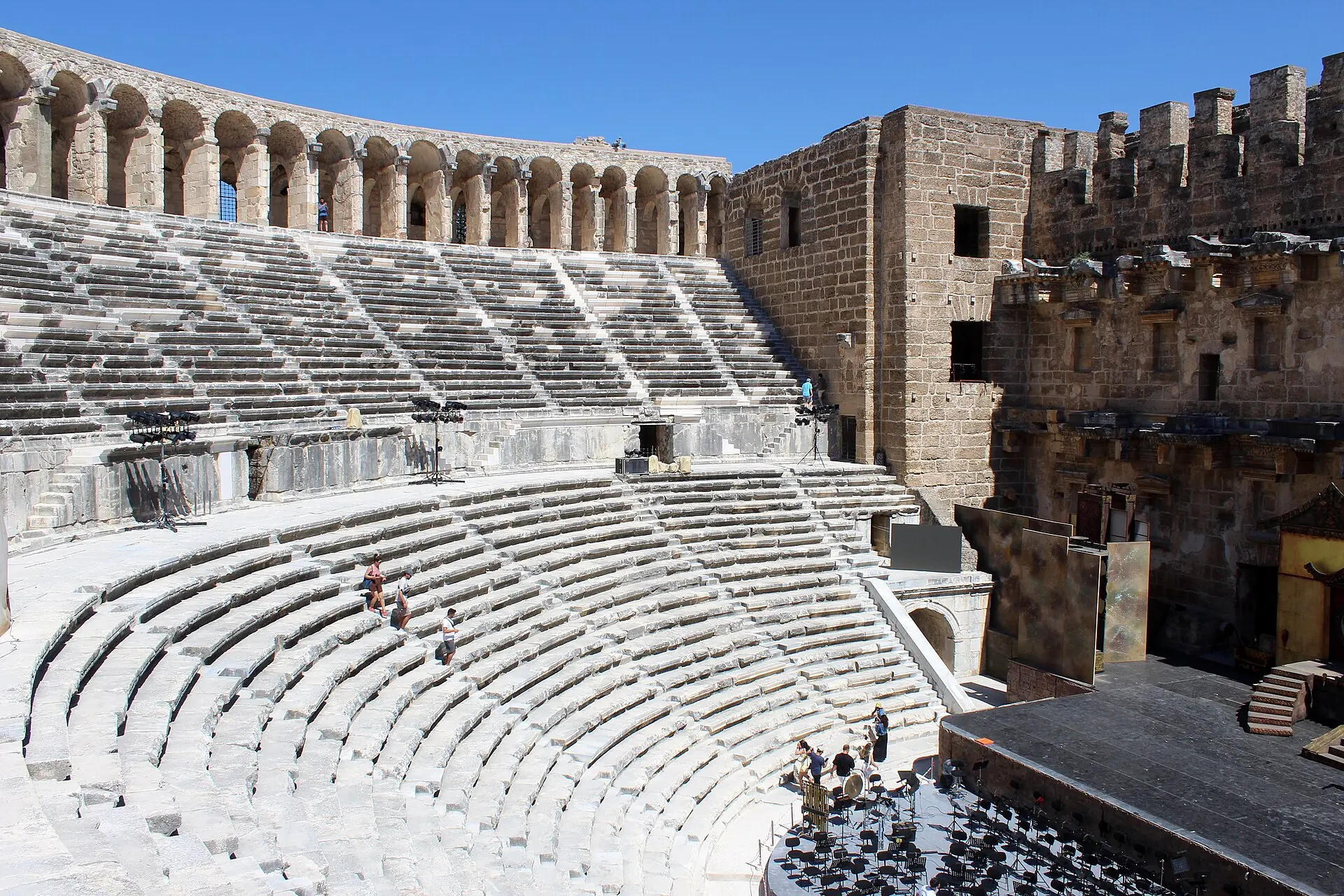
Aspendos has the best-preserved theatre of antiquity, with a diameter of 96 m according to Wikipedia. The Culture Portal says it was built under Marcus Aurelius (161-180) by the architect Zenon, and that Seljuk care helped the stage building survive. It has been on the Tentative List since 2015.
Xanthos-Letoon is made of two neighbouring settlements in Antalya and Muğla provinces. Xanthos was the capital of ancient Lycia and Letoon its cult centre. A trilingual inscription in Lycian, Aramaic and Greek helped decipher the Lycian language. UNESCO inscribed it in 1988.
Frequently asked questions
Which Greek and Roman sites in Türkiye are UNESCO sites?
Ephesus (2015), Pergamon (2014), Aphrodisias (2017), Hierapolis-Pamukkale (1988), Xanthos-Letoon (1988), Troy (1998) and Sardis (2025) on this page.
Are Perge and Aspendos UNESCO sites?
Not inscribed. The Culture Portal says Perge has been on the Tentative List since 2009 and Aspendos since 2015.
Where is the Library of Celsus?
In Ephesus, near Selçuk in İzmir Province.
Which theatre is the best preserved?
Wikipedia describes the Roman theatre of Aspendos as the best-preserved theatre of antiquity.
When was Sardis inscribed?
In 2025 under criterion (iii), according to UNESCO.
Related on TurkGT
- Aspendos Theatre
- Perge Ancient City
- Library of Celsus
- Laodicea on the Lycus
- Ephesus
- Pergamon and its Multi-Layered Cultural Landscape
- Aphrodisias
- Xanthos-Letoon
- Hierapolis-Pamukkale
- Archaeological Site of Troy
- Sardis and the Lydian Tumuli of Bin Tepe
- Türkiye’s UNESCO Intangible Heritage: 32 Living Traditions
- Neolithic Anatolia: Göbekli Tepe, Çatalhöyük and Arslantepe
- Ottoman Mosques and Complexes to Know in Türkiye
- Underground Cities and Rock-Cut Churches of Cappadocia
- Tur Abdin and Syriac Heritage: Monasteries of Mardin and Midyat
Sources
- Wikipedia: Ephesus
- Ephesus (UNESCO World Heritage Centre)
- Library of Celsus (Wikipedia)
- Celsus Kütüphanesi – Kültür Portalı
- UNESCO World Heritage Centre: Pergamon and its Multi-Layered Cultural Landscape
- Wikipedia: Pergamon
- UNESCO World Heritage Centre: Sardis and the Lydian Tumuli of Bin Tepe
- Bin Tepeler – Kültür Portalı
- Hierapolis-Pamukkale (UNESCO World Heritage Centre)
- Laodicea on the Lycus (Wikipedia)
- Denizli Province (Wikipedia)
- Laodikeia Antik Kenti – Kültür Portalı
- UNESCO World Heritage Centre: Aphrodisias
- Wikipedia: Aphrodisias
- Afrodisias Antik Kenti – Kültür Portalı (Ministry of Culture and Tourism)
- UNESCO World Heritage Centre: Archaeological Site of Troy
- Perge – Wikipedia
- Türkiye Kültür Portalı: Perge Antik Kenti
- Aspendos – Wikipedia
- Türkiye Kültür Portalı: Aspendos
- UNESCO World Heritage Centre: Xanthos-Letoon
- Letoon Antik Kenti – Kültür Portalı
Last reviewed: 2026-11-16. Opening hours, ticket prices and other changeable visitor details are not listed here because we have not verified them; check the official source before you travel.