
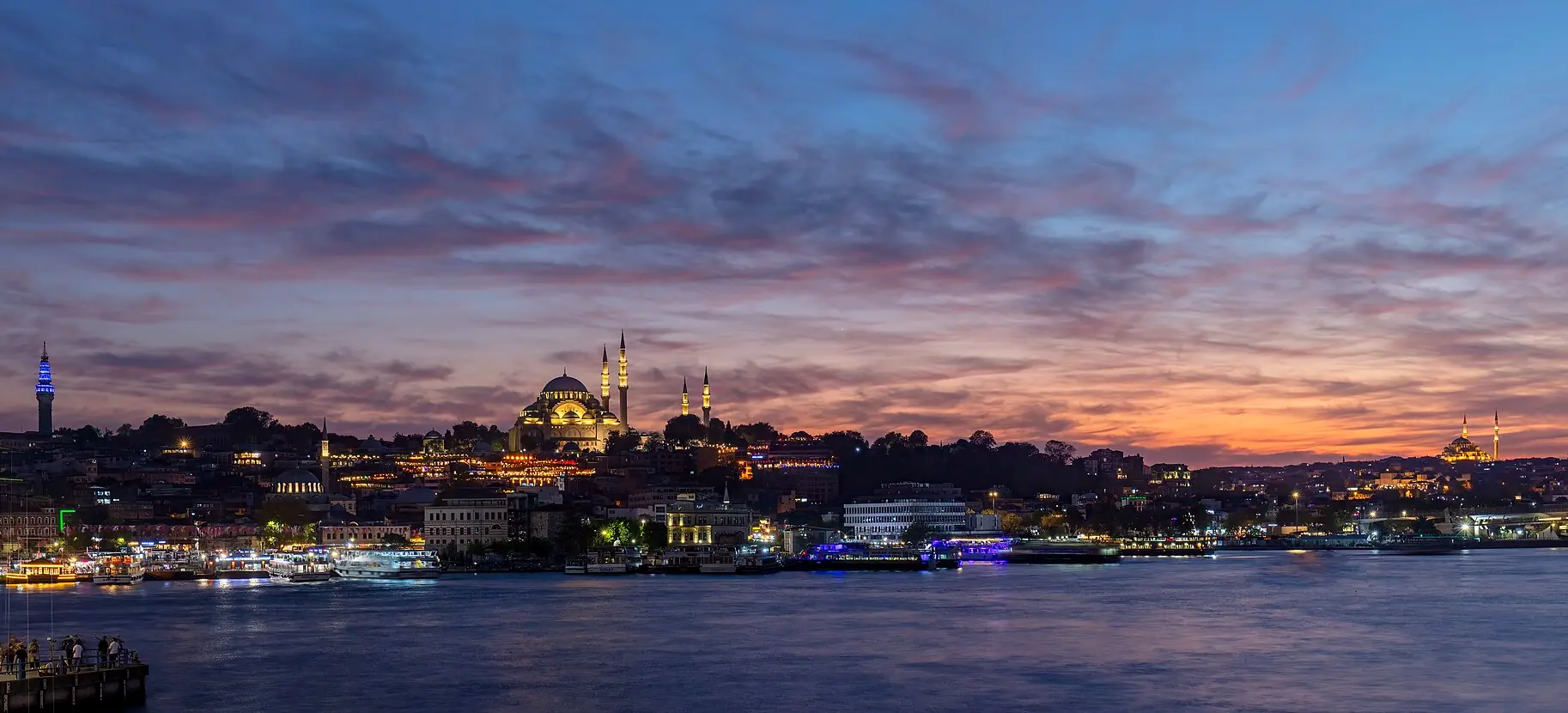
A practical 3-day Istanbul route starts in Sultanahmet, moves to Topkapı Palace and the Grand Bazaar, then ends with Dolmabahçe Palace, Galata Tower and Beyoğlu. The order is an editorial suggestion.
Key facts
- Length: 3 days
- Areas: Sultanahmet, Bosphorus shore, Beyoğlu
- UNESCO listing: Historic Areas of Istanbul, 1985
- Hagia Sophia: Completed AD 537, a mosque since 2020
- Dolmabahçe Palace: Palace-museum since 1984
- Transport card: Istanbulkart, valid on several modes
How this itinerary is organised
This plan groups Istanbul into three areas: the Historic Peninsula, the Bosphorus shore and Beyoğlu. The order of stops is an editorial suggestion, not an official route, and TurkGT gives no opening hours or prices.
Istanbul straddles the Bosphorus, and it was capital of the Roman, Byzantine and Ottoman empires. That history explains why so many major monuments sit close together on the peninsula.
Day 1: Sultanahmet and the Byzantine core
Start at Hagia Sophia. It was completed in AD 537 and was reclassified as a mosque in 2020, so it is a functioning mosque today.
Next is the Sultan Ahmed Mosque, known as the Blue Mosque. It was built between 1609 and 1617 and has six minarets.
Walk through Sultanahmet Square, which is the former Hippodrome. The Serpent Column among its monuments once stood in front of the Temple of Apollo at Delphi, and the ornate German Fountain is also there.
End the day at the Basilica Cistern, built in the 6th century. It holds 336 marble columns and reopened to the public in 2022 after restoration.
Day 2: Topkapı Palace, the Grand Bazaar and Süleymaniye
Topkapı Palace was ordered by Mehmed the Conqueror. It became a museum by a decree of 3 April 1924.
The Grand Bazaar follows. Its core was begun in the winter of 1455/56, and it has 61 covered streets.
UNESCO cites Topkapı and the Süleymaniye as supreme examples of Ottoman palace and religious ensembles. The Süleymaniye complex was designed by Sinan. These monuments belong to the Historic Areas of Istanbul, inscribed in 1985.
Day 3: Dolmabahçe Palace, Galata and Beyoğlu
Dolmabahçe Palace stands on the Bosphorus shore. Six sultans and the last caliph lived there from 1856, and it became a palace-museum in 1984.
Galata Tower in Beyoğlu was built between 1335 and 1349 and is 62.59 m tall. Beyoğlu is separated from the old city by the Golden Horn.
İstiklal Avenue and Taksim Square are also in Beyoğlu. The nostalgic tram runs between Taksim and Tünel.
Practical notes
The Istanbulkart is a contactless smart card valid on buses, funiculars, metro, Marmaray, ferries and trams. See the linked public transport guide for the card.
Check current opening hours, closures and entry rules on each site’s official page before you go. Hagia Sophia and the Blue Mosque are active mosques.
Frequently asked questions
Is 3 days enough for Istanbul?
It covers the main monuments of the Historic Peninsula, one Bosphorus palace and Beyoğlu. It is a selection, not everything.
Which area should I see first?
Sultanahmet. Hagia Sophia, the Blue Mosque and the Hippodrome are in one area.
Can I pay for transport with one card?
The Istanbulkart is valid on buses, funiculars, metro, Marmaray, ferries and trams.
Is Hagia Sophia a museum?
No. It was a museum from 1935 to 2020 and has been a mosque again since 2020.
When was the old city listed by UNESCO?
The Historic Areas of Istanbul were inscribed in 1985.
Related on TurkGT
- İstanbul
- Sultanahmet
- Beyoğlu
- Hagia Sophia
- Blue Mosque (Sultan Ahmed Mosque)
- Topkapı Palace
- Basilica Cistern
- Grand Bazaar (Kapalıçarşı)
- Galata Tower
- Dolmabahçe Palace
- Historic Areas of Istanbul
- How to Use Istanbul Public Transport
- 3 Days in Antalya: Kaleiçi, Waterfalls, Aspendos and Perge
- 2 Days in Bursa: Ottoman Capital, Cumalıkızık and Uludağ
- 2 Days at Pamukkale and Laodicea: Travertines and Ruins
- 3 Days in Cappadocia: Göreme, Underground Cities, Valleys
- One Day in Sultanahmet, Istanbul: Hagia Sophia to the Cistern
Sources
- Wikipedia: Hagia Sophia
- Wikipedia: Sultan Ahmed Mosque
- Wikipedia: Hippodrome of Constantinople
- goturkiye.com – hippodrome
- Wikipedia: Basilica Cistern
- Wikipedia: Topkap%C4%B1 Palace
- Wikipedia: Grand Bazaar, Istanbul
- UNESCO World Heritage Centre: 356
- millisaraylar.gov.tr – dolmabahce-palace
- Wikipedia: Galata Tower
- Wikipedia: Beyo%C4%9Flu
- Wikipedia: Istanbul
- Wikipedia: Istanbulkart
Last reviewed: 2026-11-16. Opening hours, ticket prices and other changeable visitor details are not listed here because we have not verified them; check the official source before you travel.